Question: Question 9 points Save A Read the following case and answer 2 out of 3 questions mentioned below: Ford Motor Company has faced the problem
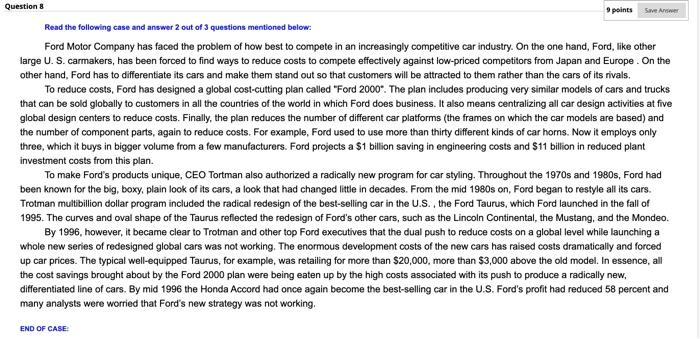
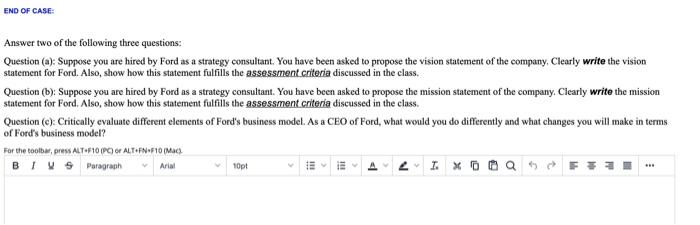
Question 9 points Save A Read the following case and answer 2 out of 3 questions mentioned below: Ford Motor Company has faced the problem of how best to compete in an increasingly competitive car industry. On the one hand, Ford, like other large U.S. carmakers, has been forced to find ways to reduce costs to compete effectively against low-priced competitors from Japan and Europe. On the other hand, Ford has to differentiate its cars and make them stand out so that customers will be attracted to them rather than the cars of its rivals. To reduce costs, Ford has designed a global cost-cutting plan called "Ford 2000". The plan includes producing very similar models of cars and trucks that can be sold globally to customers in all the countries of the world in which Ford does business. It also means centralizing all car design activities at five global design centers to reduce costs. Finally, the plan reduces the number of different car platforms (the frames on which the car models are based) and the number of component parts, again to reduce costs. For example, Ford used to use more than thirty different kinds of car horns. Now it employs only three, which it buys in bigger volume from a few manufacturers. Ford projects a $1 billion saving in engineering costs and $11 billion in reduced plant investment costs from this plan. To make Ford's products unique, CEO Tortman also authorized a radically new program for car styling. Throughout the 1970s and 1980s, Ford had been known for the big, boxy, plain look of its cars, a look that had changed little in decades. From the mid 1980s on, Ford began to restyle all its cars. Trotman multibillion dollar program included the radical redesign of the best-selling car in the U.S., the Ford Taurus, which Ford launched in the fall of 1995. The curves and oval shape of the Taurus reflected the redesign of Ford's other cars, such as the Lincoln Continental, the Mustang, and the Mondeo. By 1996, however, it became clear to Trotman and other top Ford executives that the dual push to reduce costs on a global level while launching a whole new series of redesigned global cars was not working. The enormous development costs of the new cars has raised costs dramatically and forced up car prices. The typical well-equipped Taurus, for example, was retailing for more than $20,000, more than $3,000 above the old model. In essence, all the cost savings brought about by the Ford 2000 plan were being eaten up by the high costs associated with its push to produce a radically new, differentiated line of cars. By mid 1996 the Honda Accord had once again become the best-selling car in the U.S. Ford's profit had reduced 58 percent and many analysts were worried that Ford's new strategy was not working, END OF CASE END OF CASE Answer two of the following three questions: Question (a): Suppose you are hired by Ford as a strategy consultant. You have been asked to propose the vision statement of the company. Clearly write the vision statement for Ford. Also, show how this statement fulfills the assessment criteria discussed in the class. Question (b): Suppose you are hired by Ford as a strategy consultant. You have been asked to propose the mission statement of the company. Clearly write the mission statement for Ford. Also, show how this statement fulfills the assessment criteria discussed in the class. Question (c): Critically evaluate different elements of Ford's business model. As a CEO of Ford, what would you do differently and what changes you will make in terms of Ford's business model? For the toolba, press ALTF101PG) OF ALT+FN-F10Mac BI V9 Paragraph 4 IXO QF1 Arla 10pt









 Study Help