



Question: Question (a) : If Hong Kong had no minimum production quantity requirement, how many units of each of the 10 styles of Women's parka would
Question (a): If Hong Kong had no minimum production quantity requirement, how many units of each of the 10 styles of Women's parka would you order as part of your first production lot size of 10,000 units? Use Excel formulas to answer this question.
DIrections and Notes:
Question (a): Directions and notes
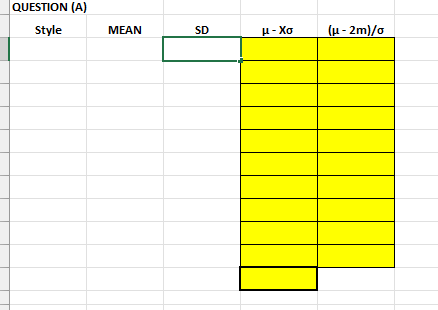
- In an Excel Spreadsheet, enter the following information. Column 1 = Style; Column 2 = Mean; Column 3 = Standard Deviation. As an example, consider Seduced. Column 1 will have Seduced; column 2 will have the number 4017 (its mean) and column 3 will have the number 1113 (its standard deviation). Note that Wally wants to use values that are twice the actual standard deviations. Therefore, we use 1113 instead of 556.
- In column 4, enter numbers that are all one standard deviation from the mean (and to the left of the mean) of each of these 10 products. You need to prepare it based on the discussion in the earlier section. You need to use Excel formulas for this column. In terms of numbers, Seduced will have a value equal to 2904 (i.e., 4017 1 * 1113) where 4017 is the mean, 1113 is its standard deviation and 1 is the Z value (Z is the number of standard deviations from the mean). We subtract because it is to the left of the mean. You must do this for all 10 styles. Note: Do you now agree that each of these products will now have the same probability of sales i.e., an 84% chance of sales?
- Objective: Take a decision to produce 10,000 units now (i.e., before the Las Vegas show)
- Do you notice that the sum of all 10 styles in column 4 does not add up to 10,000 units?
- Do you agree that we need to reduce the sum to either 10,000 units or to a number as close to 10,000 units as possible?
- Do you agree that Z represents a value equal to 1.0 right now?
- Do you agree that you need to change the value to another value so that the sum equals 10,000 units?
- Do you agree that the value of Z (which is the number of standard deviations) needs to be increased so that it is further to the left of the mean in order to reduce the number of units of each product so that the sum is reduced to 10,000 units or a value very close to it?
- Therefore, you need to figure out the appropriate value for Z so that all the 10 styles add up to a number very close to 10,000 units. Hint: Play around with Z values between 1.0 and 1.1. Play around with Z values like 1.01; 1.02; and so on. Thus, you will be looking at a maximum of 10 values of Z. The Z value that results in column 4s sum that is closest to 10,000 needs to be chosen. If you get decimal values in column 4, then round it using the decrease decimal icon so that all values become integers. That would be the answer to Question (a). Note that Question (a) assumes that Hong Kong does not have the minimum production quantity requirement.
PLEASE SHARE ALL STEPS ON EXCEL, THATS WHAT I STRUGGLE WITH, I WANT TO KNOW ALL THE STEPS TO COMPLETE IT IN THE FUTURE AS WELL. THANK YOU!
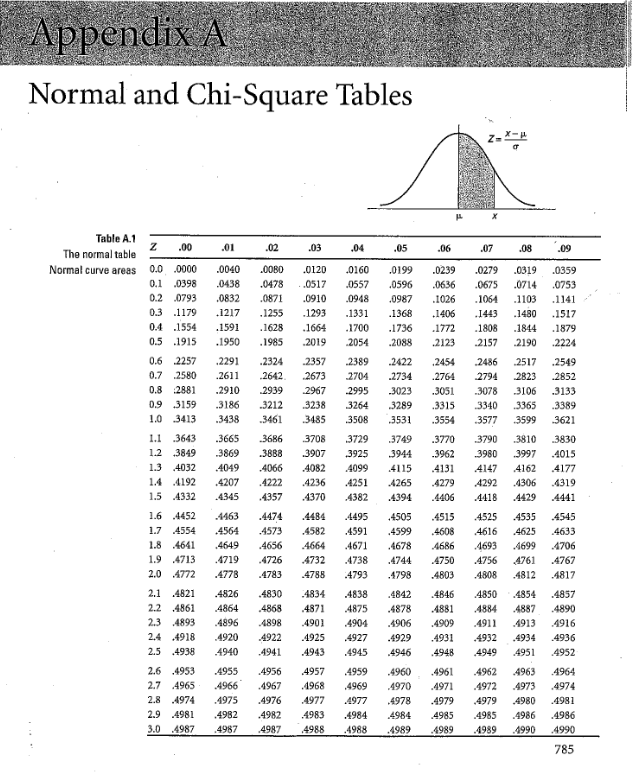
QUESTION (A) Style MEAN SD X (2m)/ \begin{tabular}{|l|l|} \hline & \\ \hline & \\ \hline & \\ \hline & \\ \hline & \\ \hline & \\ \hline & \\ \hline & \\ \hline & \\ \hline & \\ \hline \end{tabular} Normal and Chi-Square Tables QUESTION (A) Style MEAN SD X (2m)/ \begin{tabular}{|l|l|} \hline & \\ \hline & \\ \hline & \\ \hline & \\ \hline & \\ \hline & \\ \hline & \\ \hline & \\ \hline & \\ \hline & \\ \hline \end{tabular} Normal and Chi-Square Tables
Step by Step Solution
There are 3 Steps involved in it

Get step-by-step solutions from verified subject matter experts