







Question: Question: A multi-sector model Consider a version of the manufacturing bid-rent curve, but with two sectors. Let x1 and x2 be the distance that firms
Question:
A multi-sector model Consider a version of the manufacturing bid-rent curve, but with two sectors. Let x1 and x2 be the distance that firms in sector 1 and sector 2 locate away from the city center. Firms face freight, labor, and land costs ? but no intermediate goods cost. To simplify the algebra, lets also assume that firms in each sector use only one unit of land (and thus the land cost, LC(xi) = P(xi) for i = 1,2. The labor costs for each firm (as a function of distance to center) is given by:
L(x1) = 20 ? A1 ? x1
L(x2) = 30 ? A2 ? x2
The freight costs for each firm as a function of distance is given by
F(x1)=(B1 +3)?x1
F(x2)=(B2 +3)?x2
A) Write out the profit function for a firm in each sector. You should provide two equations.
Do not assume that revenue is equal in each sector. (1 points)
B) Use your answer from part A to derive the bid-rent curves for manufacturing firms in each sector. (1 points)
EC330 HW II. Due April 30th - Page 3 of 8 W2020
C) For each sector, find the point at which the WTP for land is zero (this won't be a number, but a function of the model's parameters). (2 points)
D) Interpret your answer from part C. How does the distance you calculated for sector one change with A1? Provide economic intuition for your answers. (1 point)
E)Now assume thatA1 =5, A2 =6, B1 =7and B2 =4. Furthermore, you may now assume that TR1 = TR2 = 40. Find the range of distances from the center each sector will be located. Hint: draw a graph of these lines. Remember: land is always allocated to the highest bidder. Don't worry about units and note that your answer may include fractions. (2 points)
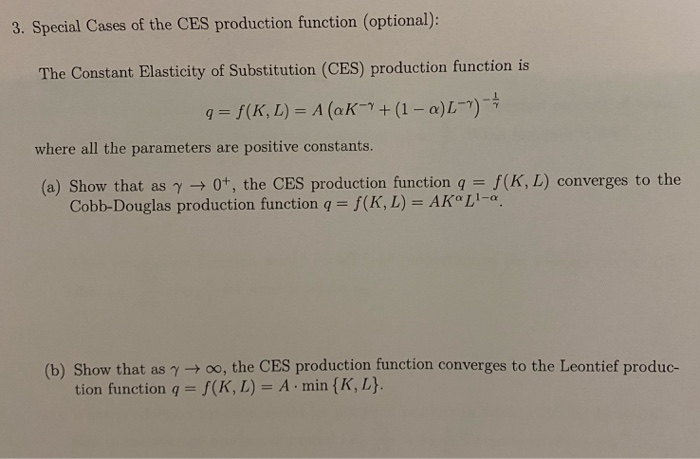
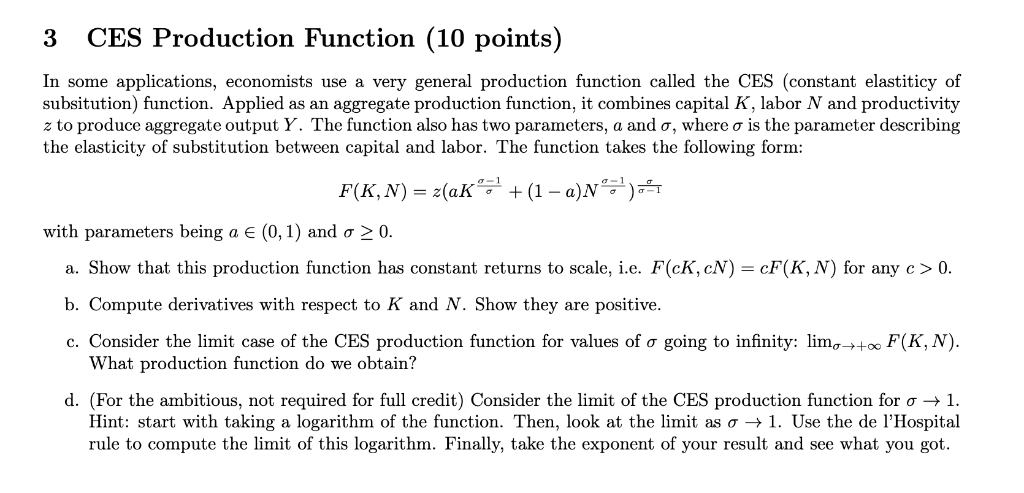
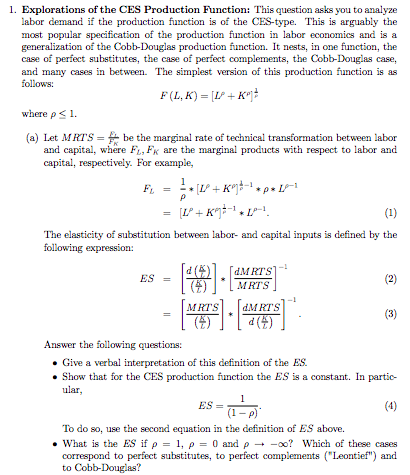
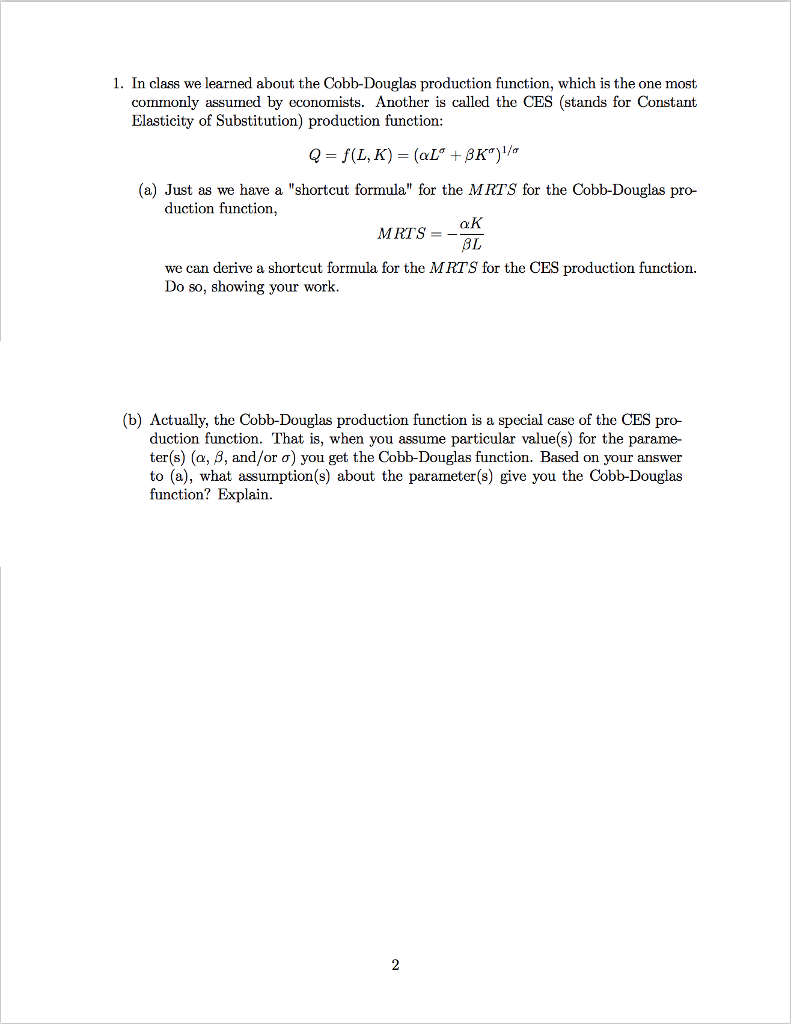
3. Special Cases of the CES production function (optional): The Constant Elasticity of Substitution (CES) production function is q = f (K, L) = A (ak + (1 -0) 1-7)-7 where all the parameters are positive constants. (a) Show that as y - 0+, the CES production function q = f(K, L) converges to the Cobb-Douglas production function q = f(K, L) = AKOLI-a. (b) Show that as y - co, the CES production function converges to the Leontief produc- tion function q = f(K, L) = A . min { K, L}.3 CES Production Function (10 points) In some applications, economists use a very general production function called the CES {constant elastiticy of subsitution) function. Applied as an aggregate production function, it combines capital K, labor N and productivity 2 to produce aggregate output 1". The function also has two parameters, a. and a, where or is the parameter describing the elasticity of substitution between capital and labor. The function takes the following form: F(K.N) = z(aK\"T" + (1 a)N"T") with parameters being a. E {0, 1) and or Z 0. a. Show that this production function has constant returns to scale, i.e. F(cK,cN) = cF[K, N) for any 5 > 0. b. Compute derivatives with respect to K and N. Show they are positive. c. Consider the limit case of the CES production function for values of or going to infinity: liman+m F(K, N). 1What production function do we obtain? d. (For the ambitious, not required for full credit) Consider the limit of the CES production ftmction for a > 1. Hint: start with taking a logarithm of the function. Then, look at the limit as or > 1. Use the de l'Hospital rule to compute the limit of this logarithm. Finally, take the exponent of your result and see what you got. 1. Explorations of the CES Production Function: This question asks you to analyze labor demand if the production function is of the CES-type. This is arguably the most popular specification of the production function in labor economics and is a generalization of the Cobb-Douglas production function. It nests, in one function, the case of perfect substitutes, the case of perfect complements, the Cobb-Douglas case, and many cases in between. The simplest version of this production function is as follows: F( L K) = D+ K]# where p
Step by Step Solution
There are 3 Steps involved in it

Get step-by-step solutions from verified subject matter experts
 Study Help