







Question: Question A4 (a) Let A {a,b,c}, B = {d, e, f, g) and C relations R and S given as follows: {1,2,3,4,5). Consider the following
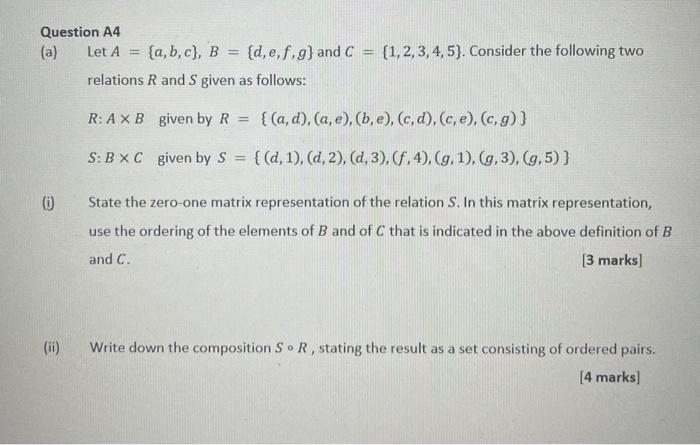
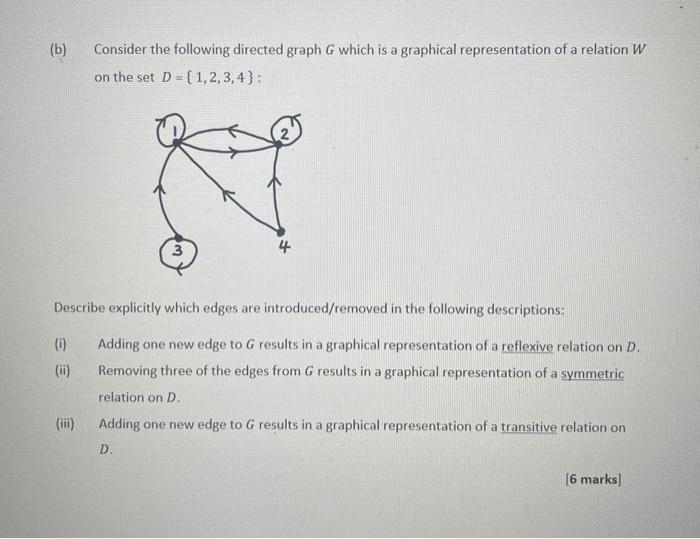
Question A4 (a) Let A {a,b,c}, B = {d, e, f, g) and C relations R and S given as follows: {1,2,3,4,5). Consider the following two R: AXB given by R = {(a, d),(a,e), (b, e), (c,d),(c,e). Cc,g)} S:BXC given by S = {(d, 1), (d, 2), (0, 3).f.4),(g,1),(0,3), (9,5)} (0 State the zero-one matrix representation of the relation S. In this matrix representation, use the ordering of the elements of B and of C that is indicated in the definition of B and C. [3 marks) (ii) Write down the composition SoR stating the result as a set consisting of ordered pairs. [4 marks) (b) Consider the following directed graph G which is a graphical representation of a relation W on the set D = {1,2,3,4} : A 3 4. Describe explicitly which edges are introduced/removed in the following descriptions: (0) (ii) Adding one new edge to G results in a graphical representation of a reflexive relation on D. Removing three of the edges from G results in a graphical representation of a symmetric relation on D. Adding one new edge to G results in a graphical representation of a transitive relation on D. [6 marks)
Step by Step Solution
There are 3 Steps involved in it

Get step-by-step solutions from verified subject matter experts
 Study Help