







Question: Question about Completely Mixed System and reaction orders The upper reach of Ford Lake in southwest Michigan has a volume of 1.2 million cubic meter.
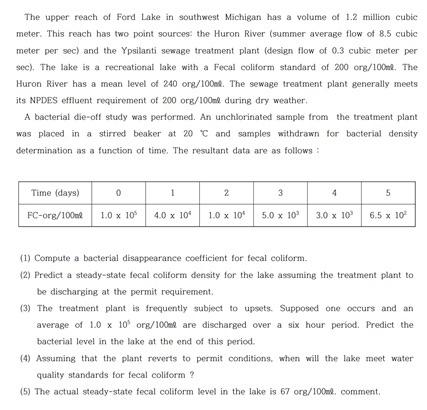
The upper reach of Ford Lake in southwest Michigan has a volume of 1.2 million cubic meter. This reach has two point sources: the Huron River (summer average flow of 8.5 cubic meter per sec) and the Ypsilanti sewage treatment plant (design flow of 0.3 cubic meter per sec). The lake is a recreational lake with a Fecal coliform standard of 200ong/100m. The Huron River has a mean level of 240org/100ht. The sewage treatment plant generally meets its NPDES effluent requirement of 200org/100ml during dry weather. A bacterial die-off study was pertormed. An unchlorifated sample from the treatment plant was placed in a stirred beaker at 20 ' C and samples withdrawn for bacterial density determination as a function of time. The resultant data are as follows : (1) Compute a bacterial disappearance coefficient for tecal coliform. (2) Predict a steady-gtate fecal coliform density for the lake assuming the treatment plant to be discharging at the permit requirement. (3) The treatment plant is frequently subject to upsets. Supposed one occurs and an average of 1.010org/100mi are discharged over a six hour period. Predict the bacterial level in the lake at the end of this period. (4) Assuming that the plant reverts to permit conditions, when will the lake meet water quality standards for tecal coliform? (5) The actual steady-state fecal coliform level in the lake is 67 org/100di. comment
Step by Step Solution
There are 3 Steps involved in it

Get step-by-step solutions from verified subject matter experts
 Study Help