







Question: Question Analyze the challenges faced by PCL in reducing returned sets and NFF returns. Aside from the recommendations put forth by PCL, what other actions
Question
- Analyze the challenges faced by PCL in reducing returned sets and NFF returns.
- Aside from the recommendations put forth by PCL, what other actions might improve the return rate of TV sets?
- What challenges can PCL draw from its exercise in controlling the high rate of returned TV sets to inform its execution of internal control mechanism in the future?
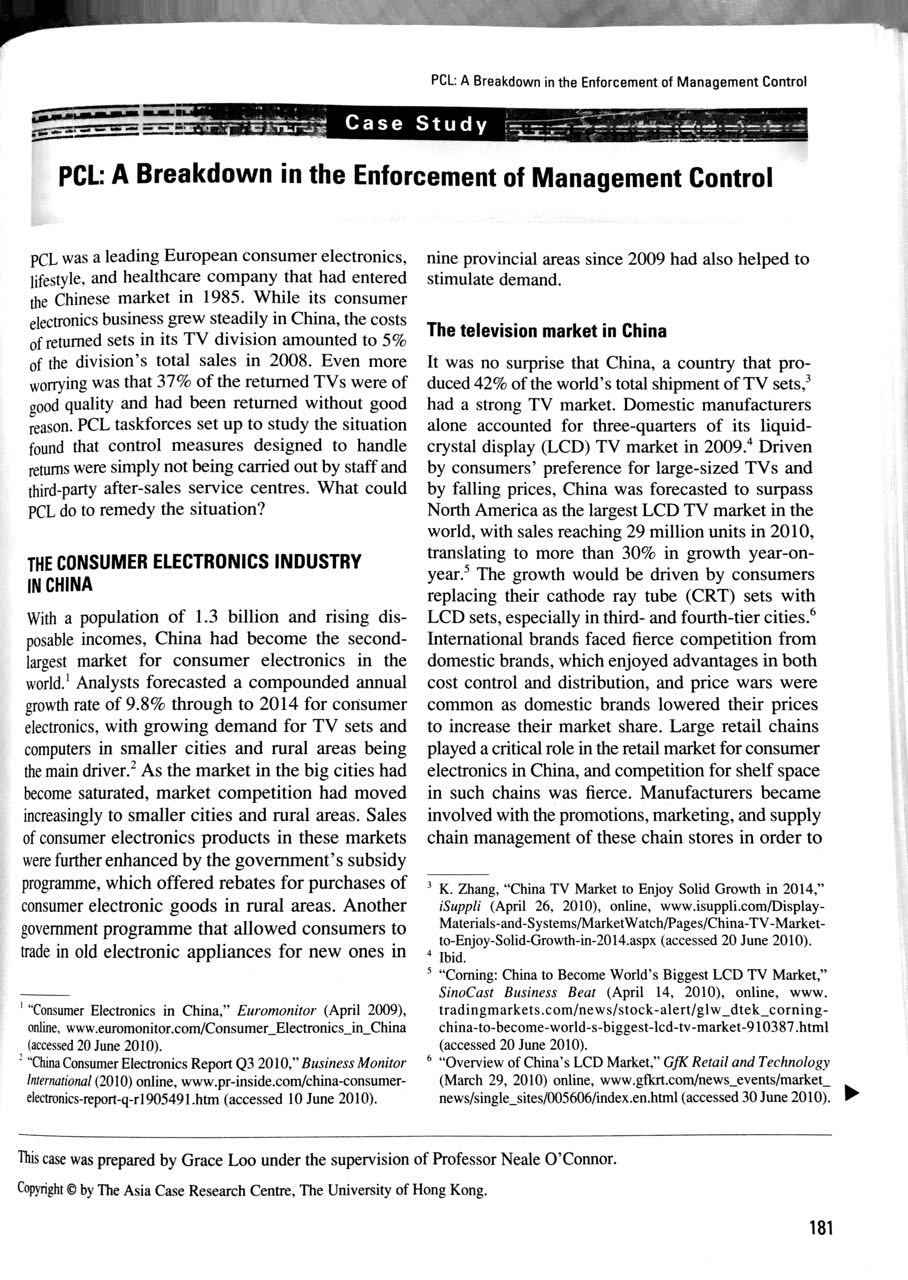
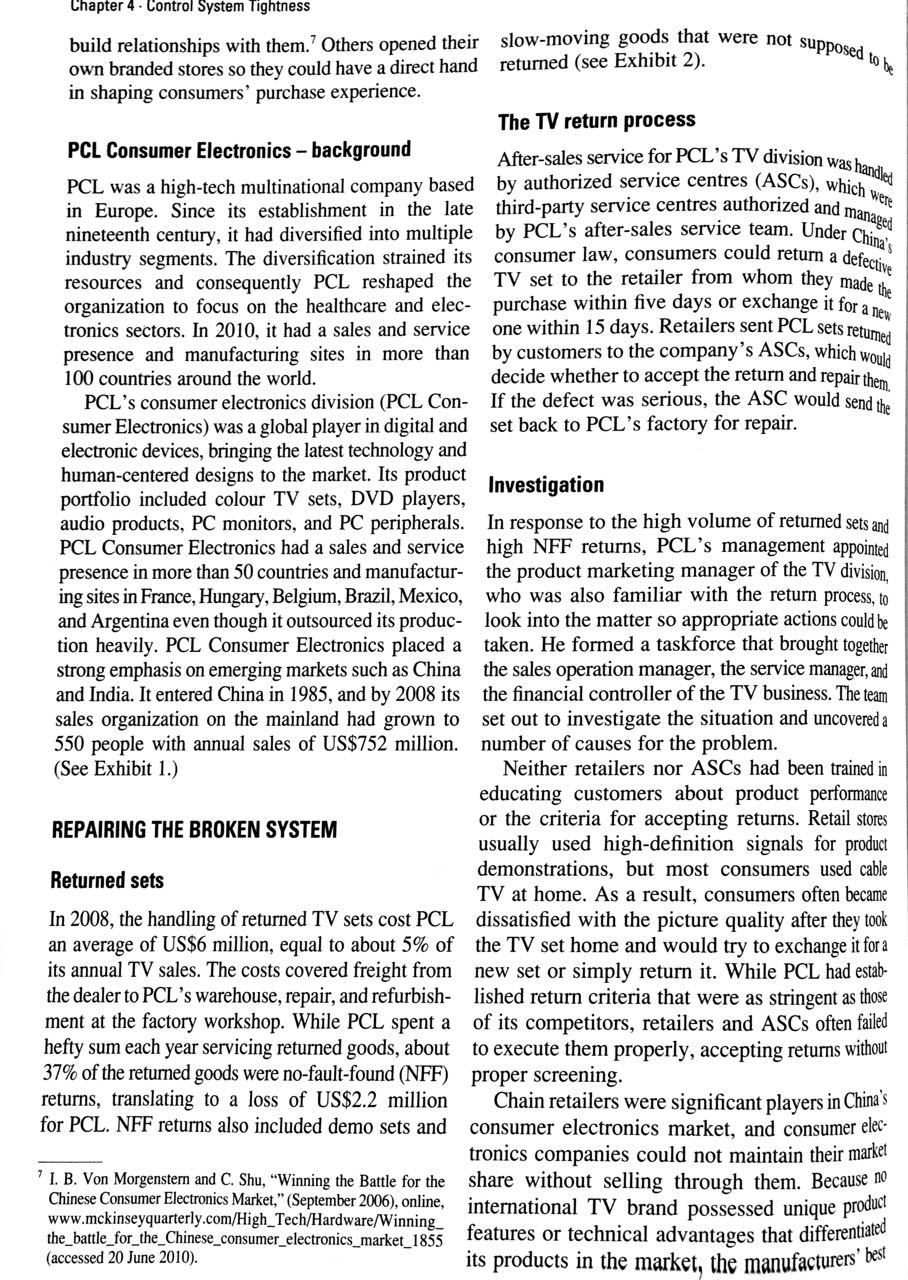
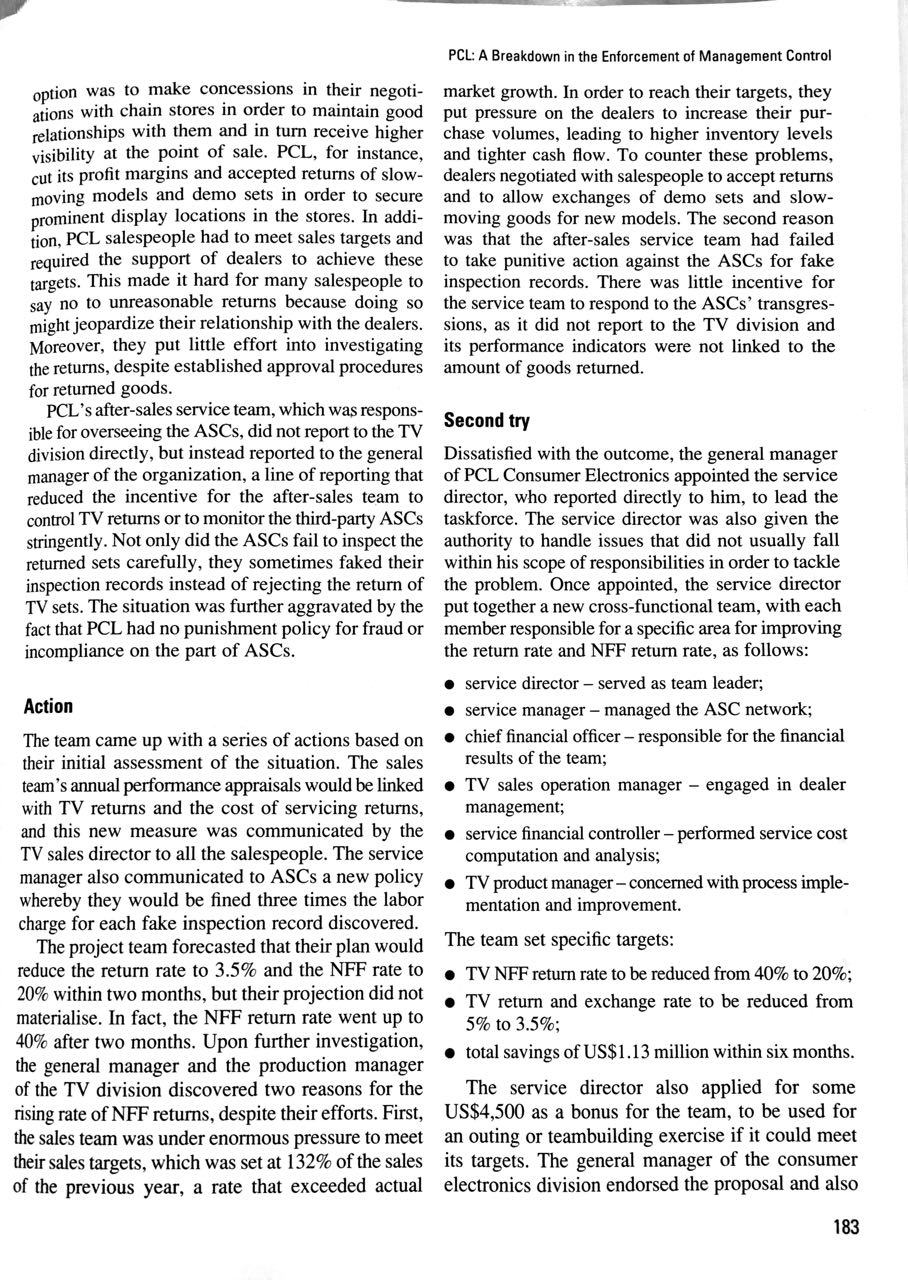
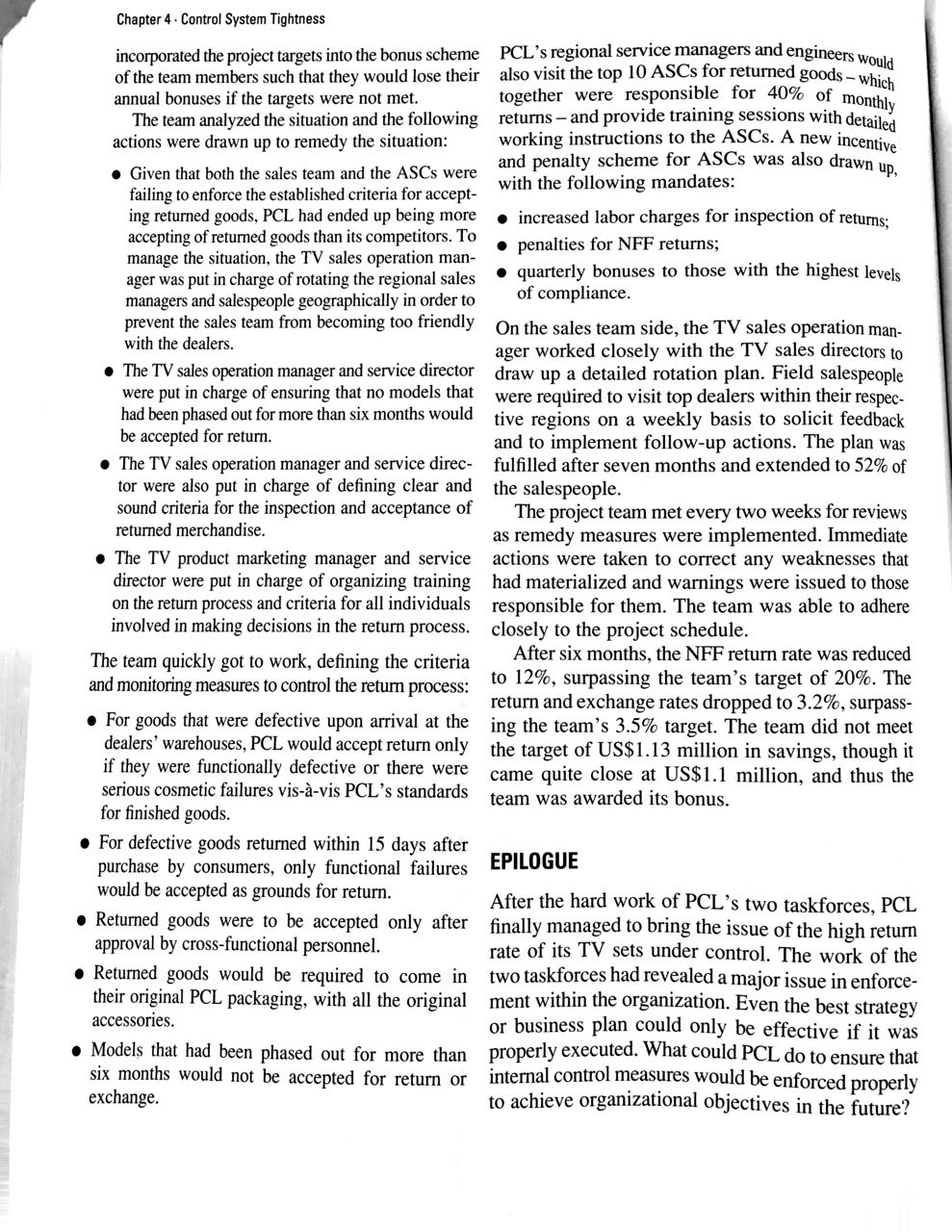
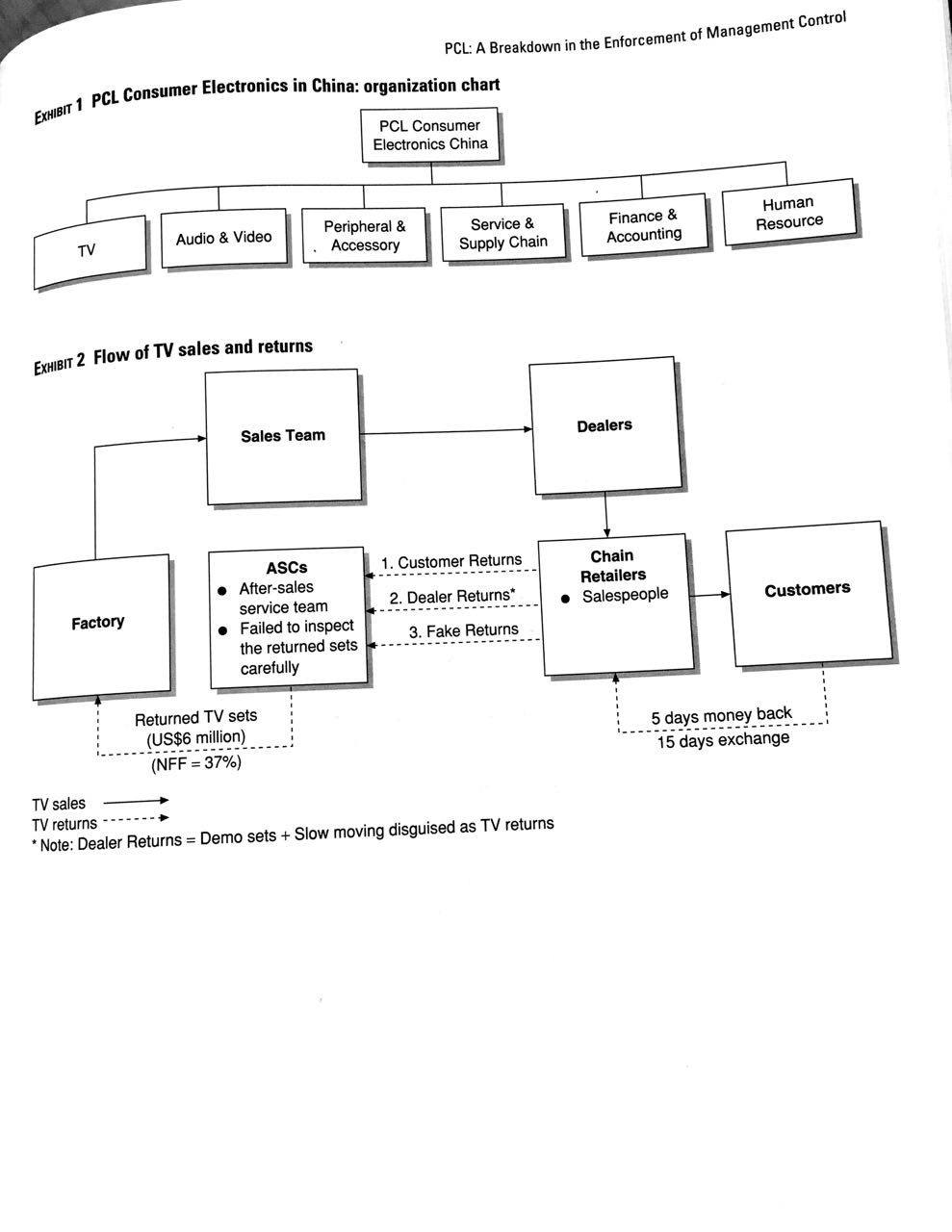
'- 7'31\"er :1\": Case StUdy -" ---'-'---\"-----'-= "' PEI; A Breakdown in the Enforcement of Management Control J_._:I__'. ' -"'"" POL: A Breakdown in the Eniorcament ol Management Control 9.31. was a leading European consumer electronics, lifestyle. and healthcare company that had entered the Chinese market in 1985. While its consumer electronics business grew steadily in China, the costs of returned sets in its TV division amounted to 5% of the division's total sales in 2008. Even more worrying was that 37% of the returned TVs were of good quality and had been returned without good reason. PCL taskforces set up to study the situation found that control measures designed to handle returns were simply not being carried out by staff and third-party after-sales service centres. What could PCL do to remedy the situation? THE CONSUMER ELEETHDNIGS INDUSTRY Ill CHINA With a population of 1.3 billion and rising dis- posable incomes. China had become the second- largest market for consumer electronics in the world.' Analysts forecasted a compounded annual growth rate of 9.8% through to 2014 for consumer eiectronics, with growing demand for TV sets and computers in smaller cities and rural areas being the main driver.2 As the market in the big cities had become saturated, market competition had moved increasingly to smaller cities and rural areas. Sales of consumer electronics products in these markets were further enhanced by the government's subsidy nine provincial areas since 2009 had also helped to stimulate demand. The television market in China it was no surprise that China, a country that pro- duced 42% of the world's total shipment of TV sets.3L had a strong TV market. Domestic manufacturers alone accounted for three-quarters of its liquid- crystal display (LCD) TV market in 2009':1 Driven by consumers' preference for large-sized TVs and by falling prices, China was forecasted to surpass North America as the largest LCD TV market in the world, with sales reaching 29 million units in 2010, translating to more than 30% in growth year-on- year.5 The growth would be driven by consumers replacing their cathode ray tube (CRT) sets with LCD sets. especially in third and fourth-tier cities. International brands faced erce competition from domestic brands, which enjoyed advantages in both cost control and distribution. and price wars were common as domestic brands lowered their prices to increase their market share. Large retail chains played a critical role in the retail market for consumer electronics in China, and competition for shelf space in such chains was erce. Manufacturers became involved with the promotions, marketing, and supply chain management of these chain stores in order to measure. which Oemd rebates for thm5 0f 3 It. Zhang, \"China "W Market to Enjoy Solid Growth in 2014," consumer electromc goods in anal areas. Another isuppn {April 25, 2010). online. www.isuppli.com)isplay- government progranune that allowed consumers to \"3'\"Tia]S'3"d'53Slemme'watcnipaesiChl\"'\"W'M\"k" trade in old electronic appliances for new ones in 4 {1:}:er Shdmw] m 2014351\" (accessed 20mm 2010}. 5 \"Coming: China to Become World's Biggest LCD TV Market.\" SinoCasr Business Bear (April 14, 2010]. online. www. tradingmarkets.con1lnewslstock-alerllglw_dtek_corning- china-to-become-world-s-biggest-lcd-tv-marltel-910387.html [accessed 20 June 2010). i' \"Overview of China's LCD Market." GjK Retail and Technology (March 29. 20101 online. www.gtkn.conunews_eventsnnarket_ news}sing]e_sitesl005606fu1dex.en.htrnl [acccssed 30 June 2010). F ' Tauumer Electronics in China." Eammem'ror (April 2009), online. www.curornonitor.conu'Consumer_Electronlcs_in_China ' [accused 201m: 2010]. ' \"Guns Cetuumer Electronics Report 03 2010." Business Monitor international (2010) online. www.pr-inside.comfchinaconsumcr electronics-repen-q-rlil5491.hnn (accessed 10 June 2010]. \"Iii case was prepared by Grace Loo under the supervision of Professor Neale O'Connor. Watt 0 by The Asia Case Research Centre. The University of Hong Kong. 181 Chapter 4 . liontrol System Trghtness build relationships with them.7 Others opened their slow-moving 30095 that were not supposed own branded stores so they could have a direct hand returned (see Exhibit 2). to be in shaping consumers' purchase experience. POL Consumer Electronics - background PCL was a high-tech multinational company based in Europe. Since its establishment in the late nineteenth century, it had diversied into multiple industry segments. The diversication strained its resources and consequently PCL reshaped the organization to focus on the healthcare and elec tronics sectors. In 2010, it had a sales and service presence and manufacturing sites in more than 100 countries around the world. PCL's consumer electronics division (PCL Con- sumer Electronics) was a global player in digital and electronic devices, bringing the latest technology and human-centered designs to the market. Its product portfolio included colour TV sets, DVD players, audio products, PC monitors, and PC peripherals. PCL Consumer Electronics had a sales and service presence in more than 50 countries and manufactur- ing sites in France, Hungary, Belgium, Brazil, Mexico, and Argentina even though it outsourced its produc- tion heavily. PCL Consumer Electronics placed a strong emphasis on emerging markets such as China and India. It entered China in 1985, and by 2008 its sales organization on the mainland had grown to 550 people with annual sales of US$752 million. (See Exhibit 1.} REPAIRING THE BROKEN SYSTEM Returned sets The TV return process Aftersales service for PCL's TV division was by authorized service centres {ASCs}, which \"Org third~party service centres authorized and by PCL's after-sales service team. Under m1 consumer law, consumers could return a (lemma TV set to the retailer from whom they Indel: purchase within ve days or exchange it foranew one within 15 days. Retailers sent PCL sets MUM by customers to the company's ASCs, which Winn decide whether to accept the return and IBpaiy \"Em If the defect was serious, the ASC would send Ills set back to PCL's factory for repair. Investigation In response to the high volume of returned sets and high NFF returns, PCL's management W the product marketing manager of the TV divisimj who was also familiar with the return process, to look into the matter so appropriate actions couldbe taken. He formed a taskforce that brought together the sales operation manager, the service manager, and the nancial controller of the TV business. The team set out to investigate the situation and uncovered; number of causes fer the problem. Neither retailers nor ASCs had been helped in educating customers about product performers: or the criteria for accepting returns. Retail stuns usually used high-denition signals for product demonstrations, but most consumers used cable TV at home. As a result. consumers often been: In 2008, the handling of retumed TV sets cost PCL dissatised with the picture quality after they tacit an average of U556 million, equal to about 5% of the TV set home and would try to exchange it fora its annual TV sales. The costs covered freight from new set or simply return it. While PCL had esul} the dealer to PCL's warehouse. repair, and tefurbish- lished return criteria that were as stringent as those ment at the factory workshop. While PCL spent a of its competitors, retailers and ASCs often failed hefty sum each year servicing returned goods, about to execute them properly, accepting returns without 37% of the returned goods were nofault-found {NFF'J proper screening. returns, translating to a loss of US$2.2 million Chain retailers were signicant playersinCit'ma'S for PCL. NFF returns also included demo sets and consumer electronics market, and consumer cler- tronics companies could not maintain their tnatltt'i share without selling through them. Because no international TV brand possessed unique prole" features or technical advantages that differentialsd its products in the market, the manufacmm' \"5' T I. B. Von Morgenstem and C. Shu. "Whaling the Battle for the Gripes: Cortsurner Electronics Market," (September 2006), online. wurw.mcltinseyquarterly.conuHighhTecbeardwareVinning_ die_battle_for_the_ChirIese_consumer_etectronit:s_marltet,_1855 [accessed 20 June 2010). 0pm\" was to make concessions in their negoti- aliens with chain stores in order to maintain good relatiOHShiPS with them and in turn receive higher visibility at the point of sale. PCL, for instance. cut 35 prot margins and accepted returns of slow- mo'ring models and demo sets in order to secure prominent display locations in the stores. in addi~ an, PCL salespeople had to meet sales targets and required the support of dealers to achieve these targets. This made it hard for many salespeople to say no to unreasonable remrns because doing so might jeopardize their relationship with the dealers. Moreover, they put little effort into investigating the returns, despite established approval procedures for returned goods. PCL's after-sales service team, which was respons- ible for overseeing the ASCs. did not report to the TV division directly, but instead reported to the general manager of the organization, a line of reporting that reduced the incentive for the after-sales team to control TV returns or to monitor the third-party ASCs stringently. Not only did the ASCs fail to inspect the returned sets carefully, they sometimes faked their inspection records instead of rejecting the return of TV sets. The situation was further aggravated by the fact that PCL had no punishment policy for fraud or incompliance on the part of A503. Action The team came up with a series of actions based on their initial assessment of the situation. The sales team's atmual performance appraisals would be linked with TV returns and the cost of servicing returns, and this new measure was communicated by the TV sales director to all the salespeople. The service manager also communicated to ASCs a new policy whereby they would be ned three times the labor charge for each fake inspection record discovered. The project team forecasted that their plan would reduce the return rate to 3.5% and the NFF rate to 20% within two months, but their projection did not materialise. In fact, the NFF return rate went up to 40% after two months. Upon further investigation, the general manager and the production manager of the TV division discovered two reasons for the rising rate of NF retruns, despite their efforts. First, the sales team was under enormous pressure to meet their sales targets, which was set at 132% of the sales of the previous year, a rate that exceeded actual PUL: A Breakdown in the Enforcement of Management Control market growth. In order to reach their targets, they put pressure on the dealers to increase their pur- chase volumes, leading to higher inventory levels and tighter cash ow. To counter these problems. dealers negotiated with salespeople to accept returns and to allow exchanges of demo sets and slow- moving goods for new models. The second reason was that the after-sales service team had failed to take punitive action against the ASCs for fake inspection records. There was little incentive for the service team to respond to the A305' uansgres- sions, as it did not report to the TV division and its performance indicators were not linked to the amount of goods returned. Second try Dissatised with the outcome, the general manager of PCL Consumer Electronics appointed the service director. who reported directly to him. to lead the taskforce. The service director was also given the authority to handle issues that did not usually fall within his scope of responsibilities in order to tackle the problem. Once appointed. the service director put together a new cross-functional team, with each member responsible for a specic area for improving the return rate and NF return rate, as follows: I service director served as team leader, 0 service manager managed the ASC network; I chief nancial ofcer responsible for the nancial results of the team; 0 TV sales operation manager engaged in dealer management; I service nancial controller performed service cost computation and analysis; e TV product manager ooncemed with process imple- mentation and improvement. The team set specic targets: 0 TVNFFretumratetobereducedfromtl-O'lhtol'i'n; I TV return and exchange rate to be reduced from 5% to 3.5%; I total savings of US$1 .13 million within six months. The service director also applied for some US$4,500 as a bonus for the team, to be used for an outing or teambuilding exercise if it could meet its targets. The general manager of the consumer electronics division endorsed the proposal and also 183 Chapter 4 - Control System lightness incorporated the project targets into the bonus scheme PCL's regional service managers and engineers Would of the team members such that they would lose their also visit the top 10 ASCS for returned goods H which annual bonuses if the targets were not met. The team analyzed the situation and the following actions were drawn up to remedy the situation: 0 Given that both the sales team and the ASCs were failing to enforce the established criteria for accept- ing returned goods, PCL had ended up being more accepting of returned geods than its competitors. To manage the situation, the TV sales operation man- agar was put in charge of rotating the regional sales managers and salespeople geographically in order to prevent the sales team from becoming too friendly with the dealers. o The'I'Vsalesoperationmanagerand service director were put in charge of ensuring that no models that had been phased out for more than six months would be accepted for return. I The TV sales operation manager and service direc- tor were also put in charge of dening clear and sound criteria for the inspection and acceptance of returned merchandise. 0 The TV product marketing manager and service director were put in charge of organizing training on the return process and criteria for all individuals involved in making decisions in the return process. The team quickly get to work, dening the criteria and monitoring measures to control the retum process: a For goods that were defective upon arrival at the dealers' warehouses, PCL would accept return only if they were functionally defective or there were serious cosmetic failures vis-a-vis PCL's standards for nished goods. 0 For defective goods returned within 15 days after purchase by consumers, only functional failures would be accepted as grounds for return. 0 Retumed goods were to be accepted only after approval by cross-functional personnel. 0 Returned goods would be required to come in their original PCL packaging, with all the original accessories. 0 Models that had been phased out for more than six months would not be accepted for return or exchange. together were responsible for 40% of mom\" returns and provide training sessions With decits: working instructions to the ASCs. A new imam\" and penalty scheme for ASCs was also drawn up with the following mandates: ' 0 increased labor charges for inspection of returns; a penalties for NFF returns; 0 quarterly bonuses to those with the highest levels of compliance. On the sales team side, the TV sales operation man- ager worked closely with the TV sales directors to draw up a detailed rotation plan. Field salespeop1e were required to visit top dealers within their respec tive regions on a weekly basis to solicit feedback and to implement follow-up actions. The plan was fullled after seven months and extended to 52% of the salespeople. The project team met every two weeks for reviews as remedy measures were implemented. Immediate actions were taken to correct any weaknesses that had materialized and warnings were issued to those responsible for them. The team was able to adhere closely to the project schedule. After six months, the NFF return rate was reduced to 12%, surpassing the team's target of 20%. The return and exchange rates dropped to 3.2%, surpass- ing the team's 3.5% target. The team did not meet the target of US$1.13 million in savings, though it came quite close at US$1.1 million, and thus the team was awarded its bonus. EPlLl'lGUE After the hard work of PCL's two taskforces, PCL nally managed to bring the issue of the high retum rate of its TV sets under control, The work of the two taskforces had revealed a major issue in enforce- ment within the organization. Even the best strategy or business plan could only be effective if it was properly executed. What could PCL do to ensure that internal control measures would be enforced properly to achieve organizational objectives in the future? t PCL' A Breakdown in the Enforcement of Manageme Gl- consume! Electronics in China: organization chart Eil' P PCL Consumer Electronics China Service & Supply Chain Peripheral & . Accessory Audio & Video ales and returns E1013": HoWoiTiis 3395 1-5.3 9??! [\"H. 59.1959? _ . I After-sales service team - 2299?]? 'iiyff': - - - o Faiied to inspect the returned Sets --_.'_ .F.a_k B_e.tyfl:l--- caireiulh,r _____=!%i%91999_9?9'5_m1 15 days exchange '6 '0"! GR 0: 3. E. = "I" ............... TVsaIes P W returns ------ * . ' Note: Dealer Hetums = Demo sets + Slow moving disgursed as TV returns
Step by Step Solution
There are 3 Steps involved in it

Get step-by-step solutions from verified subject matter experts
 Study Help