Question: Question Answer 1. What techniques include the use of seed, Traditional plant propagation techniques include the use of vegetative plant parts, and cuttings? seed venetative
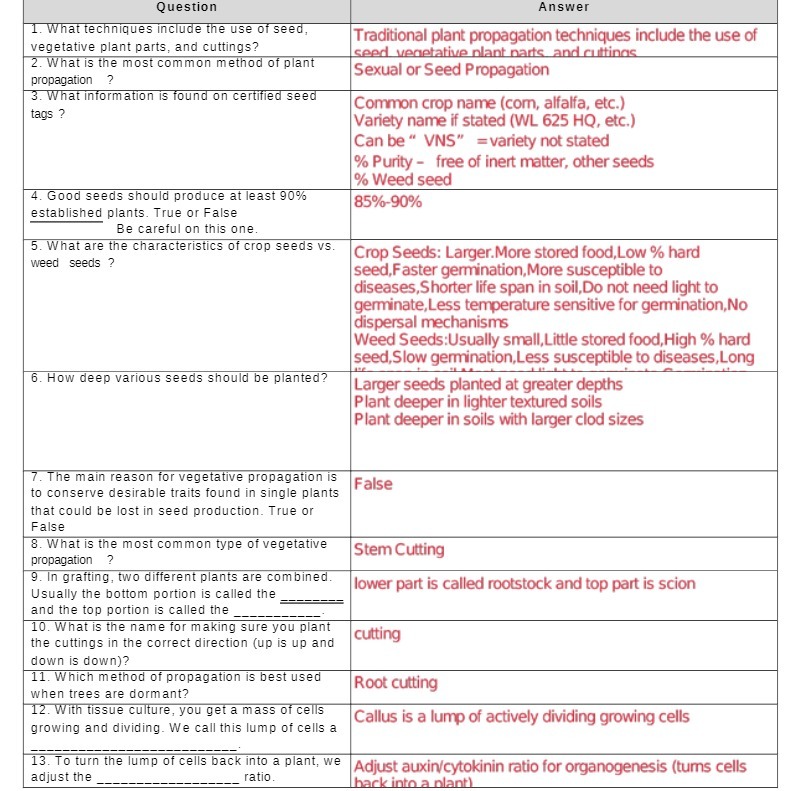
Question Answer 1. What techniques include the use of seed, Traditional plant propagation techniques include the use of vegetative plant parts, and cuttings? seed venetative plant parts and cuttings 2. What is the most common method of plant Sexual or Seed Propagation propagation ? 3. What information is found on certified seed Common crop name (com, alfalfa, etc.) tags ? Variety name if stated (WL 625 HQ, etc.) Can be " VNS" = variety not stated % Purity - free of inert matter, other seeds % Weed seed 4. Good seeds should produce at least 90% 85%-90% established plants. True or False Be careful on this one. 5. What are the characteristics of crop seeds vs. Crop Seeds: Larger.More stored food, Low % hard weed seeds ? seed,Faster germination, More susceptible to diseases,Shorter life span in soil, Do not need light to germinate, Less temperature sensitive for germination,No dispersal mechanisms Weed Seeds:Usually small, Little stored food, High % hard seed, Slow germination, Less susceptible to diseases, Long 6. How deep various seeds should be planted? Larger seeds planted at greater depths Plant deeper in lighter textured soils Plant deeper in soils with larger clod sizes 7. The main reason for vegetative propagation is False to conserve desirable traits found in single plants that could be lost in seed production. True or False 8. What is the most common type of vegetative Stem Cutting propagation ? 9. In grafting, two different plants are combined. lower part is called rootstock and top part is scion Usually the bottom portion is called the and the top portion is called the 10. What is the name for making sure you plant the cuttings in the correct direction (up is up and cutting down is down)? 11. Which method of propagation is best used Root cutting when trees are dormant? 12. With tissue culture, you get a mass of cells growing and dividing. We call this lump of cells a Callus is a lump of actively dividing growing cells 13. To turn the lump of cells back into a plant, we Adjust auxin/cytokinin ratio for organogenesis (tums cells adjust the ratio back into a plantl









 Study Help