







Question: question >, assuming that interest is compounded continuously. Question 6: The Binomial Distribution Solve A Player A throws 6 dice and wins if he scores
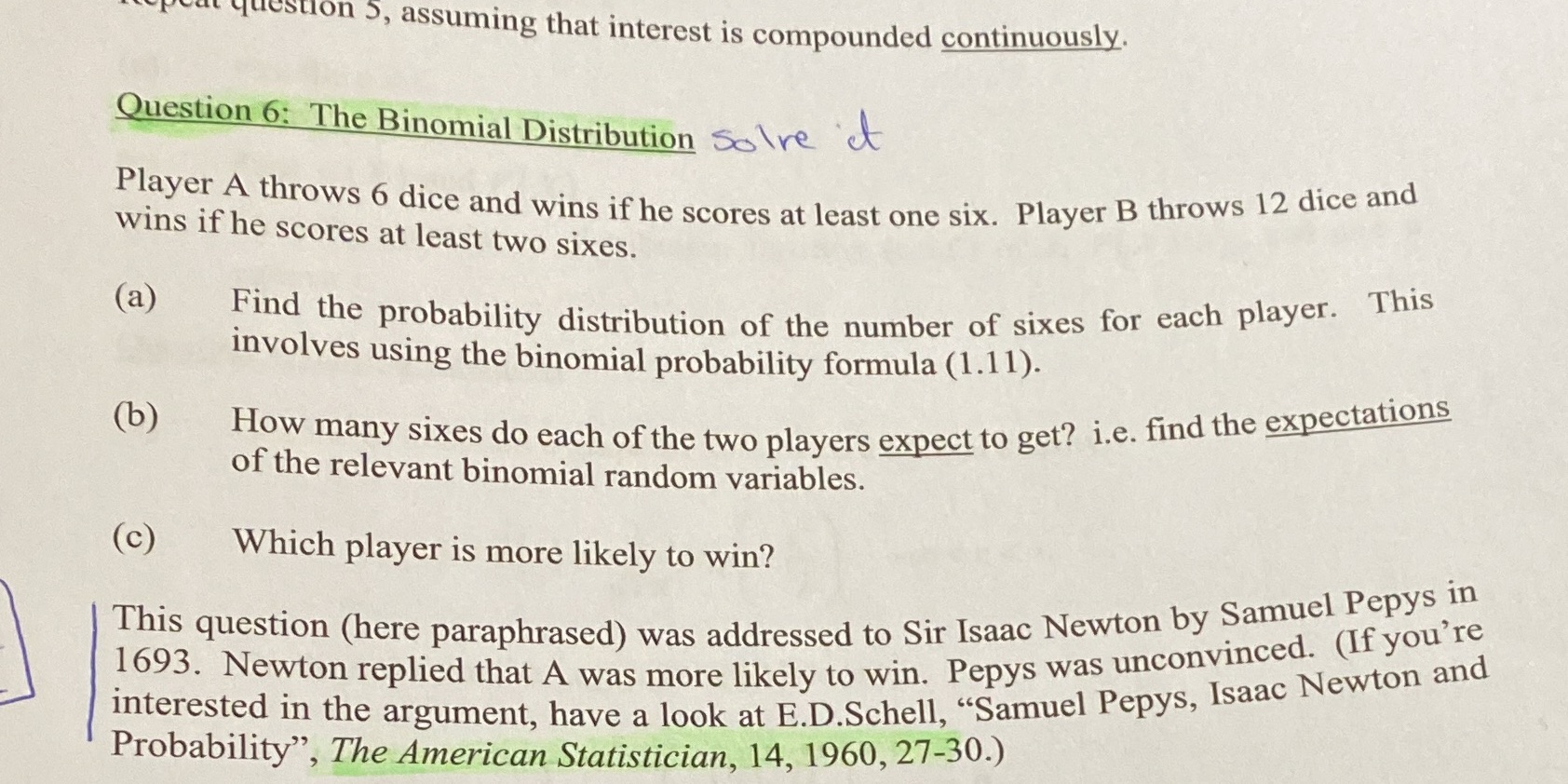
question >, assuming that interest is compounded continuously. Question 6: The Binomial Distribution Solve A Player A throws 6 dice and wins if he scores at least one six. Player B throws 12 dice and wins if he scores at least two sixes. (a) Find the probability distribution of the number of sixes for each player. This involves using the binomial probability formula (1.11). ( b ) How many sixes do each of the two players expect to get? i.e. find the expectations of the relevant binomial random variables. (c ) Which player is more likely to win? This question (here paraphrased) was addressed to Sir Isaac Newton by Samuel Pepys in 1693. Newton replied that A was more likely to win. Pepys was unconvinced. (If you're interested in the argument, have a look at E.D.Schell, "Samuel Pepys, Isaac Newton and Probability", The American Statistician, 14, 1960, 27-30.)
Step by Step Solution
There are 3 Steps involved in it

Get step-by-step solutions from verified subject matter experts
 Study Help