







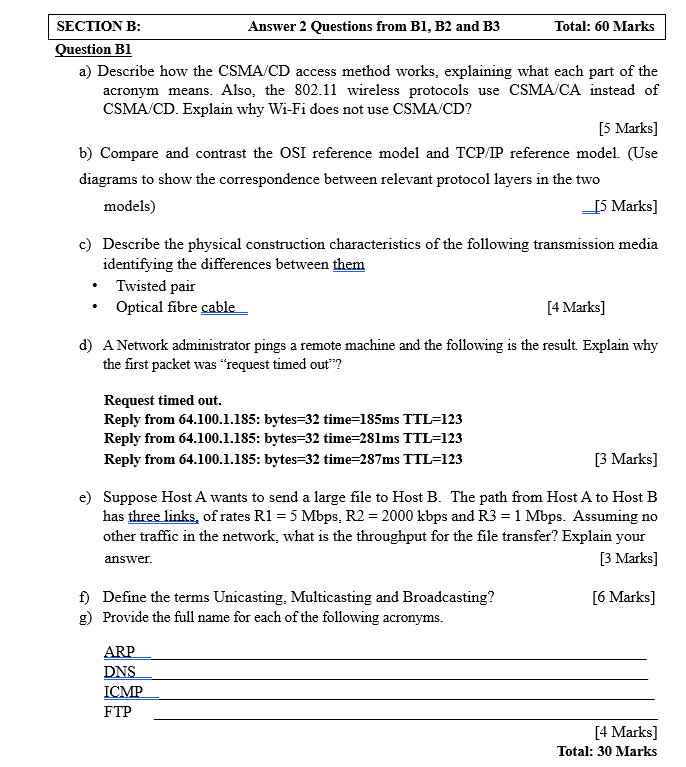
Question: Question B 1 a ) Describe how the CSMA / CD access method works, explaining what each part of the acronym means. Also, the 8
Question B
a Describe how the CSMACD access method works, explaining what each part of the
acronym means. Also, the wireless protocols use A instead of
CSMACD Explain why WiFi does not use CSMACD
Marks
b Compare and contrast the OSI reference model and TCPIP reference model. Use
diagrams to show the correspondence between relevant protocol layers in the two
models
c Describe the physical construction characteristics of the following transmission media
identifying the differences between them
Twisted pair
Optical fibre cable
Marks
d A Network administrator pings a remote machine and the following is the result. Explain why
the first packet was "request timed out"?
Request timed out.
Reply from : bytes time TTL
Reply from : bytes time TTL
Reply from : bytes time TTL
Marks
e Suppose Host A wants to send a large file to Host B The path from Host A to Host B
has three links, of rates and Assuming no
other traffic in the network, what is the throughput for the file transfer? Explain your
answer.
Marks
f Define the terms Unicasting, Multicasting and Broadcasting?
Marks
g Provide the full name for each of the following acronyms.
ARP
DNS
ICMP
FTPIn the CSMACD access method, a host requires tprop to ensure exclusive access to a transmission channel. Using your own words, please explain what this means and why, in detail. You are reminded of your obligations under the Academic Integrity Policy.
Step by Step Solution
There are 3 Steps involved in it
1 Expert Approved Answer
Step: 1 Unlock

Question Has Been Solved by an Expert!
Get step-by-step solutions from verified subject matter experts
Step: 2 Unlock
Step: 3 Unlock
 Study Help