







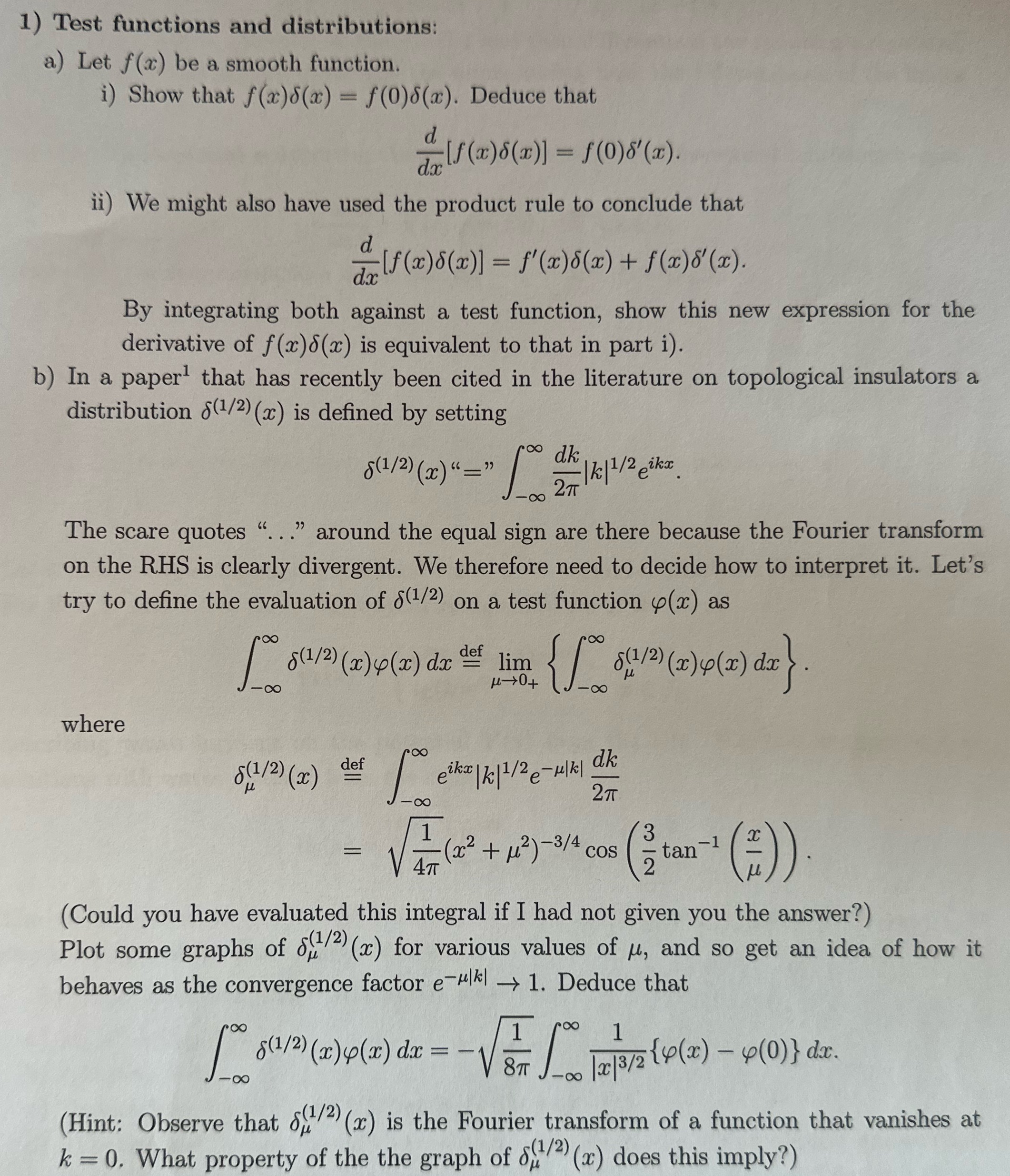
Question: question (b) 1) Test functions and distributions: a) Let f(x) be a smooth function. i) Show that f(x)(x) = f(0)S(x). Deduce that alf (x) 8(x)
question (b)
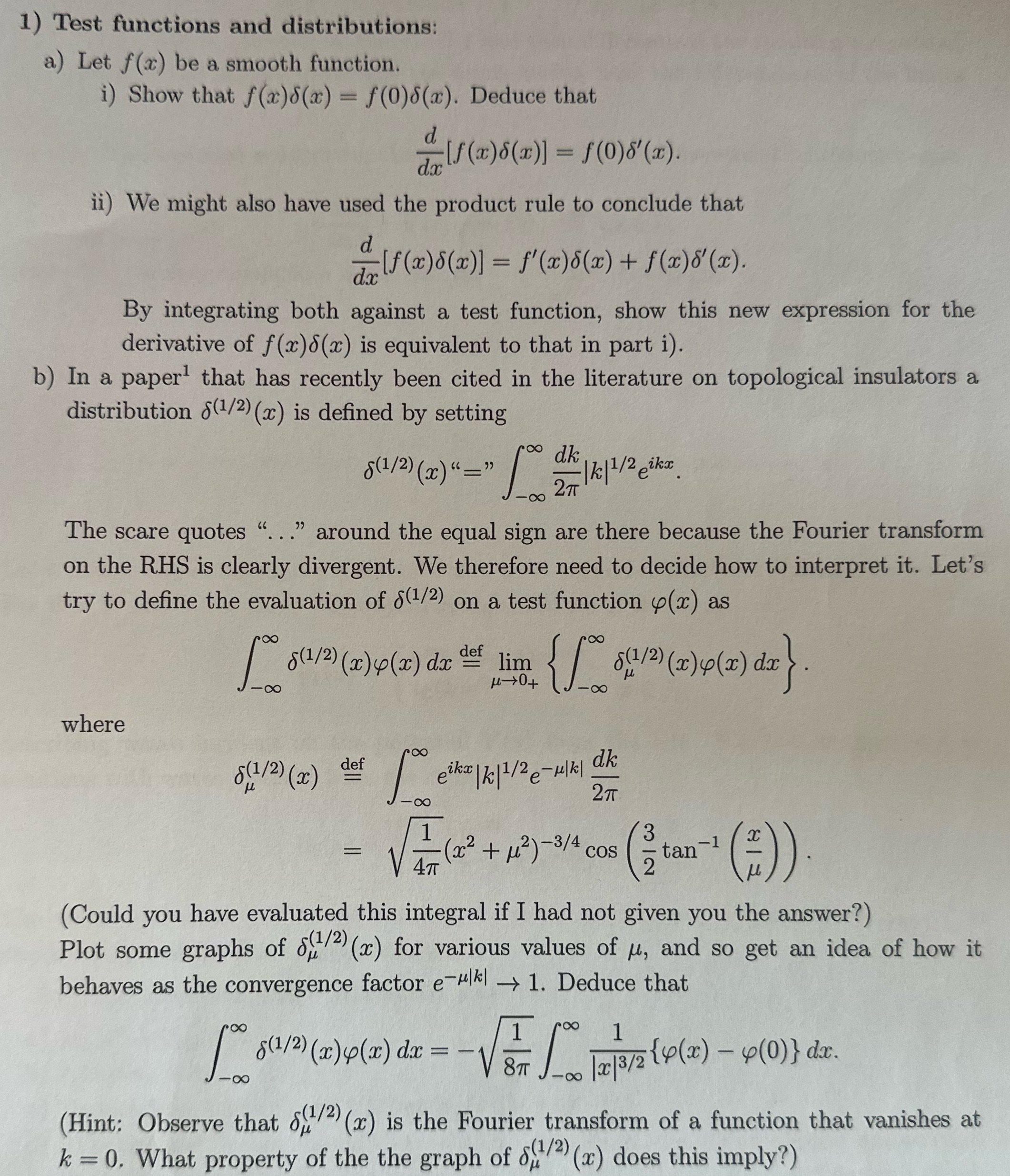
1) Test functions and distributions: a) Let f(x) be a smooth function. i) Show that f(x)(x) = f(0)S(x). Deduce that alf (x) 8(x) ] = $10)8'(1). ii) We might also have used the product rule to conclude that If ( 20 ) 8 ( 20 ) ] = f' ( 20 ) 8 ( 2 ) + f (2 ) 8' ( 20 ) . By integrating both against a test function, show this new expression for the derivative of f(x)(x) is equivalent to that in part i). b) In a paper that has recently been cited in the literature on topological insulators a distribution 8(1/2) (x) is defined by setting 8 (1/2) ( 20 ) " - "3 / 21 14 1 1 / 2 @ Ekize The scare quotes ". .." around the equal sign are there because the Fourier transform on the RHS is clearly divergent. We therefore need to decide how to interpret it. Let's try to define the evaluation of 8(1/2) on a test function y(x) as where 8(1/2) ( 20) def elka | k | 1/2 @ - ulkl dk 2 TT = 12 ( 2 2 + 1 2 )-3/4 cos NICO tan -1 (Could you have evaluated this integral if I had not given you the answer?) Plot some graphs of Su (x) for various values of u, and so get an idea of how it behaves as the convergence factor e-ukl -> 1. Deduce that (Hint: Observe that Su/(x) is the Fourier transform of a function that vanishes at k =0. What property of the the graph of S, "(x) does this imply?)
Step by Step Solution
There are 3 Steps involved in it

Get step-by-step solutions from verified subject matter experts
 Study Help