







Question: Question B.1 (a) Typical machine learning algorithms can work on either supervised or unsupervised data. Thus there are two types of machine learning algorithms, I.
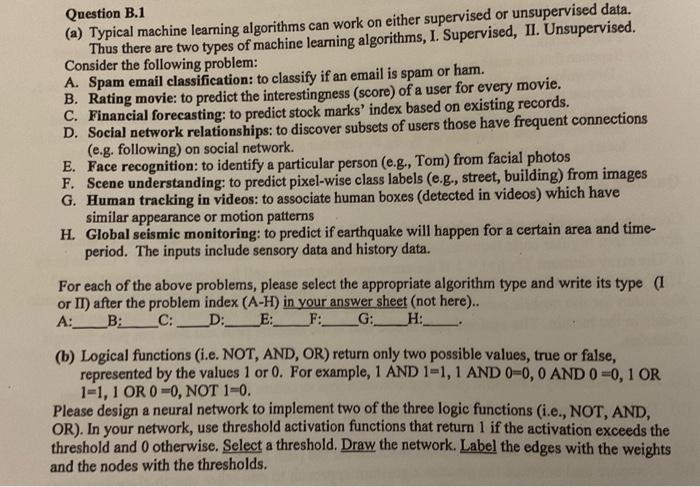
Question B.1 (a) Typical machine learning algorithms can work on either supervised or unsupervised data. Thus there are two types of machine learning algorithms, I. Supervised, II. Unsupervised. Consider the following problem: A. Spam email classification: to classify if an email is spam or ham. B. Rating movie: to predict the interestingness (score) of a user for every movie. C. Financial forecasting: to predict stock marks' index based on existing records. D. Social network relationships: to discover subsets of users those have frequent connections (e.g. following) on social network. E. Face recognition: to identify a particular person (e.g., Tom) from facial photos F. Scene understanding: to predict pixel-wise class labels (e.g., street, building) from images G. Human tracking in videos: to associate human boxes (detected in videos) which have similar appearance or motion patterns H. Global seismic monitoring: to predict if earthquake will happen for a certain area and timeperiod. The inputs include sensory data and history data. For each of the above problems, please select the appropriate algorithm type and write its type (I or II) after the problem index (A-H) in your answer sheet (not here).. A: B: C: D: E: F: G: H: (b) Logical functions (i.e. NOT, AND, OR) return only two possible values, true or false, represented by the values 1 or 0 . For example, 1 AND 1=1,1 AND 0=0,0 AND 0=0,1 OR 1=1,1 OR 0=0, NOT 1=0. Please design a neural network to implement two of the three logic functions (i.e., NOT, AND, OR). In your network, use threshold activation functions that return 1 if the activation exceeds the threshold and 0 otherwise. Select a threshold. Draw the network. Label the edges with the weights and the nodes with the thresholds
Step by Step Solution
There are 3 Steps involved in it

Get step-by-step solutions from verified subject matter experts
 Study Help