







Question: Question B1: Consider the function 9(35') 2 3174 + asc3 + 2:172 + 3.1: + 1. (3) Compute g (x). (b) Use the quadratic formula
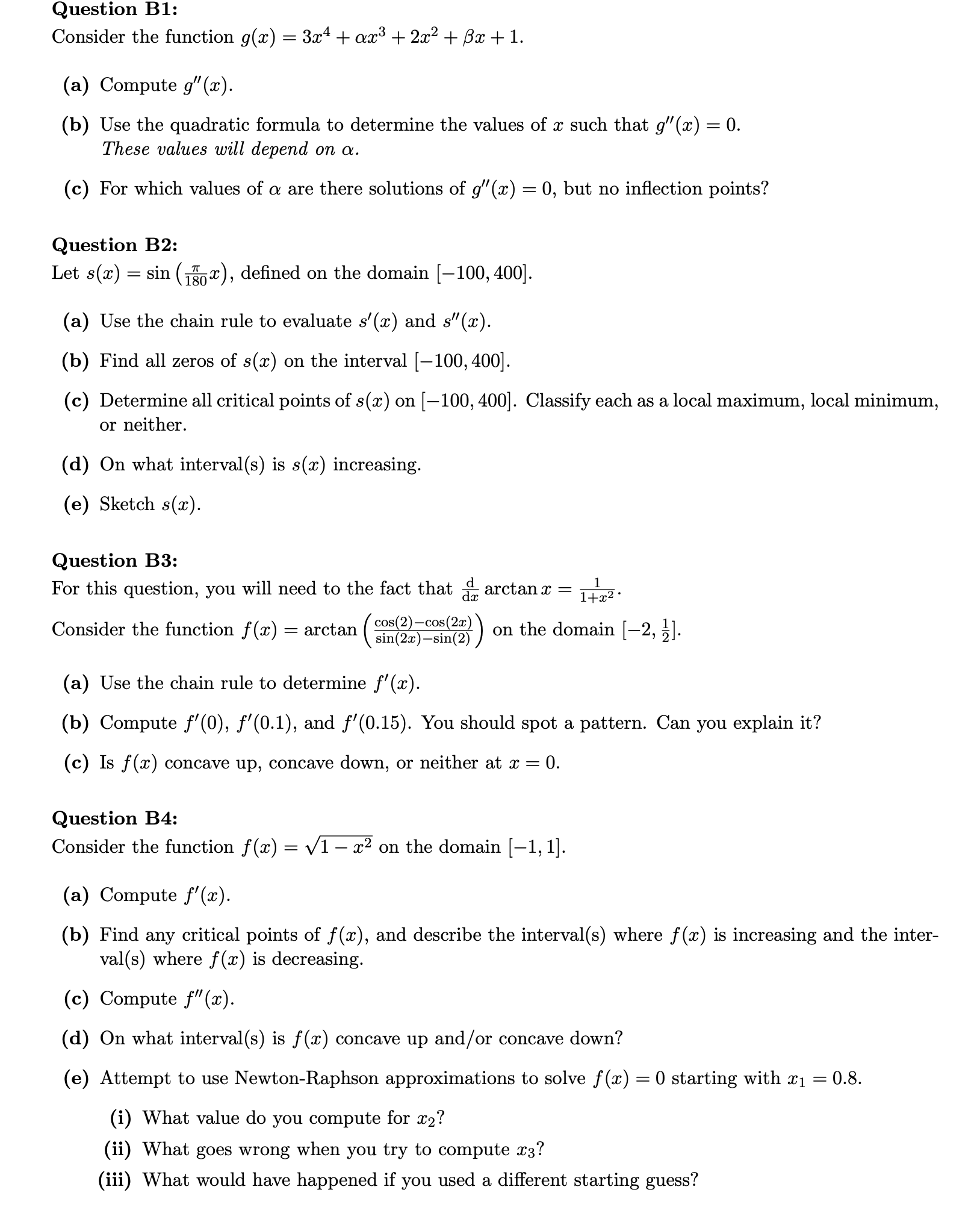
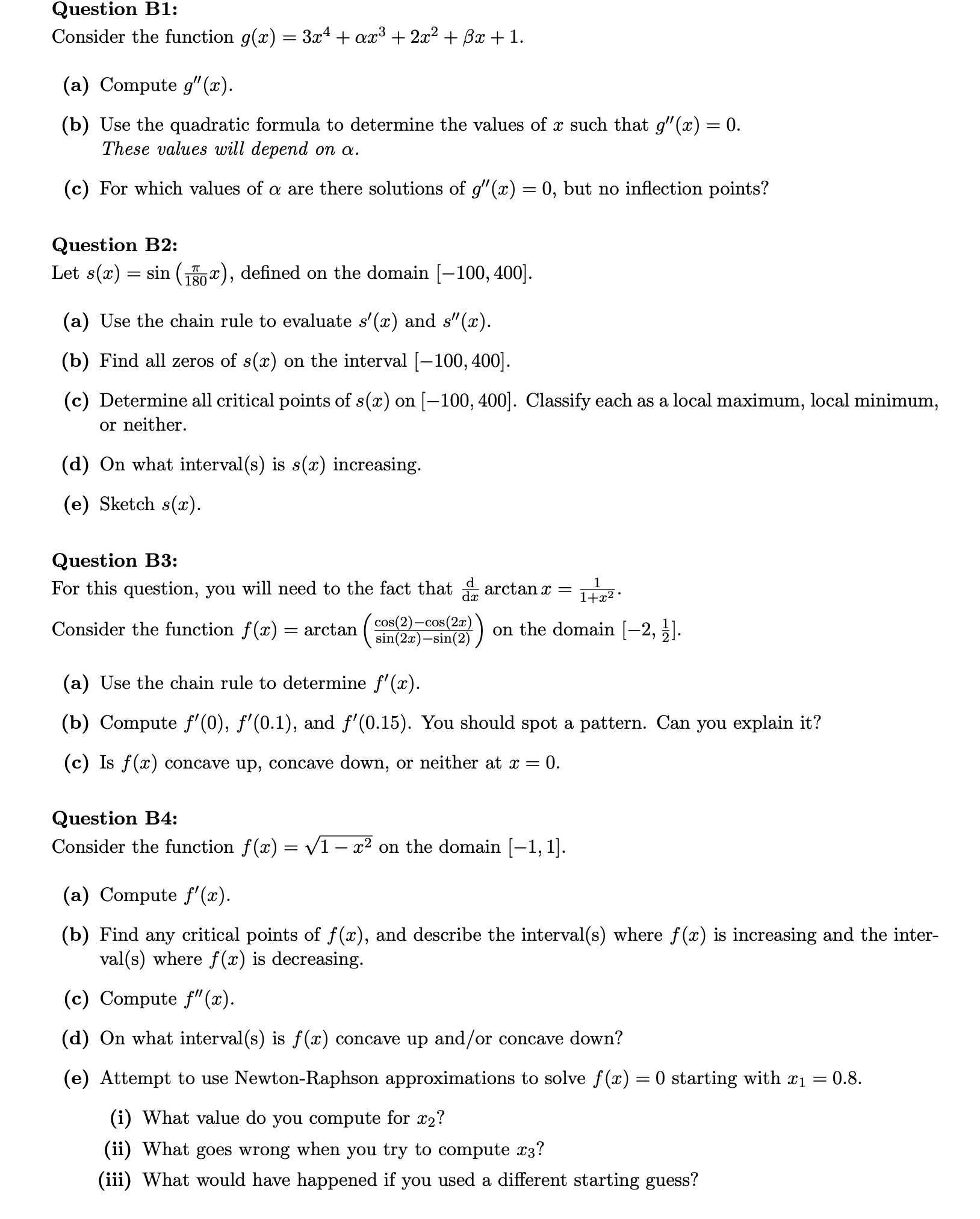
Question B1: Consider the function 9(35') 2 3174 + asc3 + 2:172 + 3.1: + 1. (3) Compute g\" (x). (b) Use the quadratic formula to determine the values of a: such that g\"($) = 0. These values will depend on a. (c) For which values of or are there solutions of g\"(m) = 0, but no inection points? Question B2: Let 5(23) 2 sin (gs), dened on the domain [100, 400]. (a) Use the chain rule to evaluate s'(:c) and s\"($). (b) Find all zeros of 3(1') 011 the interval [100, 400]. (0) Determine all critical points of 5(a) on [100, 400]. Classify each as a local maximum, local minimum, or neither. ((1) On what interval(s) is 5(3) increasing. (e) Sketch 3(59). Question B3: For this question, you will need to the fact that % arctansr; = 1 1+3:2 ' Consider the function f(:1:) = arctan (W) on the domain [2, it (3) Use the chain rule to determine f'(:1:). (b) Compute f'(0), f'(0.1), and f'(0.15). You should spot a pattern. Can you explain it? (C) Is f (m) concave up, concave down, or neither at a," = 0. Question B4: Consider the function f(:1:) = \\/ 1 532 on the domain [1, 1]. (a) Compute f'(:c). (b) Find any critical points of f (as), and describe the interval(s) where f (at) is increasing and the inter val(s) where f (m) is decreasing. (c) Compute f\"(:c). (d) On what interval(s) is f (m) concave up and/or concave down? (e) Attempt to use Newton-Raphson approximations to solve f (:17) = 0 starting with :61 = 0.8. (i) What value do you compute for 272? (ii) What goes wrong when you try to compute :53? (iii) What would have happened if you used a different starting guess
Step by Step Solution
There are 3 Steps involved in it

Get step-by-step solutions from verified subject matter experts
 Study Help