


Question: Question B1: The Associative Laws (see Table 6 in section 1.3.2) are used to justify writing expressions involving only V or only A without parentheses.
Question B1: The Associative Laws (see Table 6 in
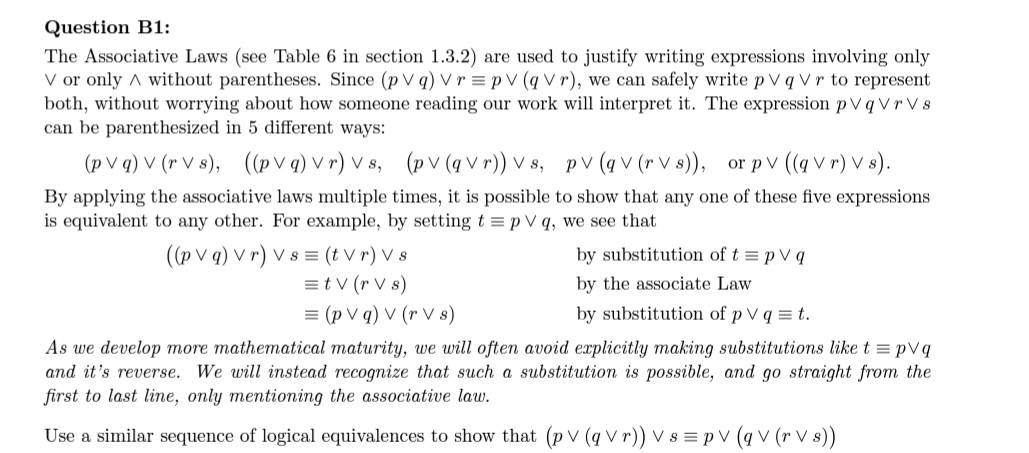
Question B1: The Associative Laws (see Table 6 in section 1.3.2) are used to justify writing expressions involving only V or only A without parentheses. Since (p V .9) V r E 30: V {q V r), we can safely write :0 V g V r to represent both, without worrying about how someone reading our work will interpret it. The expression IN a V r V s can he parenthesised in 5 different ways: {qu}V(er}, {{qu)Vr)Vs, (pV(qV-r))Vs, pV(r,IV(er)), orpV((qu)Vs)t By applying the associative laws multiple times, it is possible to show that any one of these ve expressions is equivalent to any other. For example, by setting t E :0 V q, we see that ((qu)Vr)VsE(ch)Va bysubstitutionoftEqu E t V (r V s) by the associate Law E [g] V q) V {r V s) by substitution of :0 V q E t. As we develop more mathematical maturity, we will often avoid explicitly making substitutions like t E qu and it's reverse. We will instead recognize that such a substitution is possible, and go straight from the first to last line} only mentioning the associative law. Use a similar sequence of logical equivalenees to show that [go V (q V r)) V s E 33 V (g V [r V 3])

Step by Step Solution

There are 3 Steps involved in it

1 Expert Approved Answer
Step: 1 Unlock blur-text-image
Question Has Been Solved by an Expert!

Get step-by-step solutions from verified subject matter experts

Step: 2 Unlock
Step: 3 Unlock

Students Have Also Explored These Related Mathematics Questions!