







Question: Question: Bearing the case study in mind, analyse the impact of the 'Big Shift' on the South Africa retail sector BFAD THE ARTICLE BELOW AND
Question: Bearing the case study in mind, analyse the impact of the 'Big Shift' on the South Africa retail sector 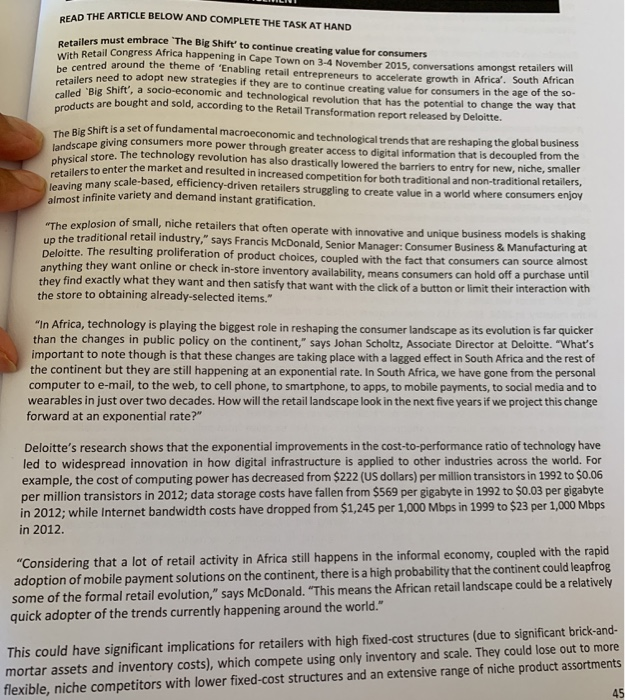
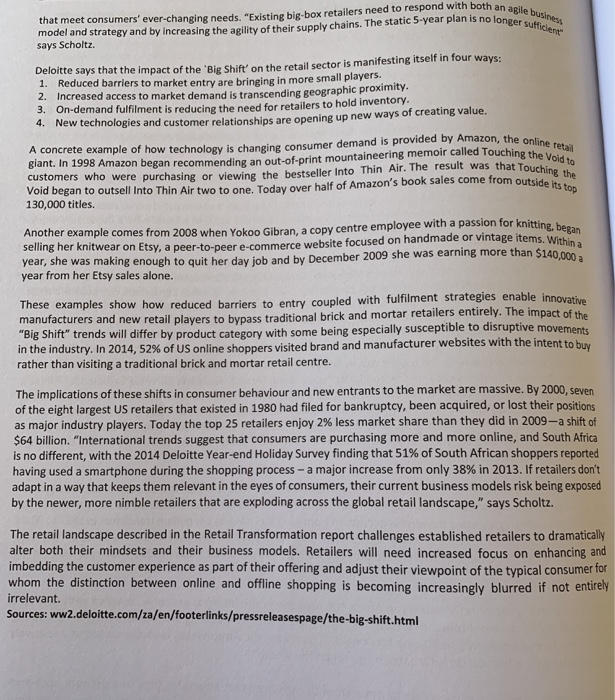
BFAD THE ARTICLE BELOW AND COMPLETE THE TASK AT HAND allers must embrace The Big Shift to continue creating value for consumers th Retail Congress Africa happening in Cape Town on 3-4 November 2015. conversations amongst retailers will centred around the theme of "Enabling retail entrepreneurs to accelerate growth in Africa South African bars need to adopt new strategies if they are to continue creatine value for consumers in the age of the so- retailers need ed 'Big Shift', a socio-economic and technological revolution that has the potential to change the way that cats are bought and sold, according to the Retail Transformation report released by Deloitte. The Big Shift is as Big Shift is a set of fundamental macroeconomic and technological trends that are reshaping the global business cape giving consumers more power through greater access to digital information that is decoupled from the landscape giving co i store. The technology revolution has also drastically lowered the barriers to entry for new, niche, smaller ters to enter the market and resulted in increased competition for both traditional and non-traditional retailers, many scale-based, efficiency-driven retailers struggling to create value in a world where consumers enjoy almost infinite variety and demand instant gratification. retailers to enter the market and resu The explosion of small, niche retailers that often operate with innovative and unique business models is shaking in the traditional retail industry," says Francis McDonald, Senior Manager: Consumer Business & Manufacturing at Deloitte. The resulting proliferation of product choices, coupled with the fact that consumers can source almost anything they want online or check in-store inventory availability. means consumers can hold off a purchase until they find exactly what they want and then satisfy that want with the click of a button or limit their interaction with the store to obtaining already selected items." in Africa, technology is playing the biggest role in reshaping the consumer landscape as its evolution is far quicker than the changes in public policy on the continent," says Johan Scholtz, Associate Director at Deloitte. "What's important to note though is that these changes are taking place with a larged effect in South Africa and the rest of the continent but they are still happening at an exponential rate. In South Africa, we have gone from the personal computer to e-mail, to the web, to cell phone, to smartphone, to apps, to mobile payments, to social media and to wearables in just over two decades. How will the retail landscape look in the next five years if we project this change forward at an exponential rate?" Deloitte's research shows that the exponential improvements in the cost-to-performance ratio of technology have led to widespread innovation in how digital infrastructure is applied to other industries across the world. For example, the cost of computing power has decreased from $222 (US dollars) per million transistors in 1992 to $0.06 per million transistors in 2012, data storage costs have fallen from $569 per gigabyte in 1992 to $0.03 per gigabyte in 2012; while Internet bandwidth costs have dropped from $1,245 per 1,000 Mbps in 1999 to $23 per 1,000 Mbps in 2012 "Considering that a lot of retail activity in Africa still happens in the informal economy, coupled with the rapid adoption of mobile payment solutions on the continent, there is a high probability that the continent could leapfrog some of the formal retail evolution," says McDonald. "This means the African retail landscape could be a relatively quick adopter of the trends currently happening around the world." This could have significant implications for retailers with high fixed-cost structures (due to significant brick-and- mortar assets and inventory costs), which compete using only inventory and scale. They could lose out to more flexible, niche competitors with lower fixed-cost structures and an extensive range of niche product assortments 45 th an agile business o longer sufficient that meet consumers' ever-changing needs. "Existine hiebox retailers need to respond with both an an model and strategy and by increasing the agility of their supply chains. The static 5-year plan is no longer says Scholtz. Deloitte says that the impact of the 'Big Shift' on the retail sector is manifesting itself in four ways: 1. Reduced barriers to market entry are bringing in more small players. 2. Increased access to market demand is transcending geographic proximity 3. On-demand fulfilment is reducing the need for retailers to hold inventory. 4. New technologies and customer relationships are opening up new ways of creating value. A concrete example of how technology is changing consumer demand is provided by Amazon, the onlin giant. In 1998 Amazon began recommending an out-of-print mountaineering memoir called Touching they customers who were purchasing or viewing the bestseller Into Thin Air. The result was that Touchi Vold began to outsell Into Thin Air two to one. Todav over half of Amazon's book sales come from outside 130,000 titles. on, the online retail Touching the Void to t was that Touching the come from outside its top voitting, began Another example comes from 2008 when Yokoo Gibran, a copy centre employee with a passion for knittine ha selling her knitwear on Etsy, a peer-to-peer e-commerce website focused on handmade or vintage items. Within year, she was making enough to quit her day job and by December 2009 she was earning more than $140 mm year from her Etsy sales alone. These examples show how reduced barriers to entry coupled with fulfilment strategies enable innovatie manufacturers and new retail players to bypass traditional brick and mortar retailers entirely. The impact of the "Big Shift" trends will differ by product category with some being especially susceptible to disruptive movemente in the industry. In 2014, 52% of US online shoppers visited brand and manufacturer websites with the intent to him rather than visiting a traditional brick and mortar retail centre. The implications of these shifts in consumer behaviour and new entrants to the market are massive. By 2000. Svo of the eight largest US retailers that existed in 1980 had filed for bankruptcy, been acquired, or lost their positions as major industry players. Today the top 25 retailers enjoy 2% less market share than they did in 2009-a shift of $64 billion. "International trends suggest that consumers are purchasing more and more online, and South Africa is no different, with the 2014 Deloitte Year-end Holiday Survey finding that 51% of South African shoppers reported having used a smartphone during the shopping process - a major increase from only 38% in 2013. If retailers don't adapt in a way that keeps them relevant in the eyes of consumers, their current business models risk being exposed by the newer, more nimble retailers that are exploding across the global retail landscape," says Scholtz. The retail landscape described in the Retail Transformation report challenges established retailers to dramatically alter both their mindsets and their business models. Retailers will need increased focus on enhancing and imbedding the customer experience as part of their offering and adjust their viewpoint of the typical consumer for whom the distinction between online and offline shopping is becoming increasingly blurred if not entirely irrelevant. Sources: ww2.deloitte.com/za/en/footerlinks/pressreleasespage/the-big-shift.html
Step by Step Solution
There are 3 Steps involved in it
1 Expert Approved Answer
Step: 1 Unlock

Question Has Been Solved by an Expert!
Get step-by-step solutions from verified subject matter experts
Step: 2 Unlock
Step: 3 Unlock
 Study Help