







Question: * Question Completion Status: QUESTION 1 Algorithms developed with divide-and-conquer paradigm are often implemented recursively. True False QUESTION 2 A binary tree illustrates sorting an
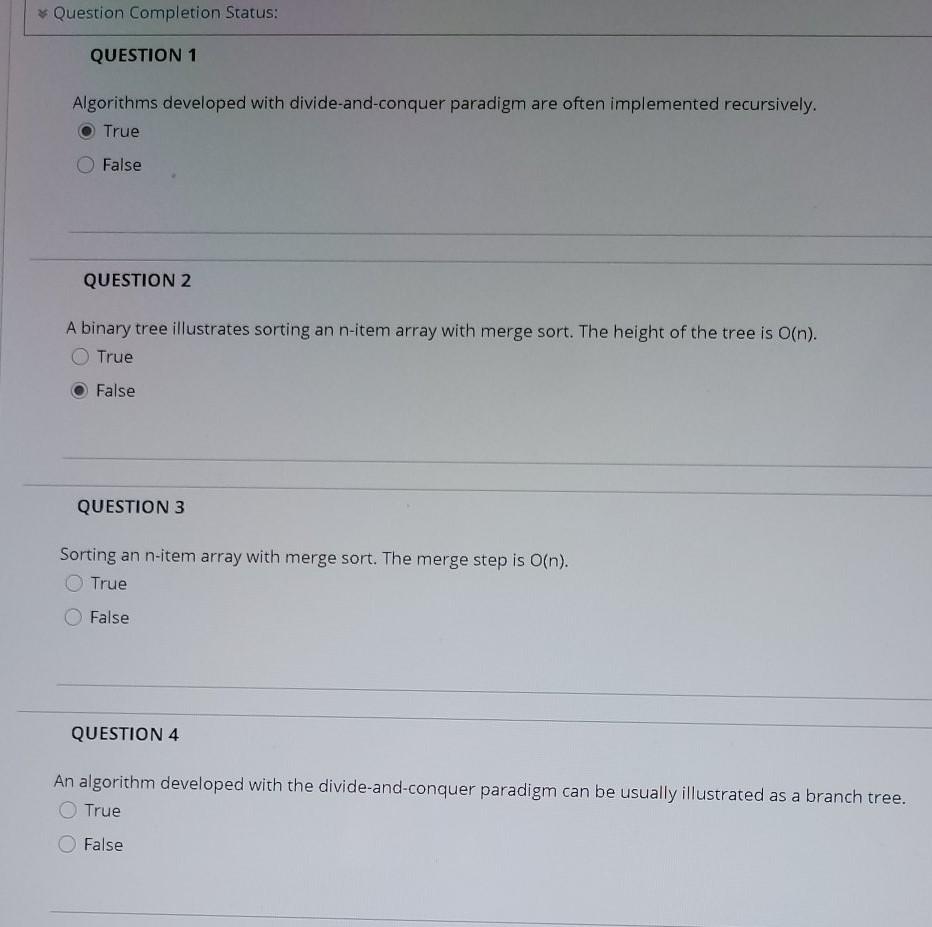
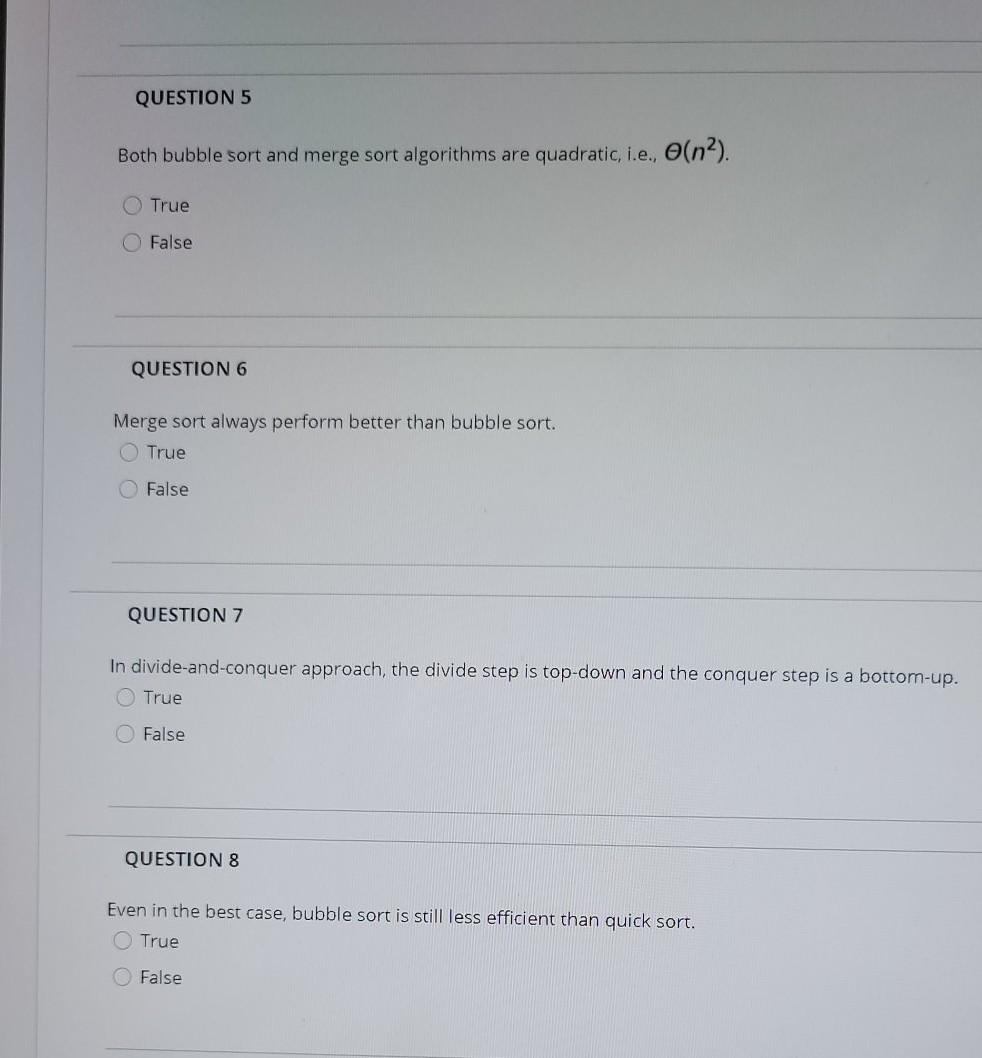
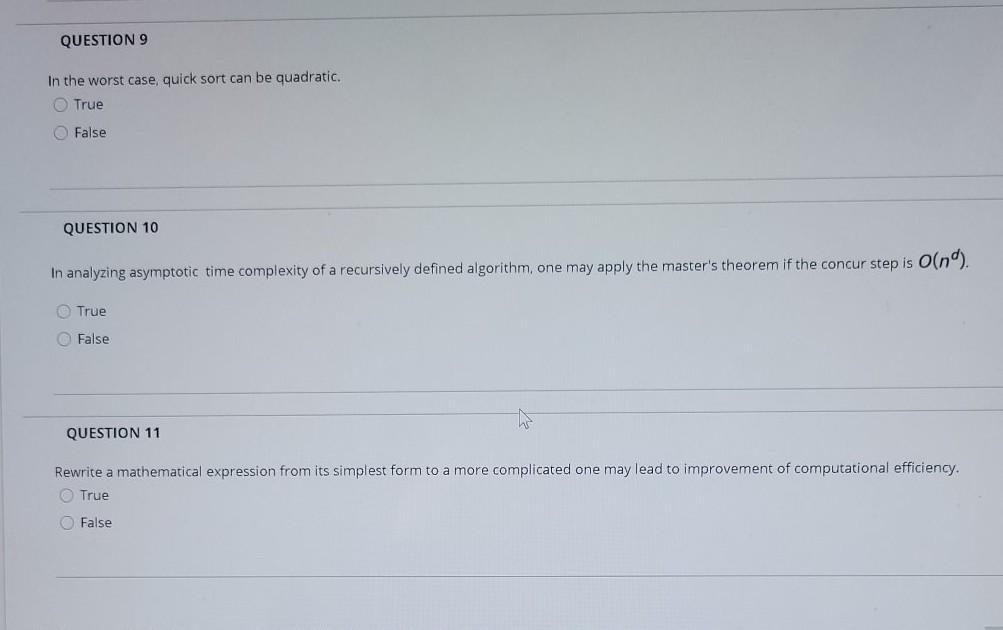
* Question Completion Status: QUESTION 1 Algorithms developed with divide-and-conquer paradigm are often implemented recursively. True False QUESTION 2 A binary tree illustrates sorting an n-item array with merge sort. The height of the tree is O(n). O True False QUESTION 3 Sorting an n-item array with merge sort. The merge step is O(n). True False QUESTION 4 An algorithm developed with the divide-and-conquer paradigm can be usually illustrated as a branch tree. True False QUESTION 5 Both bubble sort and merge sort algorithms are quadratic, i.e., (n2). True False QUESTION 6 Merge sort always perform better than bubble sort. True False QUESTION 7 In divide-and-conquer approach, the divide step is top-down and the conquer step is a bottom-up. True False QUESTION 8 Even in the best case, bubble sort is still less efficient than quick sort. O True False QUESTION 9 In the worst case, quick sort can be quadratic. True False QUESTION 10 In analyzing asymptotic time complexity of a recursively defined algorithm, one may apply the master's theorem if the concur step is O(n). True False QUESTION 11 Rewrite a mathematical expression from its simplest form to a more complicated one may lead to improvement of computational efficiency. True False
Step by Step Solution
There are 3 Steps involved in it

Get step-by-step solutions from verified subject matter experts
 Study Help