







Question: Question: Consider the function, f(x)= (e^x)/(6+e^x) x = 6+e Then f '(x) = The following questions ask for endpoints of intervals of increase or decrease
Question:
Consider the function, f(x)= (e^x)/(6+e^x)
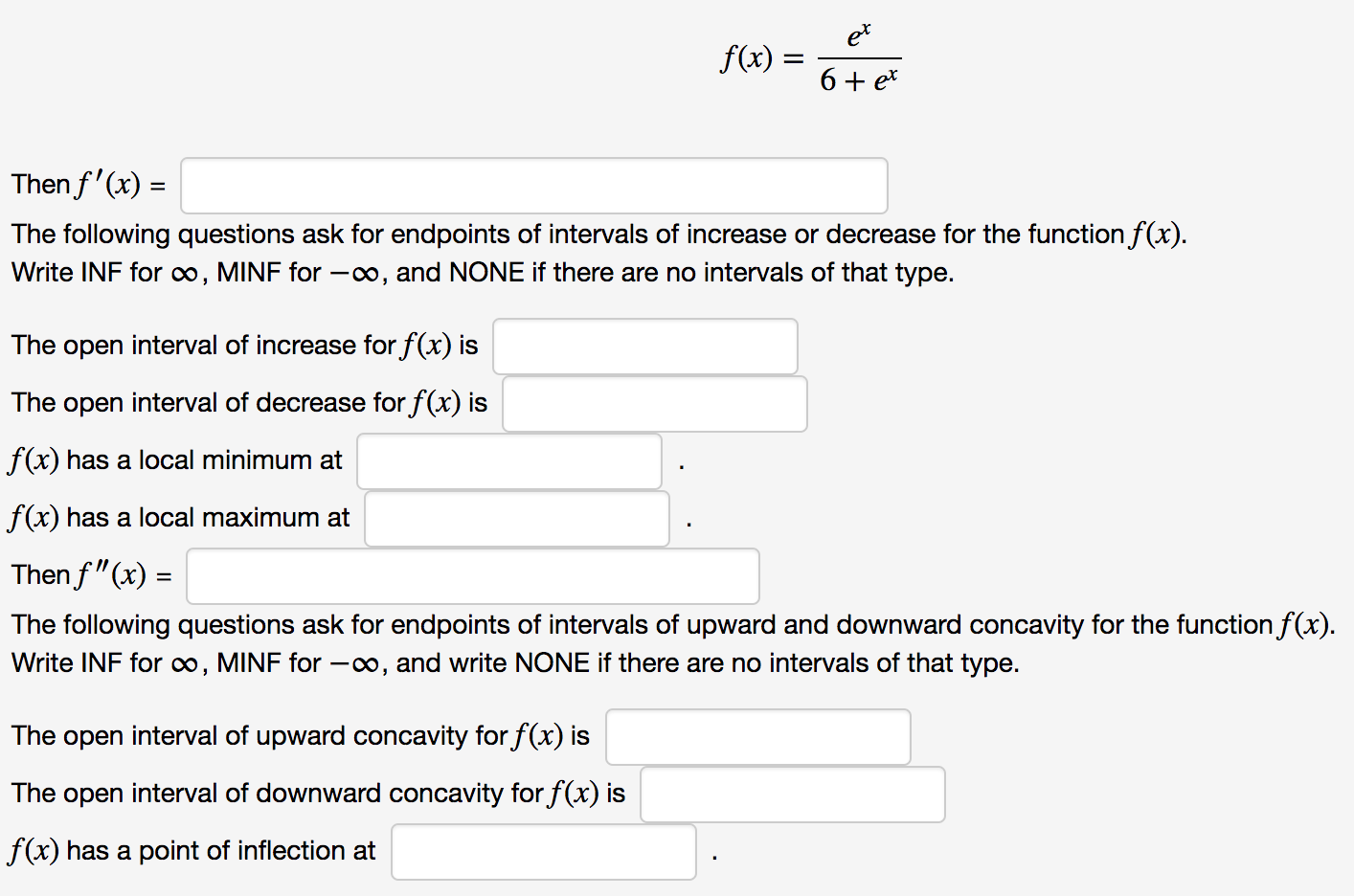
x = 6+e" Then f '(x) = The following questions ask for endpoints of intervals of increase or decrease for the function f(x). Write INF for 00, MINF for oo, and NONE if there are no intervals of that type. The open interval of increase for f(x) is The open interval of decrease for f (x) is at) has a local minimum at f(x) has a local maximum at Thenf\"(x) = The following questions ask for endpoints of intervals of upward and downward concavity for the function f(x). Write INF for 00, MINF for oo, and write NONE if there are no intervals of that type. The open interval of upward concavity for f (x) is The open interval of downward concavity for f(x) is f (x) has a point of inflection at
Step by Step Solution
There are 3 Steps involved in it

Get step-by-step solutions from verified subject matter experts
 Study Help