







Question: Question: Critically evaluate two risks that might deter a potential expatriate from taking an international assignment and how the risks could be managed to enhance
Question: Critically evaluate two risks that might deter a potential expatriate from taking an international assignment and how the risks could be managed to enhance effectiveness of expatriates performance.
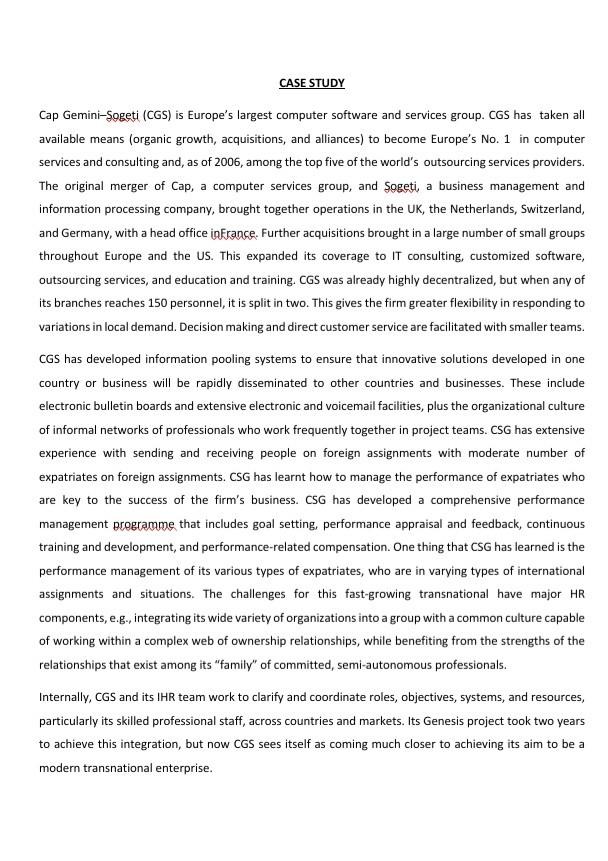
CASE STUDY Cap Gemini-Sogeti (CGS) is Europe's largest computer software and services group. CGS has taken all available means (organic growth, acquisitions, and alliances) to become Europe's No. 1 in computer services and consulting and, as of 2006, among the top five of the world's outsourcing services providers. The original merger of Cap, a computer services group, and Sogeti, a business management and information processing company, brought together operations in the UK, the Netherlands, Switzerland, and Germany, with a head office in France. Further acquisitions brought in a large number of small groups throughout Europe and the US. This expanded its coverage to IT consulting, customized software, outsourcing services, and education and training. CGS was already highly decentralized, but when any of its branches reaches 150 personnel, it is split in two. This gives the firm greater flexibility in responding to variations in local demand. Decision making and direct customer service are facilitated with smaller teams. CGS has developed information pooling systems to ensure that innovative solutions developed in one country or business will be rapidly disseminated to other countries and businesses. These include electronic bulletin boards and extensive electronic and voicemail facilities, plus the organizational culture of informal networks of professionals who work frequently together in project teams. CSG has extensive experience with sending and receiving people on foreign assignments with moderate number of expatriates on foreign assignments. CSG has learnt how to manage the performance of expatriates who are key to the success of the firm's business. CSG has developed a comprehensive performance management programme that includes goal setting, performance appraisal and feedback, continuous training and development, and performance-related compensation. One thing that CSG has learned is the performance management of its various types of expatriates, who are in varying types of international assignments and situations. The challenges for this fast-growing transnational have major HR components, e.g., integrating its wide variety of organizations into a group with a common culture capable of working within a complex web of ownership relationships, while benefiting from the strengths of the relationships that exist among its "family" of committed, semi-autonomous professionals. Internally. CGS and its IHR team work to clarify and coordinate roles, objectives, systems, and resources, particularly its skilled professional staff, across countries and markets. Its Genesis project took two years to achieve this integration, but now CGS sees itself as coming much closer to achieving its aim to be a modern transnational enterpriseStep by Step Solution
There are 3 Steps involved in it
1 Expert Approved Answer
Step: 1 Unlock

Question Has Been Solved by an Expert!
Get step-by-step solutions from verified subject matter experts
Step: 2 Unlock
Step: 3 Unlock
 Study Help