







Question: Question d) (d) Does a linear relation exist between the commute time and well-being index score? Select the correct choice below and fill in the
Question d)
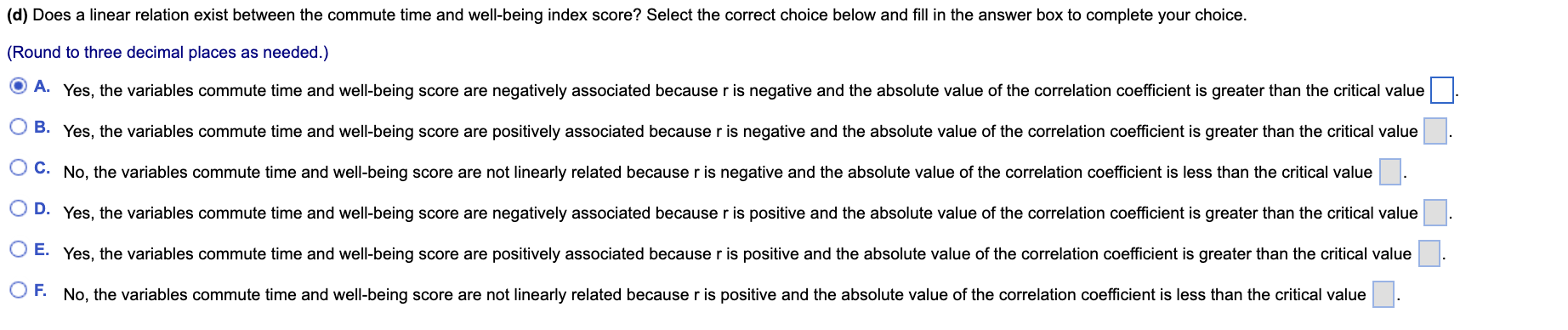
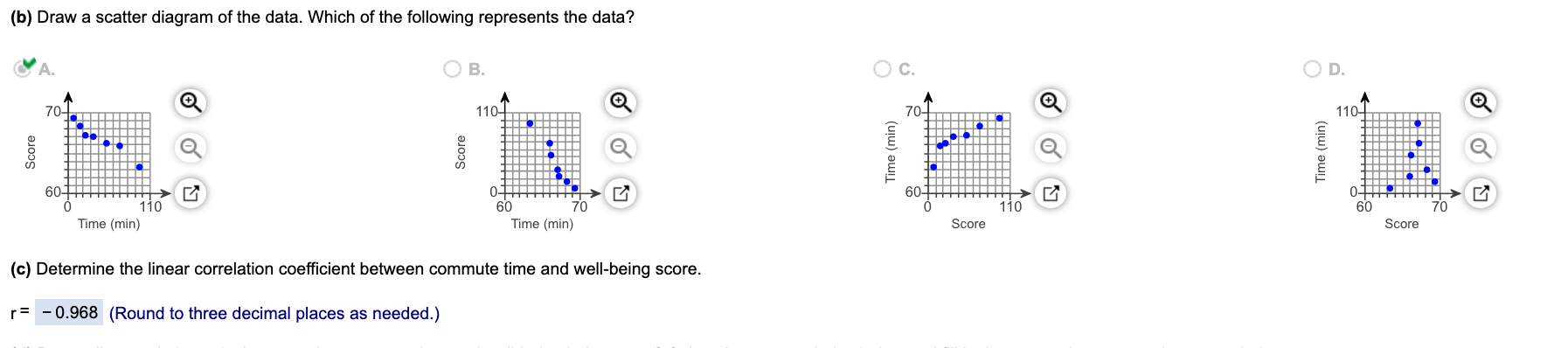
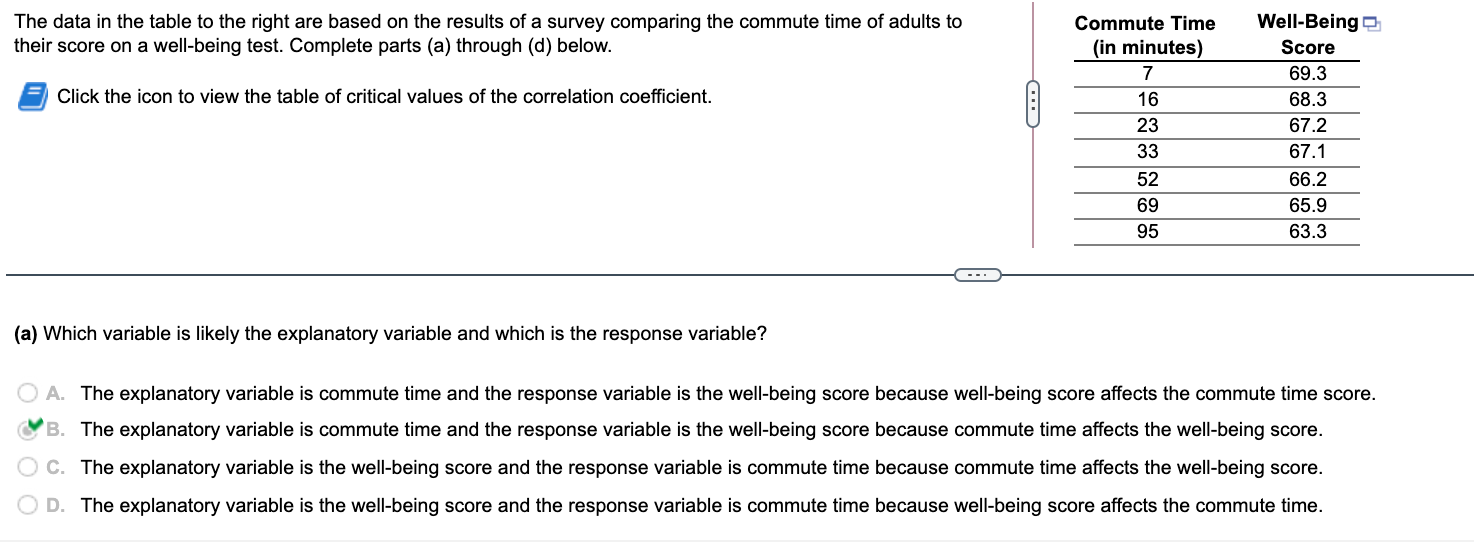
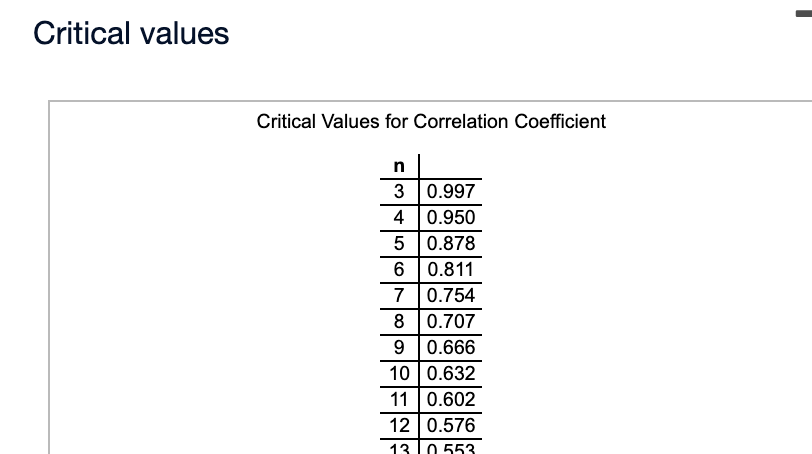

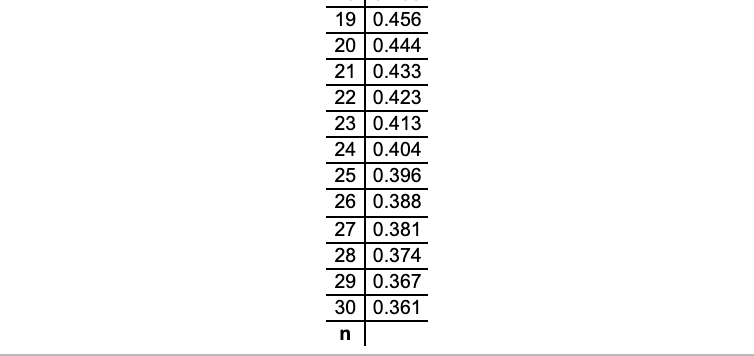
(d) Does a linear relation exist between the commute time and well-being index score? Select the correct choice below and fill in the answer box to complete your choice. (Round to three decimal places as needed.) A. Yes, the variables commute time and well-being score are negatively associated because r is negative and the absolute value of the correlation coefficient is greater than the critical value B. Yes, the variables commute time and well-being score are positively associated because r is negative and the absolute value of the correlation coefficient is greater than the critical value C. No, the variables commute time and well-being score are not linearly related because r is negative and the absolute value of the correlation coefficient is less than the critical value O D. Yes, the variables commute time and well-being score are negatively associated because r is positive and the absolute value of the correlation coefficient is greater than the critical value O E. Yes, the variables commute time and well-being score are positively associated because r is positive and the absolute value of the correlation coefficient is greater than the critical value OF. No, the variables commute time and well-being score are not linearly related because r is positive and the absolute value of the correlation coefficient is less than the critical value(b) Draw a scatter diagram of the data. Which of the following represents the data? Score Time (min) Time (min) Time (min) Time (min) (c) Determine the linear correlation coefcient between commute time and well-being score. r = - 0.968 (Round to three decimal places as needed.) The data in the table to the right are based on the results of a survey comparing the commute time of adults to Commute Time Well-Being their score on a well-being test. Complete parts (a) through (d) below. (in minutes) Score 7 69.3 Click the icon to view the table of critical values of the correlation coefficient. 16 68.3 23 67.2 33 67.1 52 66.2 69 65.9 95 63.3 - - . (a) Which variable is likely the explanatory variable and which is the response variable? A. The explanatory variable is commute time and the response variable is the well-being score because well-being score affects the commute time score. B. The explanatory variable is commute time and the response variable is the well-being score because commute time affects the well-being score. O C. The explanatory variable is the well-being score and the response variable is commute time because commute time affects the well-being score. O D. The explanatory variable is the well-being score and the response variable is commute time because well-being score affects the commute time.Critical values Critical Values for Correlation Coefficient n 3 0.997 4 0.950 5 0.878 O 0.811 7 0.754 8 0.707 9 0.666 10 0.632 11 0.602 12 0.576 12 0 552\f19 0.456 20 0.444 21 0.433 22 0.423 23 0.413 24 0.404 25 0.396 26 0.388 27 0.381 28 0.374 29 0.367 30 0.361 n
Step by Step Solution
There are 3 Steps involved in it

Get step-by-step solutions from verified subject matter experts
 Study Help