







Question: Question D1 Your friend now wants to predict future values of two variables, but wants to generate a model that is mutually consistent. What type
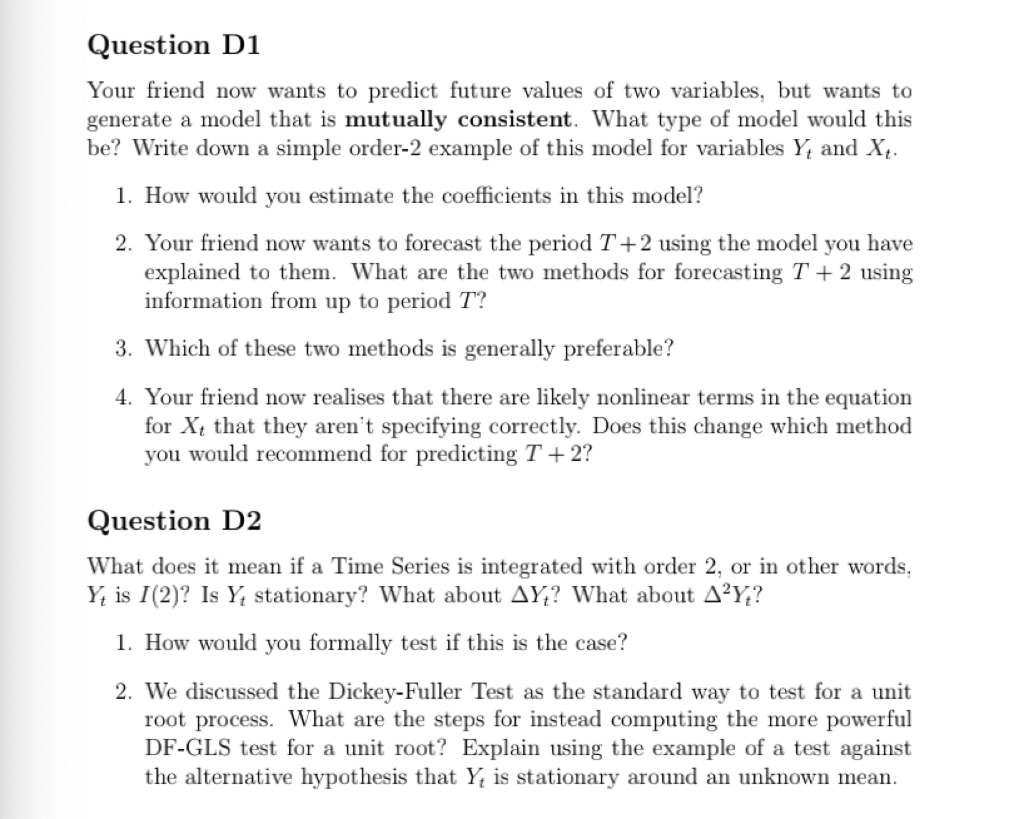
Question D1 Your friend now wants to predict future values of two variables, but wants to generate a model that is mutually consistent. What type of model would this be? Write down a simple order-2 example of this model for variables Y and X. 1. How would you estimate the coefficients in this model? 2. Your friend now wants to forecast the period T + 2 using the model you have explained to them. What are the two methods for forecasting T + 2 using information from up to period T? 3. Which of these two methods is generally preferable? 4. Your friend now realises that there are likely nonlinear terms in the equation for X that they aren't specifying correctly. Does this change which method you would recommend for predicting T + 2? Question D2 What does it mean if a Time Series is integrated with order 2, or in other words, Yis 1(2)? Is Y stationary? What about AY/? What about AY? 1. How would you formally test if this is the case? 2. We discussed the Dickey-Fuller Test as the standard way to test for a unit root process. What are the steps for instead computing the more powerful DF-GLS test for a unit root? Explain using the example of a test against the alternative hypothesis that Y is stationary around an unknown mean. Question D1 Your friend now wants to predict future values of two variables, but wants to generate a model that is mutually consistent. What type of model would this be? Write down a simple order-2 example of this model for variables Y and X. 1. How would you estimate the coefficients in this model? 2. Your friend now wants to forecast the period T + 2 using the model you have explained to them. What are the two methods for forecasting T + 2 using information from up to period T? 3. Which of these two methods is generally preferable? 4. Your friend now realises that there are likely nonlinear terms in the equation for X that they aren't specifying correctly. Does this change which method you would recommend for predicting T + 2? Question D2 What does it mean if a Time Series is integrated with order 2, or in other words, Yis 1(2)? Is Y stationary? What about AY/? What about AY? 1. How would you formally test if this is the case? 2. We discussed the Dickey-Fuller Test as the standard way to test for a unit root process. What are the steps for instead computing the more powerful DF-GLS test for a unit root? Explain using the example of a test against the alternative hypothesis that Y is stationary around an unknown mean
Step by Step Solution
There are 3 Steps involved in it

Get step-by-step solutions from verified subject matter experts
 Study Help