







Question: QUESTION : Differentiate Different types of services ? please help me to answer this question . thankyou There are seven basic network services that you
QUESTION :
Differentiate Different types of services ?
please help me to answer this question . thankyou
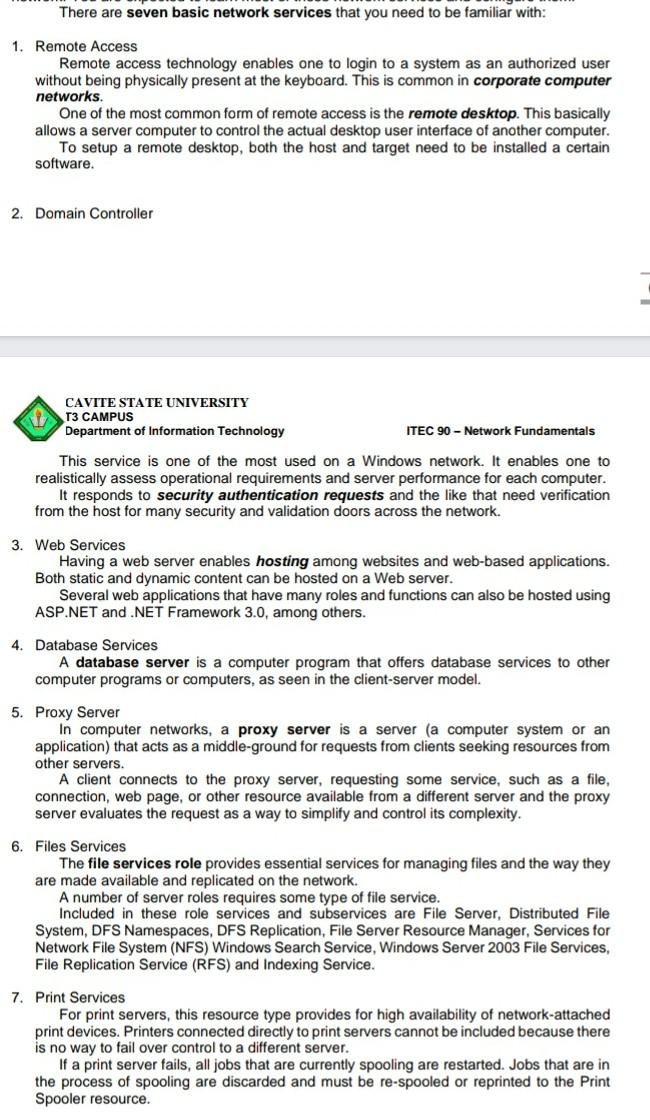
There are seven basic network services that you need to be familiar with: 1. Remote Access Remote access technology enables one to login to a system as an authorized user without being physically present at the keyboard. This is common in corporate computer networks One of the most common form of remote access is the remote desktop. This basically allows a server computer to control the actual desktop user interface of another computer. To setup a remote desktop, both the host and target need to be installed a certain software. 2. Domain Controller CAVITE STATE UNIVERSITY T3 CAMPUS Department of Information Technology ITEC 90 - Network Fundamentals This service is one of the most used on a Windows network. It enables one to realistically assess operational requirements and server performance for each computer. It responds to security authentication requests and the like that need verification from the host for many security and validation doors across the network. 3. Web Services Having a web server enables hosting among websites and web-based applications. Both static and dynamic content can be hosted on a Web server. Several web applications that have many roles and functions can also be hosted using ASP.NET and .NET Framework 3.0, among others. 4. Database Services A database server is a computer program that offers database services to other computer programs or computers, as seen in the client-server model. 5. Proxy Server In computer networks, a proxy server is a server (a computer system or an application) that acts as a middle-ground for requests from clients seeking resources from other servers. A client connects to the proxy server, requesting some service, such as a file, connection, web page, or other resource available from a different server and the proxy server evaluates the request as a way to simplify and control its complexity. 6. Files Services The file services role provides essential services for managing files and the way they are made available and replicated on the network. A number of server roles requires some type of file service. Included in these role services and subservices are File Server, Distributed File System, DFS Namespaces, DFS Replication, File Server Resource Manager, Services for Network File System (NFS) Windows Search Service, Windows Server 2003 File Services, File Replication Service (RFS) and Indexing Service. 7. Print Services For print servers, this resource type provides for high availability of network-attached print devices. Printers connected directly to print servers cannot be included because there no way to fail over control to a different server. If a print server fails, all jobs that are currently spooling are restarted. Jobs that are in the process of spooling are discarded and must be re-spooled or reprinted to the Print Spooler resource
Step by Step Solution
There are 3 Steps involved in it

Get step-by-step solutions from verified subject matter experts
 Study Help