







Question: Question: Dynamic environments require dynamic processes, people, systems and culture, especially for managing change successfully. Critically discuss and elaborate on what constitutes a good change
Question:
Dynamic environments require dynamic processes, people, systems and culture, especially for managing change successfully. Critically discuss and elaborate on what constitutes a good change management practice in an organization of your choice.
(25 marks)
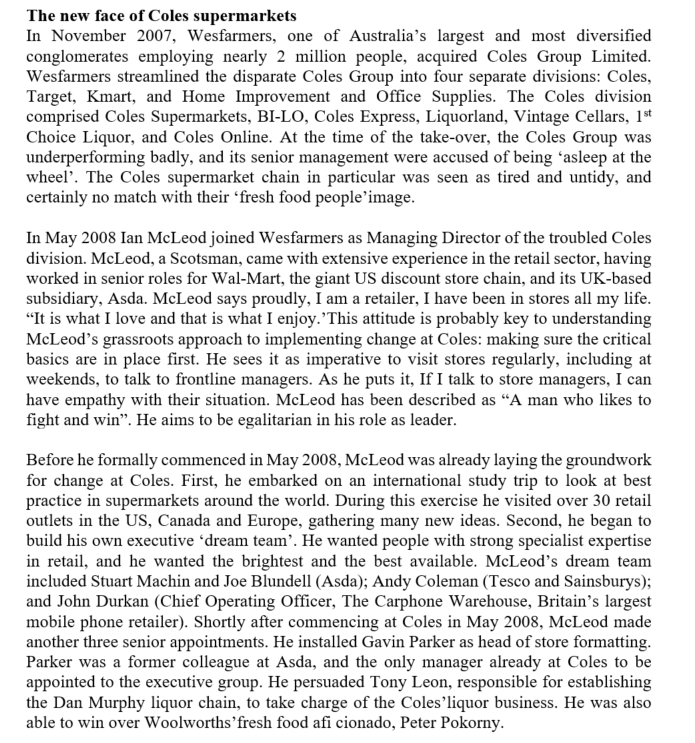
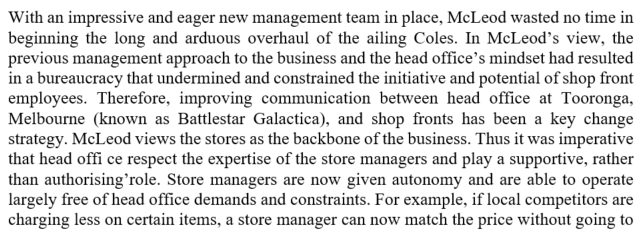
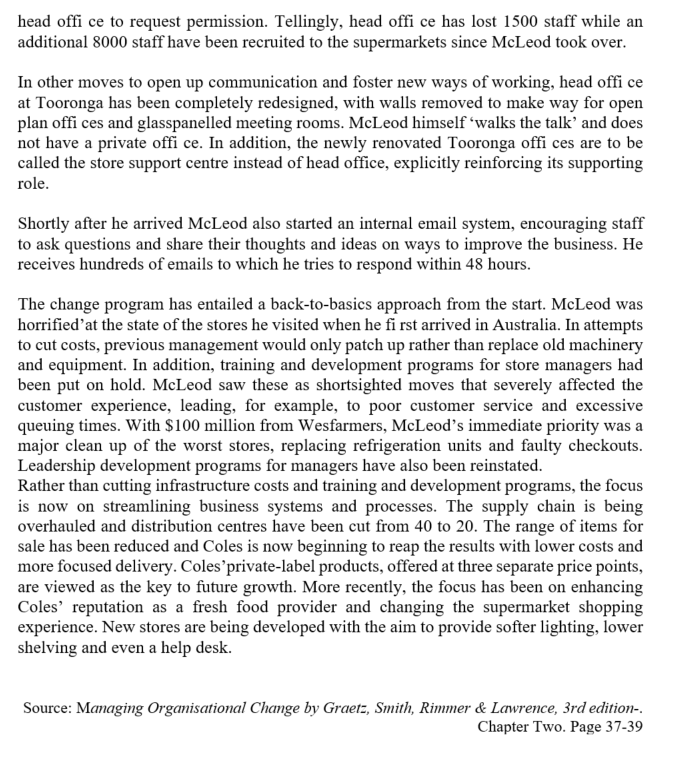
The new face of Coles supermarkets In November 2007, Wesfarmers, one of Australia's largest and most diversified conglomerates employing nearly 2 million people, acquired Coles Group Limited. Wesfarmers streamlined the disparate Coles Group into four separate divisions: Coles, Target, Kmart, and Home Improvement and Office Supplies. The Coles division comprised Coles Supermarkets, BI-LO, Coles Express, Liquorland, Vintage Cellars, 1st Choice Liquor, and Coles Online. At the time of the take-over, the Coles Group was underperforming badly, and its senior management were accused of being asleep at the wheel. The Coles supermarket chain in particular was seen as tired and untidy, and certainly no match with their fresh food peopleimage. In May 2008 Ian McLeod joined Wesfarmers as Managing Director of the troubled Coles division. McLeod, a Scotsman, came with extensive experience in the retail sector, having worked in senior roles for Wal-Mart, the giant US discount store chain, and its UK-based subsidiary, Asda. McLeod says proudly, I am a retailer, I have been in stores all my life. It is what I love and that is what I enjoy.'This attitude is probably key to understanding McLeod's grassroots approach to implementing change at Coles: making sure the critical basics are in place first. He sees it as imperative to visit stores regularly, including at weekends, to talk to frontline managers. As he puts it, If I talk to store managers, I can have empathy with their situation. McLeod has been described as "A man who likes to fight and win. He aims to be egalitarian in his role as leader. Before he formally commenced in May 2008, McLeod was already laying the groundwork for change at Coles. First, he embarked on an international study trip to look at best practice in supermarkets around the world. During this exercise he visited over 30 retail outlets in the US, Canada and Europe, gathering many new ideas. Second, he began to build his own executive dream team'. He wanted people with strong specialist expertise in retail, and he wanted the brightest and the best available. McLeod's dream team included Stuart Machin and Joe Blundell (Asda); Andy Coleman (Tesco and Sainsburys); and John Durkan (Chief Operating Officer, The Carphone Warehouse, Britain's largest mobile phone retailer). Shortly after commencing at Coles in May 2008, McLeod made another three senior appointments. He installed Gavin Parker as head of store formatting. Parker was a former colleague at Asda, and the only manager already at Coles to be appointed to the executive group. He persuaded Tony Leon, responsible for establishing the Dan Murphy liquor chain, to take charge of the Colesliquor business. He was also able to win over Woolworths' fresh food afi cionado, Peter Pokorny. With an impressive and eager new management team in place, McLeod wasted no time in beginning the long and arduous overhaul of the ailing Coles. In McLeod's view, the previous management approach to the business and the head office's mindset had resulted in a bureaucracy that undermined and constrained the initiative and potential of shop front employees. Therefore, improving communication between head office at Tooronga, Melbourne (known as Battlestar Galactica), and shop fronts has been a key change strategy. McLeod views the stores as the backbone of the business. Thus it was imperative that head offi ce respect the expertise of the store managers and play a supportive, rather than authorisingrole. Store managers are now given autonomy and are able to operate largely free of head office demands and constraints. For example, if local competitors are charging less on certain items, a store manager can now match the price without going to head offi ce to request permission. Tellingly, head offi ce has lost 1500 staff while an additional 8000 staff have been recruited to the supermarkets since McLeod took over. In other moves to open up communication and foster new ways of working, head office at Tooronga has been completely redesigned, with walls removed to make way for open plan offices and glasspanelled meeting rooms. McLeod himself walks the talk' and does not have a private office. In addition, the newly renovated Tooronga offi ces are to be called the store support centre instead of head office, explicitly reinforcing its supporting role. Shortly after he arrived McLeod also started an internal email system, encouraging staff to ask questions and share their thoughts and ideas on ways to improve the business. He receives hundreds of emails to which he tries to respond within 48 hours. The change program has entailed a back-to-basics approach from the start. McLeod was horrifiedat the state of the stores he visited when he first arrived in Australia. In attempts to cut costs, previous management would only patch up rather than replace old machinery and equipment. In addition, training and development programs for store managers had been put on hold. McLeod saw these as shortsighted moves that severely affected the customer experience, leading, for example, to poor customer service and excessive queuing times. With $100 million from Wesfarmers, McLeod's immediate priority was a major clean up of the worst stores, replacing refrigeration units and faulty checkouts. Leadership development programs for managers have also been reinstated. Rather than cutting infrastructure costs and training and development programs, the focus is now on streamlining business systems and processes. The supply chain is being overhauled and distribution centres have been cut from 40 to 20. The range of items for sale has been reduced and Coles is now beginning to reap the results with lower costs and more focused delivery. Colesprivate-label products, offered at three separate price points, are viewed as the key to future growth. More recently, the focus has been on enhancing Coles' reputation as a fresh food provider and changing the supermarket shopping experience. New stores are being developed with the aim to provide softer lighting, lower shelving and even a help desk. Source: Managing Organisational Change by Graetz, Smith, Rimmer & Lawrence, 3rd edition- Chapter Two. Page 37-39Step by Step Solution
There are 3 Steps involved in it
1 Expert Approved Answer
Step: 1 Unlock

Question Has Been Solved by an Expert!
Get step-by-step solutions from verified subject matter experts
Step: 2 Unlock
Step: 3 Unlock
 Study Help