







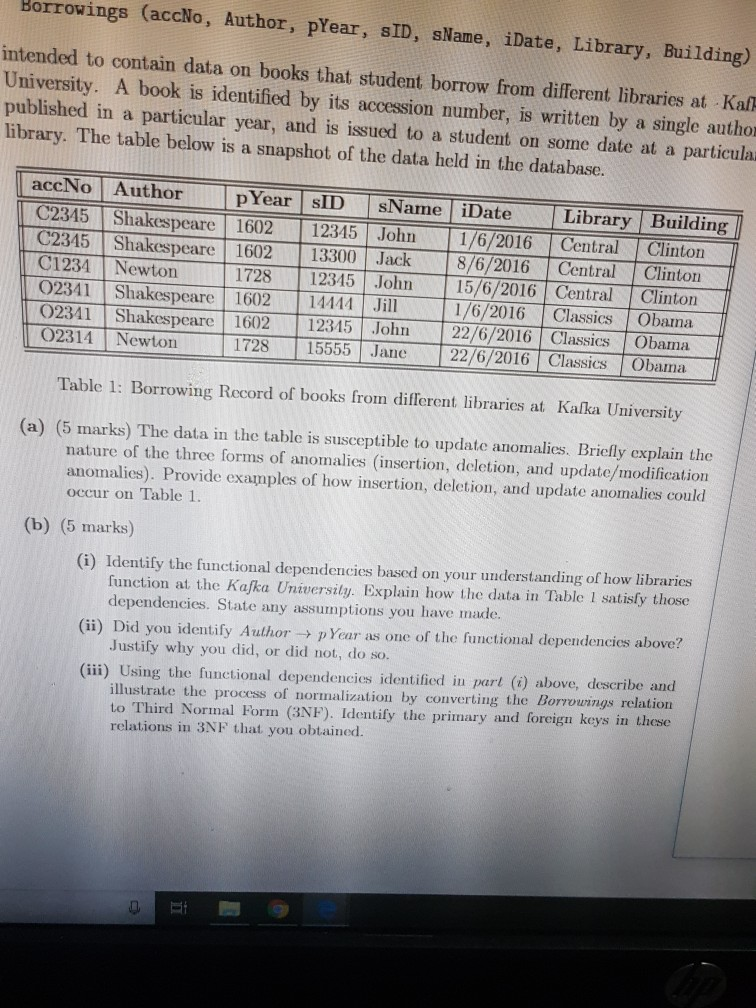
Question: question from pastpaper 2016 transform into 3nf table , most answers i see as examples are wrong because they dont use a composite key. In
question from pastpaper 2016
transform into 3nf table , most answers i see as examples are wrong because they dont use a composite key. In this case accNo and sID are composite key because none of them are unique
Borrowings (accNo, Author, pYear, sID, sName, iDate, Library, Building) intended to contain data on books that student borrow from different libraries at Ka University. A book is identified by its accession number, is written by a single author year, and is issued to a student on some date at a particula library. The table below is a snapshot of the data held in the database. accNo Author pYear SID Nme iDatei Library Building C2345 Shakespeare 160212345 John 1 CentralClinton C2345 Shakespeare 1602 13300 Jack 86/2016 Central Clintor C1234 Newton 1/6/2016 1728 12315 John 15/6/2016 Central Clinton 1/6/2016 Classics Obama 02341 Shakespeare 1602 1411 Jill 02341 Shakespeare 160212315 John 22/6/2016sis Obama 02311 Newton1725 15555 Janc22/6 2016 Classics Obana 02314 Newton Table 1: Borrowing Record of books from different libraries at Kalka University (a) (5 marks) The data in the table is susceptible to update anomalies. Briefly explain the nature of the three forms of anomalies (insertion, deletion, and update/modification anomalies). Provide examples of how insertion, deletion, and update anomalies could occur on Table 1. (b) (5 marks) (i) Identify the functional dependencies based on your understanding of how libraries (ii) Did you identify Author p Year as one of the functional dependencies above? (ii) Using the functional dependencics identified in part () above, describe and function at the Kafka Universily. Explain how the data in Table 1 satisfy those dependencies. State any assumptions you have made Justify why you did, or did not, do so. illustrate the process of normalization by converting the Borrouings relation to Third Normal Form (3NF). Identify the primary and forcign keys in these relations in 3NF that you obtained
Step by Step Solution
There are 3 Steps involved in it

Get step-by-step solutions from verified subject matter experts
 Study Help