



Question: Question: How does Best Buys social responsibility efforts impact key stakeholders such as employees, shareholders, consumers, and suppliers? CASE 20 Best Buy Fights Against Electronic
Question:
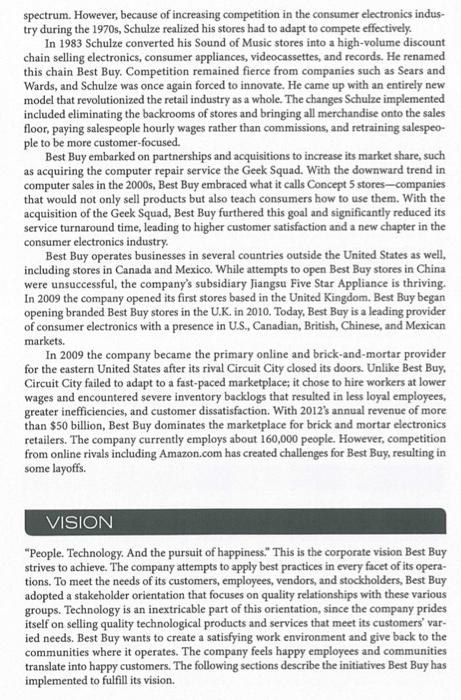
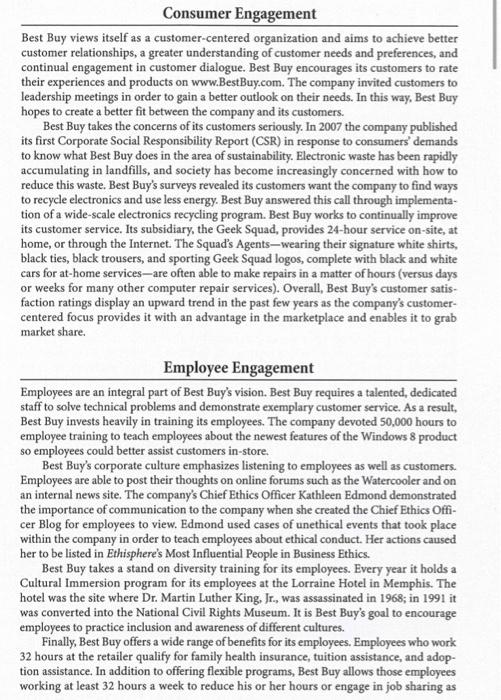
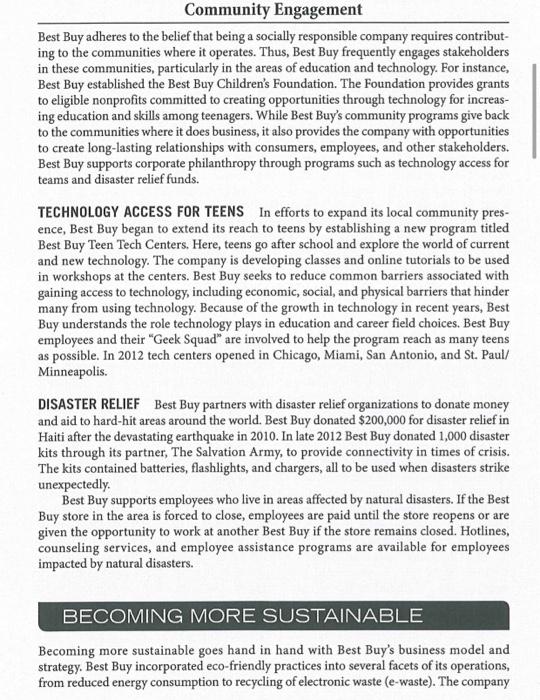
CASE 20 Best Buy Fights Against Electronic Waste* Although Best Buy has not been in business as long as other established brands, the com- pany is a well-known name both within and outside the United States. This consumer electronics retailer is the largest specialty retailer within its sector throughout the United States. To maintain its competitive advantage against rivals in specialty electronics, Best Buy began investigating competitive pricing strategies, international expansion, and the targeting of a younger demographic. In addition to its discounted and high-quality products, Best Buy became known for its customer-centered approach and sustainable outreach. After realizing the importance of sustainability to its customers, Best Buy implemented an extensive recycling program. In the process, Best Buy earned itself a name as a socially responsible company. The company adopted programs and systems to provide flexibility and aid to its employees. As a result of its corporate and social responsibility initiatives, Best Buy has been awarded numerous honors, including Ethisphere's World's Most Ethical Companies and Forbes America's Most Reputable Companies. This case provides a brief history of Best Buy, including details on its expansion and the models it implemented to become the success it is today. Next, we discuss Best Buy's vision, along with the actions the company is taking to turn its vision into a reality. We briefly analyze Best Buy's community Outreach programs. We look at Best Buy's large-scale envi- ronmental initiatives, particularly those regarding energy savings and recycling. Finally. we examine some of the challenges Best Buy is encountering as it struggles to maintain its dominance in the consumer electronics market. HISTORY Best Buy has undergone a number of changes over the course of its 40-year history. The company was founded by Richard Schulze, who worked as a representative for a consumer- electronics manufacturer. Schulze recognized that a demand existed among college-age consumers for audio equipment, and in 1966 he opened an audio specialty store called Sound of Music in the Twin Cities (Minnesota) area. A year later, the company acquired the Kencraft Hi-Fi Company. The company continued to grow and flourish over the next few years, hitting $1 million in annual revenue by 1970. Best Buy's equipment was origi- nally targeted to college students who wanted electronic goods at the higher end of the "This case was developed by Jennifer Sawayda and Danielle Jolley for and under the direction of O. C Ferrell and Linda Ferrell. Amanda Solosky and Shelby Peters contributed to a previous edition of this case. It was prepared for classroom discussion rather than to illustrate effective or ineffective handling of an administrative, ethical, or legal decision by management. All sources used for this case were obtained through publicly available material spectrum. However, because of increasing competition in the consumer electronics indus- try during the 1970s, Schulze realized his stores had to adapt to compete effectively. In 1983 Schulze converted his Sound of Music stores into a high-volume discount chain selling electronics, consumer appliances, videocassettes, and records. He renamed this chain Best Buy. Competition remained fierce from companies such as Sears and Wards, and Schulze was once again forced to innovate. He came up with an entirely new model that revolutionized the retail industry as a whole. The changes Schulze implemented included eliminating the backrooms of stores and bringing all merchandise onto the sales floor, paying salespeople hourly wages rather than commissions, and retraining salespeo- ple to be more customer-focused. Best Buy embarked on partnerships and acquisitions to increase its market share, such as acquiring the computer repair service the Geek Squad. With the downward trend in computer sales in the 2000s, Best Buy embraced what it calls Concept 5 stores-companies that would not only sell products but also teach consumers how to use them. With the acquisition of the Geek Squad, Best Buy furthered this goal and significantly reduced its service turnaround time, leading to higher customer satisfaction and a new chapter in the consumer electronics industry, Best Buy operates businesses in several countries outside the United States as well, including stores in Canada and Mexico. While attempts to open Best Buy stores in China were unsuccessful, the company's subsidiary Jiangsu Five Star Appliance is thriving. In 2009 the company opened its first stores based in the United Kingdom. Best Buy began opening branded Best Buy stores in the U.K. in 2010. Today, Best Buy is a leading provider of consumer electronics with a presence in U.S. Canadian, British, Chinese, and Mexican markets. In 2009 the company became the primary online and brick-and- mortar provider for the eastern United States after its rival Circuit City closed its doors. Unlike Best Buy, Circuit City failed to adapt to a fast-paced marketplace; it chose to hire workers at lower wages and encountered severe inventory backlogs that resulted in less loyal employees, greater inefficiencies, and customer dissatisfaction. With 2012's annual revenue of more than $50 billion, Best Buy dominates the marketplace for brick and mortar electronics retailers. The company currently employs about 160,000 people. However, competition from online rivals including Amazon.com has created challenges for Best Buy, resulting in some layoffs. VISION "People. Technology. And the pursuit of happiness." This is the corporate vision Best Buy strives to achieve. The company attempts to apply best practices in every facet of its opera- tions. To meet the needs of its customers, employees, vendors, and stockholders, Best Buy adopted a stakeholder orientation that focuses on quality relationships with these various groups. Technology is an inextricable part of this orientation, since the company prides itself on selling quality technological products and services that meet its customers' var- ied needs. Best Buy wants to create a satisfying work environment and give back to the communities where it operates. The company feels happy employees and communities translate into happy customers. The following sections describe the initiatives Best Buy has implemented to fulfill its vision. Consumer Engagement Best Buy views itself as a customer-centered organization and aims to achieve better customer relationships, a greater understanding of customer needs and preferences, and continual engagement in customer dialogue. Best Buy encourages its customers to rate their experiences and products on www.BestBuy.com. The company invited customers to leadership meetings in order to gain a better outlook on their needs. In this way, Best Buy hopes to create a better fit between the company and its customers. Best Buy takes the concerns of its customers seriously. In 2007 the company published its first Corporate Social Responsibility Report (CSR) in response to consumers' demands to know what Best Buy does in the area of sustainability. Electronic waste has been rapidly accumulating in landfills, and society has become increasingly concerned with how to reduce this waste. Best Buy's surveys revealed its customers want the company to find ways to recycle electronics and use less energy. Best Buy answered this call through implementa- tion of a wide-scale electronics recycling program. Best Buy works to continually improve its customer service. Its subsidiary, the Geek Squad, provides 24-hour service on-site, at home, or through the Internet. The Squad's Agents-wearing their signature white shirts, black ties, black trousers, and sporting Geek Squad logos, complete with black and white cars for at-home servicesare often able to make repairs in a matter of hours (versus days or weeks for many other computer repair services). Overall, Best Buy's customer satis- faction ratings display an upward trend in the past few years as the company's customer- centered focus provides it with an advantage in the marketplace and enables it to grab market share. Employee Engagement Employees are an integral part of Best Buy's vision. Best Buy requires a talented, dedicated staff to solve technical problems and demonstrate exemplary customer service. As a result, Best Buy invests heavily in training its employees. The company devoted 50,000 hours to employee training to teach employees about the newest features of the Windows 8 product so employees could better assist customers in-store. Best Buy's corporate culture emphasizes listening to employees as well as customers. Employees are able to post their thoughts on online forums such as the Watercooler and on an internal news site. The company's Chief Ethics Officer Kathleen Edmond demonstrated the importance of communication to the company when she created the Chief Ethics Offi- cer Blog for employees to view. Edmond used cases of unethical events that took place within the company in order to teach employees about ethical conduct. Her actions caused her to be listed in Ethisphere's Most Influential People in Business Ethics. Best Buy takes a stand on diversity training for its employees. Every year it holds a Cultural Immersion program for its employees at the Lorraine Hotel in Memphis. The hotel was the site where Dr. Martin Luther King, Jr., was assassinated in 1968; in 1991 it was converted into the National Civil Rights Museum. It is Best Buy's goal to encourage employees to practice inclusion and awareness of different cultures. Finally, Best Buy offers a wide range of benefits for its employees. Employees who work 32 hours at the retailer qualify for family health insurance, tuition assistance, and adop- tion assistance. In addition to offering flexible programs, Best Buy allows those employees working at least 32 hours a week to reduce his or her hours or engage in job sharing as Community Engagement Best Buy adheres to the belief that being a socially responsible company requires contribut- ing to the communities where it operates. Thus, Best Buy frequently engages stakeholders in these communities, particularly in the areas of education and technology. For instance, Best Buy established the Best Buy Children's Foundation. The Foundation provides grants to eligible nonprofits committed to creating opportunities through technology for increas- ing education and skills among teenagers. While Best Buy's community programs give back to the communities where it does business, it also provides the company with opportunities to create long-lasting relationships with consumers, employees, and other stakeholders. Best Buy supports corporate philanthropy through programs such as technology access for teams and disaster relief funds. TECHNOLOGY ACCESS FOR TEENS In efforts to expand its local community pres- ence, Best Buy began to extend its reach to teens by establishing a new program titled Best Buy Teen Tech Centers. Here, teens go after school and explore the world of current and new technology. The company is developing classes and online tutorials to be used in workshops at the centers. Best Buy seeks to reduce common barriers associated with gaining access to technology, including economic, social, and physical barriers that hinder many from using technology. Because of the growth in technology in recent years, Best Buy understands the role technology plays in education and career field choices. Best Buy employees and their "Geek Squad" are involved to help the program reach as many teens as possible. In 2012 tech centers opened in Chicago, Miami, San Antonio, and St. Paul/ Minneapolis. DISASTER RELIEF Best Buy partners with disaster relief organizations to donate money and aid to hard-hit areas around the world. Best Buy donated $200,000 for disaster relief in Haiti after the devastating earthquake in 2010. In late 2012 Best Buy donated 1,000 disaster kits through its partner, The Salvation Army, to provide connectivity in times of crisis. The kits contained batteries, flashlights, and chargers, all to be used when disasters strike unexpectedly. Best Buy supports employees who live in areas affected by natural disasters. If the Best Buy store in the area is forced to close, employees are paid until the store reopens or are given the opportunity to work at another Best Buy if the store remains closed. Hotlines, counseling services, and employee assistance programs are available for employees impacted by natural disasters. BECOMING MORE SUSTAINABLE Becoming more sustainable goes hand in hand with Best Buy's business model and strategy. Best Buy incorporated eco-friendly practices into several facets of its operations, from reduced energy consumption to recycling of electronic waste (e-waste). The company also incorporates innovative eco-friendly inventions into its product line. For instance, Best Buy began selling electric bicycles and providing charging stations for Ford Motor Company's electric cars. To reduce its environmental footprint, Best Buy formed partner- ships with other companies such as Energy Star. Best Buy joined with SmartWay Transport to reduce greenhouse gas emissions. SmartWay Transport is a collaboration between the Environmental Protection Agency and the freight industry with the goal of reducing waste and becoming more energy efficient. Best Buy began to enforce ethical and sustainable practices among its vendors. Suppli- ers must adhere to the company's Supplier Compliance Standards, and to ensure compli- ance, Best Buy audits its various suppliers each year. Factories found to have violations are dealt with accordingly, those that do not improve sufficiently in the designated time frame may be dropped. To ensure suppliers are not abusing worker rights, Best Buy conducts ongoing human rights audits. CONSERVING ENERGY ONE STORE AT A TIME One area of particular concern to Best Buy is energy consumption. Realizing its stores consume large quantities of energy-some that could be conserved through more sustain- able practices --Best Buy joined the Business for Innovative Climate and Energy (BICEP) in February 2010. BICEP is a coalition of companies wanting to advance climate and energy policies within the United States. The focus of BICEP is on embracing innovation in sustainability. According to Best Buy Senior Director of Government Relations, this is one step toward Best Buy's commitment for promoting sustainability both inside the com- pany and among consumers. As part of Best Buy's energy conservation program, the company set the goal of reduc- ing carbon emissions 20 percent per square foot by 2020. The company's action plan includes improving lighting in its stores through skylights, implementing a "no-idling policy prohibiting trucks from running their engines outside Best Buy locations, and investigating new energy-saving technologies such as virtual servers and surge protectors/ power bars. Additionally, in 2010 Best Buy created an everyday in-store recycling program in U.S.stores with a goal of increasing its recycling rate to 1 billion consumer products in five to six years. That year Best Buy collected more than 75 million pounds of electronic waste for recycling. These changes improved Best Buy's ability to become more sustainable through energy conservation and recycling. ENVIRONMENTAL SUSTAINABILITY- ENERGY STAR PRODUCTS In addition to saving energy in its operations, Best Buy sells energy-saving prod. ucts. Best Buy's extensive partnership with Energy Star saves its customers money on energy costs and helps the environment by selling energy-efficient items. Energy Star- qualified products meet strict efficiency guidelines set by the U.S. Department of Energy and the Environmental Protection Agency. It has been estimated that Energy Star products-including compact fluorescent lights and lighting fixtures-reduce greenhouse gas emissions by 46 million metric tons and saves consumers $6.4 billion in electric bills. During 2008 Best Buy employees underwent Energy Star training so they can provide consumers with detailed information on Energy Star products. In 2009 Best Buy won the Energy Star Excellence in Electronic and Appliance Retailing award for its commitment to saving energy. Best Buy offers everything from refrigerators to laptops to printers that are Energy Star-qualified. COMBATING E-WASTE As the world moves toward sustainability, the issue of e-waste takes on an increased importance among consumers. Best Buy surveys revealed that both its employees and consumers are concerned about the growing amount of electronic waste that occurs after an item breaks or, more frequently, becomes obsolete. Without any clear idea of how to recycle these electronic items, consumers were often forced to throw them away-contributing to a greater amount of e-waste in landfills. Stakeholders desired programs that could help them determine how to recycle their used electronics, and Best Buy met that demand with its Best Buy Consumer Electronics Recycling Program. This program brought the recycling of electronic waste to a whole new level. Consum- ers drop off their used electronics and Best Buy recycles them regardless of their con- dition or brand. If Best Buy does not recycle a specific product, it helps the customer find a way to recycle it. The tech trade-in service prints out a shipping label so custom- ers can send their unwanted products to places that will recycle the item. The stores take cell phones, DVD players, and most other electronic products. Electronics over 32 inches in size used to cost $10 to recycle, although customers were given a $10 Best Buy gift card to replace the money spent on recycling them. However, in late 2011 Best Buy eliminated this $10 fee. Now consumers can drop off electronics at Best Buy loca- tions free of charge. This is a step toward Best Buy's goal to recycle 1 billion pounds of e-waste by 2014 Other resources Best Buy uses in its large-scale recycling initiatives are its trade-in program, recycling kiosks, and TV and appliance pickup service. The trade-in program offers consumers two options: trading electronics online or in-store. The online system accepts a wider variety of product trade-ins. After inputting the product information, consumers are provided with a trade-in value and can accept or decline the value offered. If they accept consumers print a prepaid shipping label and ship the item. They receive a Best Buy gift card or check within 14 days after Best Buy receives the item. The trade- in system allows consumers to exchange an item and use the store credit to buy a newer model of a similar item. The in-store option follows similar steps, although it only allows trade-ins of iPods, mobile phones, and laptops. Recycling kiosks have become a familiar site at Best Buy stores. Every Best Buy in the United States now has recycling kiosks located near the front entrance. The kiosks are used to recycle small items including rechargeable batteries, cell phones, and ink cartridges. During 2009 Best Buy installed recycling kiosks across its stores in Canada as well. Best Buy also offers haul-away services for large items. If a customer buys a television from Best Buy and has it delivered, Best Buy offers to haul the old television away and recycle it for free. If consumers want to hire Best Buy to haul a large item off without a purchase, Best Buy charges a $100 fee. This is Best Buy's attempt to gain environmentally conscious customers. The company is dedicated to its mission of recycling unwanted materials and, if possible, giving the products a second life. As part of this mission, since 2003 Best Buy has been a member of the Environmental Protection Agency's Plug Into eCycling program that is committed to increasing consumer awareness about the impor- tance of recycling. Managing such an extensive recycling program requires that Best Buy collaborate with other organizations committed to the same cause. As a result, Best Buy has part- nered with various recycling companies, many that attempt to give used electronics a "second life." Several of Best Buy's recycling partners take the items apart and organize them into plastics, metals, glass, etc. Then they decide whether the products can be repaired before recycling the parts for other uses. To ensure its partners are acting in a socially responsible manner , Best Buy monitors recyclers to make sure they follow safe recycling practices. These partnerships serve to reduce pollution by keeping items out of landfills. RECYCLING PROGRAM BENEFITS The environmental benefits of recycling are quite clear--reduction in waste, decreased gas emissions, energy-savings, and more. However, as Best Buy demonstrates, recycling can have positive implications for the business world as well. For example, if a product like a cell phone can be fixed, it can be sent to outlets like eBay who can resell the product. If not, the products are taken apart so the materials can be reused. Best Buy splits the profit made from recycled products with its partners. Recycling programs encourage manufacturers to take greater responsibility in product design. With the growing demand for sustainability, many manufacturing com- panies began to embark on new and innovative designs to make their products more recyclable. For example, Dell began using fewer screws in its computers to make them easier to recycle. Best Buy supports this movement toward lighter recyclable electronics, as demonstrated by product offerings like its organic LED (OLED) televisions that are lighter and easier to recycle. Of course, with the benefits of recycling come costs as well. Televisions are heavy to handle and not as recyclable as other goods. Dealing with them costs companies like Best Buy time and money. However, Best Buy feels the connections developed between Best Buy and the community make the company's effort worth the cost. Best Buy hopes its status as a sustainable and ethical company attracts more loyal customers, aiding both its reputation and its bottom line. In 2012 Dow Jones announced Best Buy made the Dow Jones Sustainability Index for the second year in a row. The index evaluates 2,500 companies globally, including 600 within the United States and Canada. The index measures and compares companies across 57 industries on environmental, social, and corporate governance standards. To qualify for the index, the companies must score better on sustainability than most of their contem- poraries within their industry (best-in-class). The index is used by investors to evaluate sustainability leadership and risk management. Best Buy placed in the 68th percentile and increased their score from the year before by three points. CHALLENGES FOR BEST BUY Best Buy faces intense competition from retailers such as Amazon and Apple. Analysts believe the reason for this loss is based on pricing considerations. It is more common for consumers to visit Best Buy stores, find items they want, and shop for those items on Amazon or other e-commerce sites at lower prices (a practice known as showrooming). This trend is causing Best Buy to consider investigating more aggressive pricing strategies as a way to compete. Best Buy has sometimes struggled with delayed delivery services as well. During the 2011 Christmas season, many products ordered at Thanksgiving were delayed and not delivered until after Christmas. Best Buy apologized to thousands of customers and experienced a dip in customer satisfaction ratings. However, overall customer satisfaction rose to its highest score in 2012. One strategy Best Buy began to implement to combat showrooming started during the holiday season of 2012. Best Buy began a holiday-price matching policy that stated the company would match online prices in hopes to win consumers back. Deducing they could not lose any more market share to online competitors, the company decided to extend the policy indefinitely. In 2013 they implemented the price matching policy, and their stock price increased 95 percent in the next five months. They also reduced their merchandise return policy from 30 days to 15 days. Many retailers are following suit in hopes to win back customers from online competition. Best Buy faces challenges in global markets. The company's big-box retailers did not perform well in the Chinese market, causing Best Buy to abandon its nine branded stores in that country. Once again, price may have been a primary factor. Chinese consumers indi- cated that although the environment of Best Buy was much nicer than comparable retailers, the prices were too high. However, Best Buy is not abandoning China entirely. While it is shutting down its branded stores, Best Buy has expanded its Chinese subsidiary Five Star. Currently Five Star has about 200 stores and is looking to add up to 500 more by 2016. The subsidiary took a different approach when targeting China's middle class, specifically by diverging from its initial approach of emulating an American lifestyle. It began to target China's lesser known cities, where 70 percent of consumers are young families. As China's economy progresses, Best Buy is confident these stores will continue to profit. Along with its China stores, Best Buy looks to close 15 of its big-box stores in Canada, eliminating 900 jobs. This comes after closing 50 U.S. stores in 2012. Continually, sales for Best Buy have slowly declined. New CEO Hubert Joly plans to revive the company by adapting to current and projected market trends and reaching younger demographics through innovative campaigns. CORPORATE GOVERNANCE CHALLENGES Perhaps one of the greatest blows to Best Buy came with the ouster of CEO Brian Dunn, who was recognized as an ethical business leader. In April 2012, CEO Brian Dunn resigned after an internal investigation from the audit committee led to accusations he violated com- pany policy by having a close personal relationship with a female employee. The investiga- tion showed Dunn did not misuse any company resources while engaging in inappropriate How does Best Buys social responsibility efforts impact key stakeholders such as employees, shareholders, consumers, and suppliers? 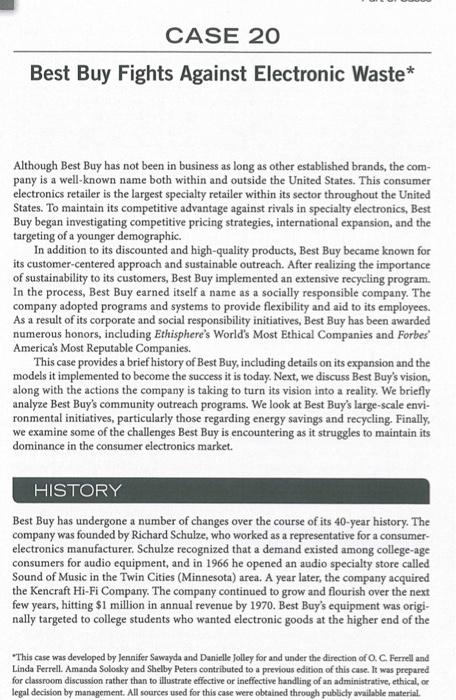
Step by Step Solution
There are 3 Steps involved in it
1 Expert Approved Answer
Step: 1 Unlock

Question Has Been Solved by an Expert!
Get step-by-step solutions from verified subject matter experts
Step: 2 Unlock
Step: 3 Unlock