







Question: Question I: Factorial design at two levels. (30 points) An experiment was conducted on an operating chemical process in which four factors were studied in
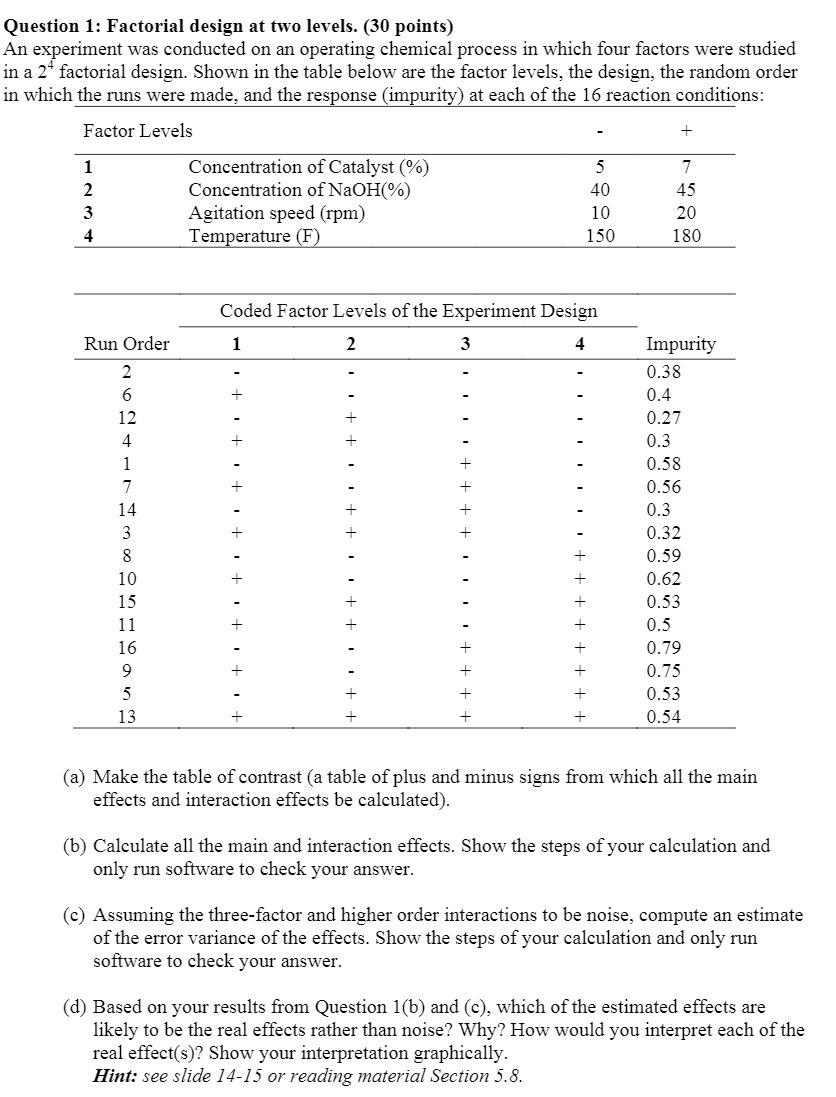
Question I: Factorial design at two levels. (30 points) An experiment was conducted on an operating chemical process in which four factors were studied in a 24 factorial desigm. Shown in the table below are the factor levels, the design], the random order in which the runs were made, and the response (impurity) at each of the 16 reaction conditions: Factor Levels - + 1 Concentration of Catalyst (9/0} 5 T 2 Concentration of NaOH(%) 40 45 3 Agitation speed {rpm} 10 20 4 Temperature (F)- 150 180 Coded Factor Levels of the Experiment Design Run Order 1 2 3 4 Impurity 2 - - - - 0.38 6 + - - - 0.4 12 - + - - 0.2? 4 + + - - 0.3 1 - - + - 0.58 7' + - + - 0.56 14 - + + - 0.3 3 + + + - 0.32 3 - - - + 0.59 10 + - - + 0.62 15 - + - + 0.53 11 + + - + 0.5 16 - - + + 0.?9 9 + - + + 0.75 5 - + + + 0.53 13 + + + 0.53r {a} Make the table of contrast (a table of plus and minus signs om which all the main effects and interaction effects be calculated). (b) Calculate all the main and interaction effects. Show the steps of your calculation and only run software to check your answer. {c} Assuming the three-factor and higher order interactions to be noise, compute an estimate of the error variance of the effects. Show the steps of your calculation and only run software to check your answer. ((1) Based on your results from Question 1(b} and (c)= which of the estimated effects are likely to be the real effects rather than noise? Why? How would you interpret each of the real effect(s)? Show your interpretation graphically. Hint: see slide 1' 445 or reading material Section 5. 8
Step by Step Solution
There are 3 Steps involved in it

Get step-by-step solutions from verified subject matter experts
 Study Help