







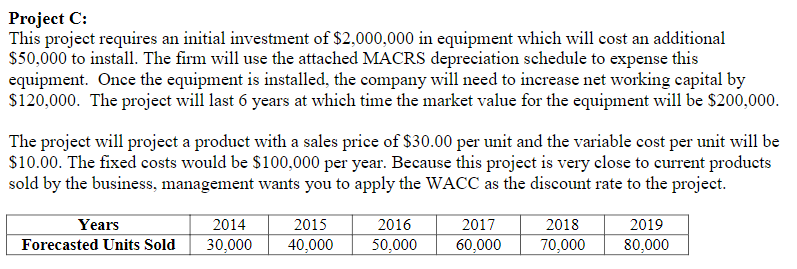
Question: Question: Instructions: Project C: This project requires an initial investment of $2,000,000 in equipment which will cost an additional $50,000 to install. The firm will
Question:
Instructions:
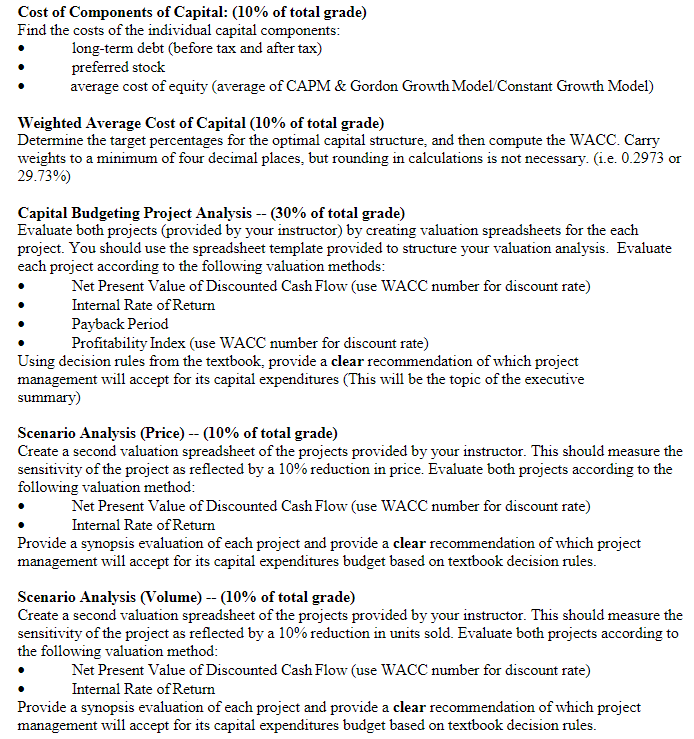
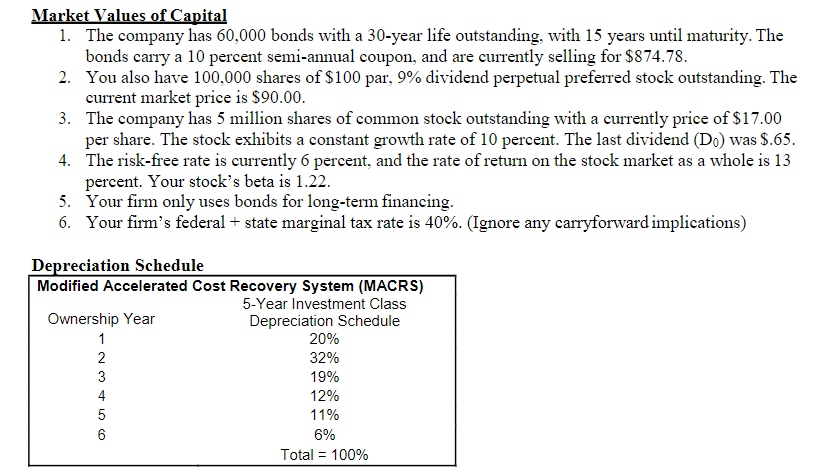
Project C: This project requires an initial investment of $2,000,000 in equipment which will cost an additional $50,000 to install. The firm will use the attached MACRS depreciation schedule to expense this equipment. Once the equipment is installed, the company will need to increase net working capital by $120,000. The project will last 6 years at which time the market value for the equipment will be $200,000. The project will project a product with a sales price of $30.00 per unit and the variable cost per unit will be $10.00. The fixed costs would be $100,000 per year. Because this project is very close to current products sold by the business, management wants you to apply the WACC as the discount rate to the project. Years Forecasted Units Sold 2014 30.000 2015 40.000 2016 50.000 2017 60.000 2018 70.000 2019 80.000 Cost of Components of Capital: (10% of total grade) Find the costs of the individual capital components: long-term debt (before tax and after tax) preferred stock average cost of equity (average of CAPM & Gordon Growth Model Constant Growth Model) Weighted Average Cost of Capital (10% of total grade) Determine the target percentages for the optimal capital structure, and then compute the WACC. Carry weights to a minimum of four decimal places, but rounding in calculations is not necessary. (1.e. 0.2973 or 29.73%) Capital Budgeting Project Analysis -- (30% of total grade) Evaluate both projects (provided by your instructor) by creating valuation spreadsheets for the each project. You should use the spreadsheet template provided to structure your valuation analysis. Evaluate each project according to the following valuation methods: Net Present Value of Discounted Cash Flow (use WACC number for discount rate) Internal Rate of Return Payback Period Profitability Index (use WACC number for discount rate) Using decision rules from the textbook, provide a clear recommendation of which project management will accept for its capital expenditures (This will be the topic of the executive summary) Scenario Analysis (Price) -- (10% of total grade) Create a second valuation spreadsheet of the projects provided by your instructor. This should measure the sensitivity of the project as reflected by a 10% reduction in price. Evaluate both projects according to the following valuation method: Net Present Value of Discounted Cash Flow (use WACC number for discount rate) Internal Rate of Return Provide a synopsis evaluation of each project and provide a clear recommendation of which project management will accept for its capital expenditures budget based on textbook decision rules. Scenario Analysis (Volume) -- (10% of total grade) Create a second valuation spreadsheet of the projects provided by your instructor. This should measure the sensitivity of the project as reflected by a 10% reduction in units sold. Evaluate both projects according to the following valuation method: Net Present Value of Discounted Cash Flow (use WACC number for discount rate) Internal Rate of Return Provide a synopsis evaluation of each project and provide a clear recommendation of which project management will accept for its capital expenditures budget based on textbook decision rules. Market Values of Capital 1. The company has 60,000 bonds with a 30-year life outstanding, with 15 years until maturity. The bonds carry a 10 percent semi-annual coupon, and are currently selling for $874.78. 2. You also have 100,000 shares of $100 par, 9% dividend perpetual preferred stock outstanding. The current market price is $90.00. 3. The company has 5 million shares of common stock outstanding with a currently price of $17.00 per share. The stock exhibits a constant growth rate of 10 percent. The last dividend (D) was $.65. 4. The risk-free rate is currently 6 percent, and the rate of return on the stock market as a whole is 13 percent. Your stock's beta is 1.22. 5. Your firm only uses bonds for long-term financing. 6. Your firm's federal + state marginal tax rate is 40%. (Ignore any carryforward implications) Depreciation Schedule Modified Accelerated Cost Recovery System (MACRS) 5-Year Investment Class Ownership Year Depreciation Schedule 20% 32% WN- 19% 12% 11% 6% Total = 100% O Project C: This project requires an initial investment of $2,000,000 in equipment which will cost an additional $50,000 to install. The firm will use the attached MACRS depreciation schedule to expense this equipment. Once the equipment is installed, the company will need to increase net working capital by $120,000. The project will last 6 years at which time the market value for the equipment will be $200,000. The project will project a product with a sales price of $30.00 per unit and the variable cost per unit will be $10.00. The fixed costs would be $100,000 per year. Because this project is very close to current products sold by the business, management wants you to apply the WACC as the discount rate to the project. Years Forecasted Units Sold 2014 30.000 2015 40.000 2016 50.000 2017 60.000 2018 70.000 2019 80.000 Cost of Components of Capital: (10% of total grade) Find the costs of the individual capital components: long-term debt (before tax and after tax) preferred stock average cost of equity (average of CAPM & Gordon Growth Model Constant Growth Model) Weighted Average Cost of Capital (10% of total grade) Determine the target percentages for the optimal capital structure, and then compute the WACC. Carry weights to a minimum of four decimal places, but rounding in calculations is not necessary. (1.e. 0.2973 or 29.73%) Capital Budgeting Project Analysis -- (30% of total grade) Evaluate both projects (provided by your instructor) by creating valuation spreadsheets for the each project. You should use the spreadsheet template provided to structure your valuation analysis. Evaluate each project according to the following valuation methods: Net Present Value of Discounted Cash Flow (use WACC number for discount rate) Internal Rate of Return Payback Period Profitability Index (use WACC number for discount rate) Using decision rules from the textbook, provide a clear recommendation of which project management will accept for its capital expenditures (This will be the topic of the executive summary) Scenario Analysis (Price) -- (10% of total grade) Create a second valuation spreadsheet of the projects provided by your instructor. This should measure the sensitivity of the project as reflected by a 10% reduction in price. Evaluate both projects according to the following valuation method: Net Present Value of Discounted Cash Flow (use WACC number for discount rate) Internal Rate of Return Provide a synopsis evaluation of each project and provide a clear recommendation of which project management will accept for its capital expenditures budget based on textbook decision rules. Scenario Analysis (Volume) -- (10% of total grade) Create a second valuation spreadsheet of the projects provided by your instructor. This should measure the sensitivity of the project as reflected by a 10% reduction in units sold. Evaluate both projects according to the following valuation method: Net Present Value of Discounted Cash Flow (use WACC number for discount rate) Internal Rate of Return Provide a synopsis evaluation of each project and provide a clear recommendation of which project management will accept for its capital expenditures budget based on textbook decision rules. Market Values of Capital 1. The company has 60,000 bonds with a 30-year life outstanding, with 15 years until maturity. The bonds carry a 10 percent semi-annual coupon, and are currently selling for $874.78. 2. You also have 100,000 shares of $100 par, 9% dividend perpetual preferred stock outstanding. The current market price is $90.00. 3. The company has 5 million shares of common stock outstanding with a currently price of $17.00 per share. The stock exhibits a constant growth rate of 10 percent. The last dividend (D) was $.65. 4. The risk-free rate is currently 6 percent, and the rate of return on the stock market as a whole is 13 percent. Your stock's beta is 1.22. 5. Your firm only uses bonds for long-term financing. 6. Your firm's federal + state marginal tax rate is 40%. (Ignore any carryforward implications) Depreciation Schedule Modified Accelerated Cost Recovery System (MACRS) 5-Year Investment Class Ownership Year Depreciation Schedule 20% 32% WN- 19% 12% 11% 6% Total = 100% O
Step by Step Solution
There are 3 Steps involved in it

Get step-by-step solutions from verified subject matter experts
 Study Help