Question: Question : Introduction challenge - to help meet the needs of the present and future generations, while creating as little negative impact as possible to
 Question :
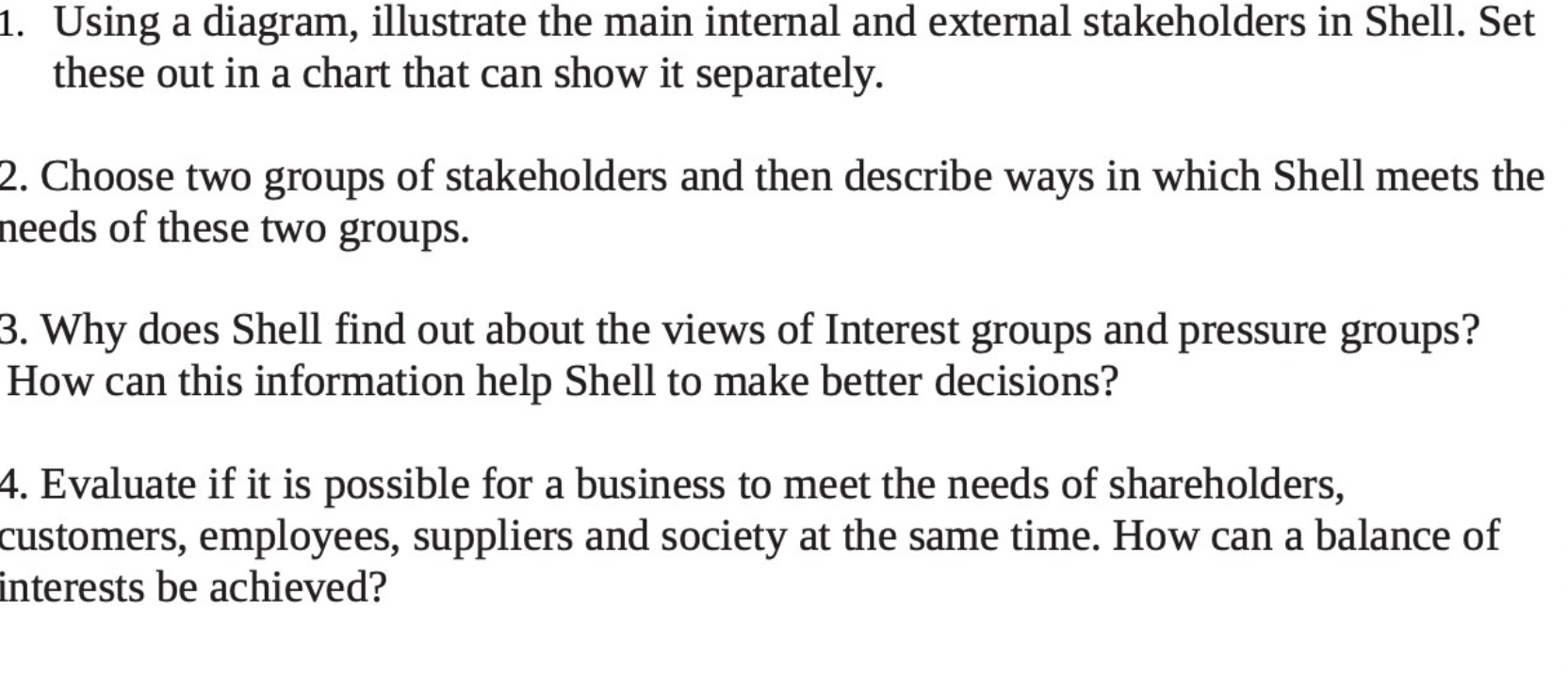
Introduction challenge - to help meet the needs of the present and future generations, while creating as little negative impact as possible to the environment. A stakeholder is anyone who has an interest in what a business does or an influence upon the business. Large organisations have many different stakeholder groups. Some are internal to the business, like employees. Others are external as they are outside of the business, like government. It is important to identify and balance the needs and expectations of these groups, and to act responsibly in view of all of them in order to avoid conflict and ensure the business is as prosperous as possible and keeps its licence to operate'. Shell aims to provide energy in responsible ways and serve all its stakeholders, customers and investors, effectively. Two key aims of the Shell Group are: 1. to engage efficiently, responsibly and profitably in oil, gas, chemicals and other businesses 2. to participate in the search for and development of other sources of energy to meet evolving customer needs and the world's growing demand for energy. Balancing the needs of all stakeholders is particularly important for large energy companies like Shell, one of the world's largest and most profitable multinational companies. It is an Anglo-Dutch company with headquarters in the Netherlands. Shell provides 2.5% of the world's oil and 3% of its natural gas. Oil and gas are non-renewable resources, but remain essential for powering the world's needs and their demand is continuously increasing. The case study examines how stakeholders influence the achievement of these aims and how Shell seeks to meet the needs of all of its stakeholders and balance the social, economic and environmental impacts of its work. Internal stakeholders Shell sells enough petrol and diesel a day to fuel 16 million cars and enough liquefied natural gas to provide electricity for 34 million homes around the world. However, energy use is increasing due to a growing world population and higher standards of living. This means more demand not only for oil and gas but also for other energy sources. Shell is therefore faced with an enormous Internal stakeholders are seen by the wider community as reflecting Shell and how it works. Shell's main internal stakeholders are its shareholders, employees and suppliers. Large businesses like Shell, Sainsbury's, Virgin, and M&S are owned by shareholders. Shareholders play a crucial part in the life of the business. They provide a sizeable part of the capital required to set up and run the business. They take a reward from a share of the profits in the form of a dividend. This varies according to how many shares they own. The shareholders choose a Board of Directors to represent them and provide a direction to the company. This is set out in a long-term plan which is called a strategy. Suppliers are also internal stakeholders who are Shell's partners in the chain of production - for example in bringing petrol from the oil well to the petrol pump. Shell has a number of core values that are central to everything it does. Shell's reputation depends on making sure that its business actions reflect these core values. Shell works with contractors and other partners in the supply chain who also demonstrate these values. If they do not, Shell will not use them. Shareholders Board of Directors The business strategy choose who create External stakeholders - customers and communities The business strategy The directors are responsible for the implementation of the strategy. Each year the directors must produce a report for shareholders. This report is presented each year at an Annual General Meeting of shareholders. External stakeholders are not part of the business but have a keen interest in what it does and influence Shell's decision-making. Shell is committed to satisfying the needs of its external stakeholders. Another important internal stakeholder group are employees. Shell employs over 100,000 people worldwide. These include senior international managers specialising in finance, marketing, sales, oil and gas exploration and other aspects of the business. Other employees include geologists, market researchers, site engineers, oil platform workers, office administrators, business analysts and many more. Customers Without customers a business would not exist. One of Shell's major objectives therefore is: 'To win and maintain customers by developing and providing products and services which offer value in terms of price, quality, safety and environmental impact, which are supported by technological, environmental and commercial expertise.' Opinion formers. . Local communities Internal stakeholders Interes Shareholders Suppliers As stakeholders, employees are influenced by Shell but also affect how Shell operates. The employees' standard of work and commitment to health and safety and excellence is vital in order to keep Shell as a leader in the energy field. Mistakes can be costly in terms of reputation and the livelihood of other employees. A priority at Shell is to respect people. It seeks to provide its staff with good and safe working conditions, and competitive terms of employment. This has a positive influence on employees as it keeps them safe and motivated. custome groups Employees External Stakeholders Honesty Achieving this objective is challenging. Customers want value for money which involves providing the highest quality fuels at competitive prices. Research drives this process. Core values Integrity Market research Product research To find out what customers want + Respect for people To find out the best ways to produce and provide the best products External stakeholders - Interest groups Safety and environmental impact are key ingredients of the research and development process. Increasingly customers, concerned about pollution and environmental damage, require cleaner, more efficient fuels such as biofuel. There is global interest in liquid biofuels for transport as people travel more. Biofuels also offer the potential to slow the rate of growth in the world's CO2 emissions. Shell responds to present changes in customer views and seeks to anticipate future customer expectations. It aims to help customers use less energy and emit less CO2. Shell products include fuels and lubricants for all forms of transport such as, cars, ships, aeroplanes and trains. Shell has a set of global environmental standards/expectations for all of its companies. Topics include: managing greenhouse gases, energy efficiency, control of waste and the impact on water. Local communities Shell's oil and gas operations aim to create economic and social development while minimising negative impacts. It seeks to invest in lasting benefits for the community. Shell needs to work with a range of interest groups. These are decision makers and opinion formers. People and organisations in positions of influence make decisions and form opinions that can affect Shell. These include academics, government, media, non- governmental organisations (NGOs) business leaders and the financial community. They interact with Shell in different ways: governments - Shell has operations in many countries across all regions of the globe. To gain approval to operate in these countries it has shown the host governments that it is operating in the right way. This includes creating jobs, paying taxes and providing important energy supplies. Shell is also working with governments to promote the need for more effective regulation on CO2 emissions. the business community - Shell supplies to and buys from hundreds of other businesses. other oil companies - Shell works in partnership on projects with many other oil companies. These include both competitors such as BP and Exxon, and partners such as government owned oil companies in the countries in which it operates. Partnership activities have included building new oil or gas supply lines and new refineries. NGOs are important bodies that influence decision-making. For example, Shell was considering drilling in 2008 for gas in British Columbia's Sacred Headwaters (the source of three important rivers). These rivers provided a source of wild salmon and other natural resources. A number of organisations were set up to protect the Headwaters including 'Friends of Wild Salmon'. Shell listened to their concerns and postponed further drilling work. the media - it is essential for competitive companies like Shell to continue to operate in ways that receive positive press coverage from newspapers, television and magazines. This reinforces its position in the market and can help to attract new customers through a positive reputation. Development of local facilities e.g. health & education Investment in the community e.g. set a good example of business practice Benefits to the community Use local contractors Create jobs for local people Local communities living close to oil refineries have raised concerns over their safety. Shell seeks to overcome these fears by earning the trust of people by taking all the necessary safety measures. This includes operating the plant safely and making people aware of plans and emergency procedures. Shell, in its commitment to improve the wellbeing of local communities, has created local partnerships. It has provided health facilities and supported the development of local schools and universities. A pressure group is a group of people with specific aims and interests which tries to influence major decision makers like businesses and governments and raise public awareness about issues. Shell talks regularly with major pressure groups such as WWF and Greenpeace about key issues such as how best to dispose of old oil rigs to minimise damage to the environment. It deals directly with specific pressure groups that are campaigning on local issues such as the unique ecosystem of the Louisiana coast in the USA. GRAND ANIVA Shell has committed over two million dollars on research and restoration of Breton Sound in Louisiana what will monitor the actual changes that occur in this area while the wetland is being restored. Economic impact Shareholders was previously used for other purposes such as timber, or agriculture, Shell looks to see if the longer term social or environmental impacts do not outweigh the financial return on that activity. Social impact Employees Communities Environmental impact The planet Shell is dedicated to protecting human rights and helping communities. The search for oil and gas can take energy companies to places with poor human rights records. It treats each case separately using decision-making methods set out by the Danish Institute for Human Rights. If Shell chooses not to operate in these areas, this opens the door for less principled competitors to exploit workers in these countries. If it stays then it can be seen to be part of the problem. Shell will only operate in countries where it is able to follow its business principles. These principles set out what Shell stands for and define its behaviour and are published on its website. Conclusion It is not easy to balance the needs of stakeholders. In order to best achieve this balance Shell recognises five areas of responsibility to: shareholders, customers, employees, suppliers and society. Shareholders and resolving conflicts Ongoing communication with all of these groups is essential. In this way it is possible to take account of everyone's needs and expectations in making decisions for today and the future. The start of the case study focussed on the importance of shareholders. Shell's main shareholders consist of large institutional stockholders, employees and the general public. Shell believes that it has a key responsibility to protect shareholders' investment, and provide a long-term return competitive with those of other leading companies in the industry. Shell, as one of the world's major companies has consistently made healthy profits. These profits have then been used productively to reward shareholders in the form of dividends and to plough back into developing new research, new products, new forms of energy for the future and better ways of managing fuel reserves. Shell has resolved and minimised conflicts between its activities and its stakeholders through its clear strategies and commitment to corporate values. By setting minimum thresholds for decision making, it is able to balance its impact in economic, social and environmental terms. This ensures that no decision will affect one stakeholder group more than others. Shell believes that it will continue to exist and grow if it can balance the needs of stakeholder groups. Shell employs three criteria in making such decisions. It assesses whether: 1. the economic impact of the activity is likely to yield a good return for shareholders 2. the social impact will be suitable for employees and communities 3. the long-term effect of its activity will harm the environment. 1. Using a diagram, illustrate the main internal and external stakeholders in Shell. Set these out in a chart that can be displayed on the classroom wall. 2. Choose two groups of stakeholders and then describe ways in which Shell meets the needs of these two groups. 3. Why does Shell find out about the views of Interest groups and pressure groups? How can this information help Shell to make better ecision 4. Evaluate if it is possible for a business to meet the needs of shareholders, customers, employees, suppliers and society at the same time. How can a balance of interests be achieved? QUESTIONS To avoid conflict, Shell sets minimum levels that must be met for all three areas before making a major decision or investment in any one. For example, when planning new activity on land that 1. Using a diagram, illustrate the main internal and external stakeholders in Shell. Set these out in a chart that can show it separately. 2. Choose two groups of stakeholders and then describe ways in which Shell meets the needs of these two groups. 3. Why does Shell find out about the views of Interest groups and pressure groups? How can this information help Shell to make better decisions? 4. Evaluate if it is possible for a business to meet the needs of shareholders, customers, employees, suppliers and society at the same time. How can a balance of interests be achieved









 Study Help