







Question: question is below: 4. Classify the differential equation (2), the equation with harvesting. Is it linear? What is its order? Is it autonomous? Describe the
question is below:

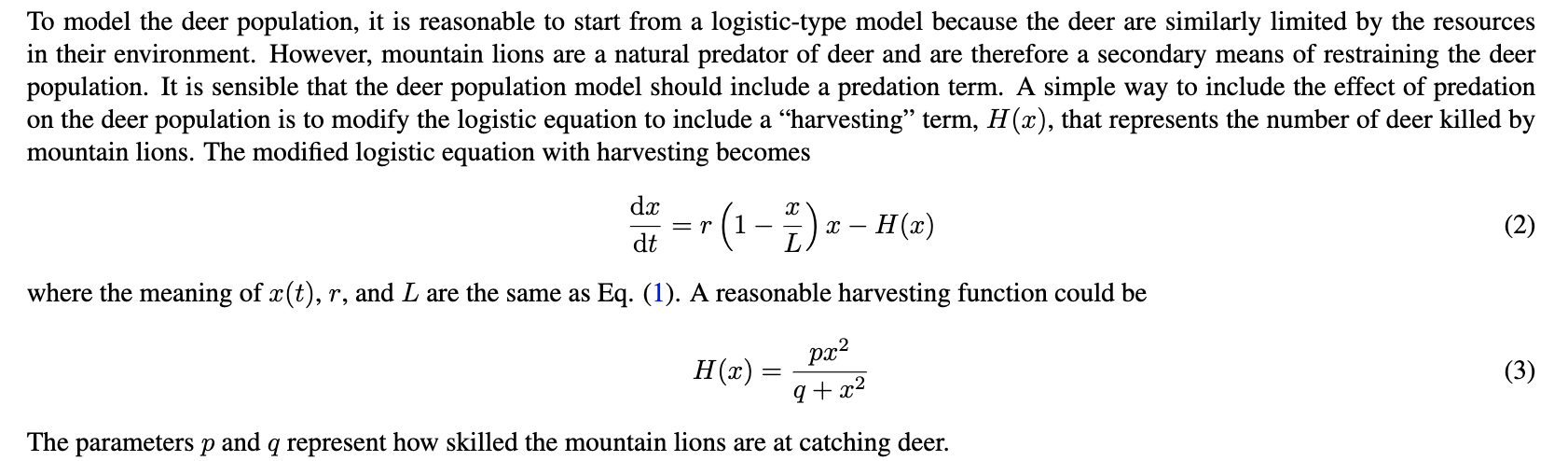
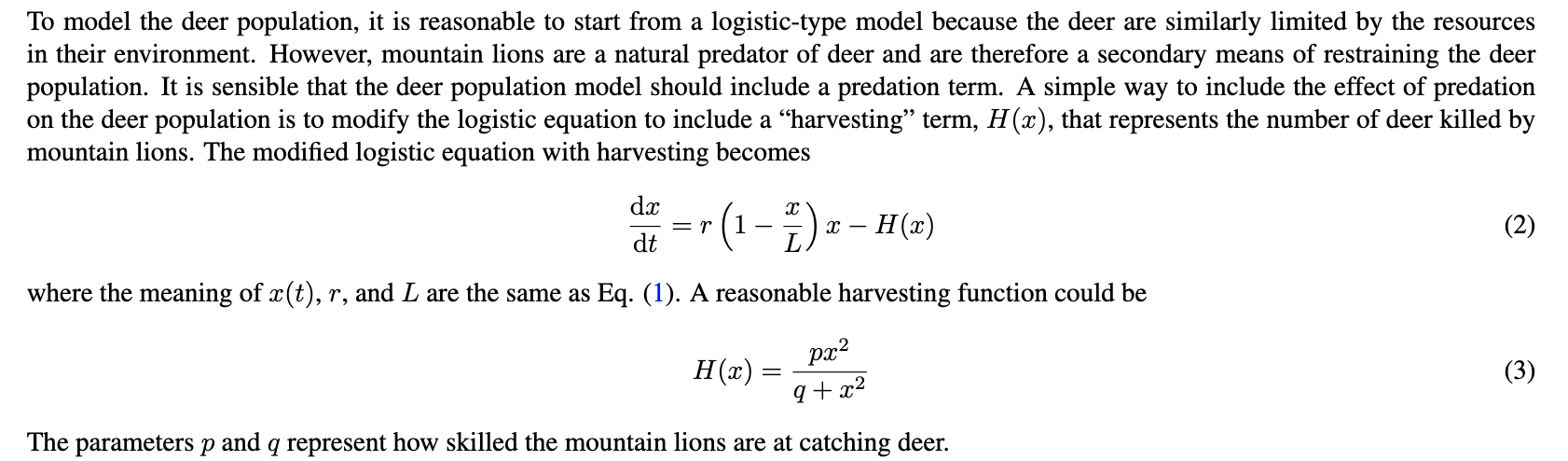
4. Classify the differential equation (2), the equation with harvesting. Is it linear? What is its order? Is it autonomous? Describe the physical meaning of autonomy or non-autonomy for this equation. 5. Explore the behavior of the harvesting function (3) (a plot might help). What happens to H (at) as :6 becomes very large? What if a: is close to 0? Does this make sense physically? Explain. To model the deer population, it is reasonable to start from a logistic-type model because the deer are similarly limited by the resources in their environment. However, mountain lions are a natural predator of deer and are therefore a secondary means of restraining the deer population. It is sensible that the deer population model should include a predation term. A simple way to include the effect of predation on the deer population is to modify the logistic equation to include a \"harvesting" term, H (as) that represents the number of deer killed by mountain lions, The modied logistic equation with harvesting becomes die x a=1~(1E)$H(m) (2) where the meaning of 9303), 7', and L are the same as Eq. (1). A reasonable harvesting function could be 2 _ Pm H06) q +932 (3) The parameters 10 and (1 represent how skilled the mountain lions are at catching deer
Step by Step Solution
There are 3 Steps involved in it

Get step-by-step solutions from verified subject matter experts
 Study Help