







Question: Question is shown in image below: 4. (10 points) Consider the twoplayer bargaining game discussed in class in which the two players make alternating offers
Question is shown in image below:
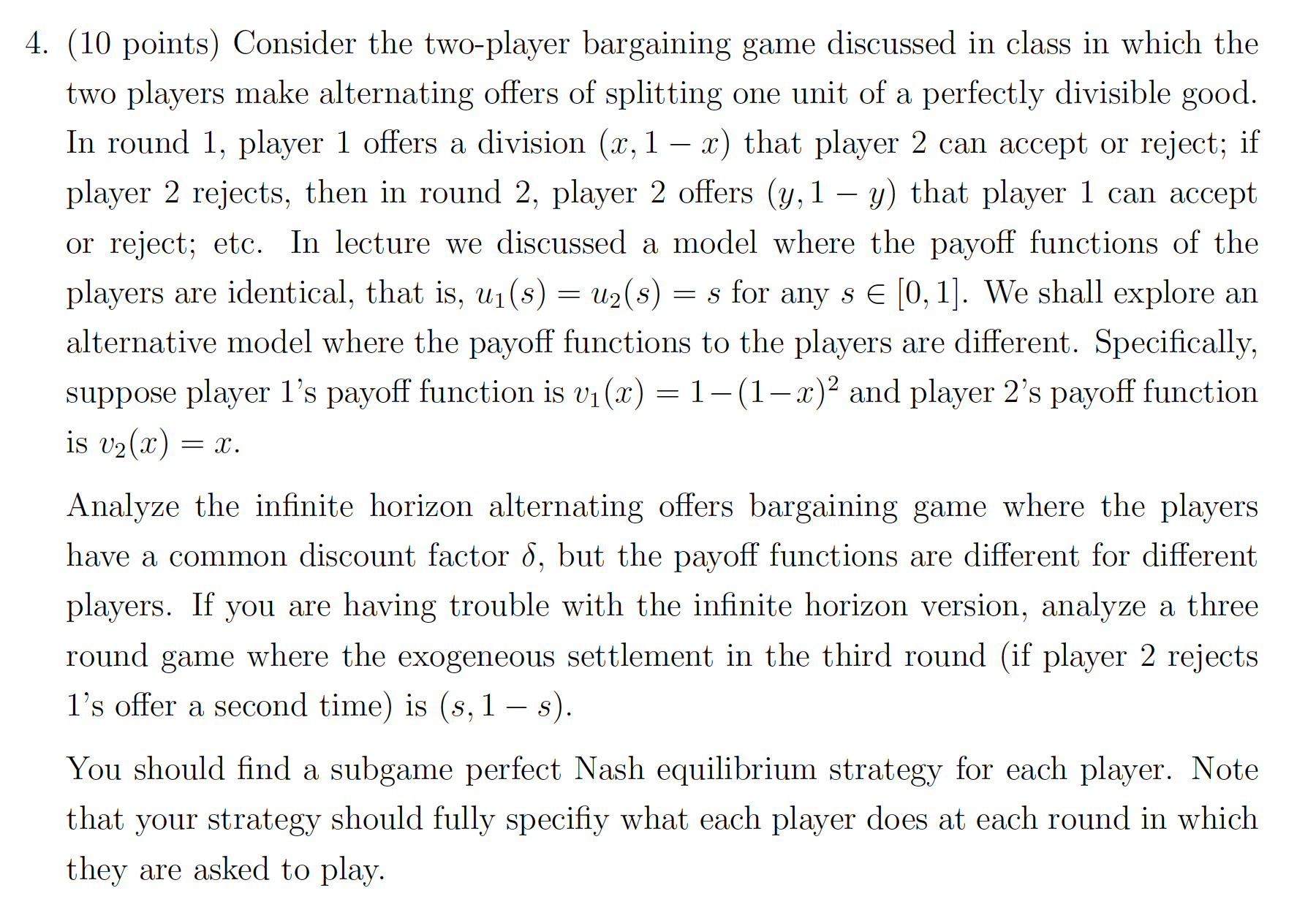
4. (10 points) Consider the twoplayer bargaining game discussed in class in which the two players make alternating offers of splitting one unit of a perfectly divisible good. In round 1, player 1 offers a division (113,1 2:) that player 2 can accept or reject; if player 2 rejects, then in round 2, player 2 offers (y, 1 y) that player 1 can accept or reject; etc. In lecture we discussed a model where the payoff functions of the players are identical, that is, u1(3) 2 152(3) = s for any 3 E [0, 1]. We shall explore an alternative model where the payoff functions to the players are different. Specically, suppose player 1's payoff function is v1(x) = 1 (1 a:)2 and player 2's payoff function is 11201:) = 2:. Analyze the innite horizon alternating offers bargaining game where the players have a common discount factor (5, but the payoff functions are different for different players. If you are having trouble with the innite horizon version, analyze a three round game where the exogeneous settlement in the third round (if player 2 rejects 1's offer a second time) is (s, 1 8). You should nd a subgame perfect Nash equilibrium strategy for each player. Note that your strategy should fully speciy what each player does at each round in which they are asked to play
Step by Step Solution
There are 3 Steps involved in it

Get step-by-step solutions from verified subject matter experts
 Study Help