







Question: Question: Leave X alone an irregular variable with thickness fx(x) = (I/4)x 0 x and let Y = X+ 3. (a) Discover EN, and afterward
Question:
Leave X alone an irregular variable with thickness fx(x) = (I/4)x 0 x and let Y = X+ 3. (a) Discover EN, and afterward utilize the principles for assumption to discover E[Y].
(b) Discover the thickness for Y.
(c) Utilize the thickness for Y to discover Period and contrast your answer with that found to a limited extent (a).
Question 26
Let Xdenote the slack time in a printing line at a specific PC community. That is, X means the distinction between the time that a program is set in the line and the time at which printing starts. Expect that Xis ordinarily appropriated with mean 15 minutes and difference 25.
(a) Discover the articulation for the thickness for X.
(b) Discover the likelihood that a program will arrive at the printer inside 3 minutes of showing up in the line.
(c) Would it be uncommon for a program to remain in the line somewhere in the range of 10 and 20 minutes? Clarify, in view of the rough likelihood of this happening. You don't need to utilize the Z table to respond to this inquiry!
(d) Would you be shocked in the event that it took longer than 30 minutes for the program to arrive at the printer? Clarify, in view of the likelihood of this happening.
Question 27
Let Xdenote the time needed to redesign a PC framework in hours. Expect that the thickness for Xis given by f(x) = k exp (- 2x) 0
(b) Discover the likelihood that it will require all things considered 1 hour to redesign a given framework. (c) Figure out the normal time needed to redesign a framework. (d) Track down the standard deviation in the time needed for the redesign.
Question 28
Let Xdenote the opportunity to disappointment in long stretches of a phone modem used to get to a centralized server PC from a far off terminal. Accept that the peril rate work for X is given by P(t) = a$119-1 where a = 2 and 13 = 1/5. (a) Discover the disappointment thickness for X.
(b) Track down the normal estimation of X. (c) Discover the unwavering quality capacity for X.
(d) Discover the likelihood that the modem will keep going for in any event 2 years. (e) What is the risk rate at t = 1 year? (l Depict generally the hypothetical example in the reasons for disappointment in these modems.

![utilize the principles for assumption to discover E[Y]. (b) Discover the thickness](https://dsd5zvtm8ll6.cloudfront.net/si.experts.images/questions/2024/09/66eea93546890_91766eea9352d7fb.jpg)
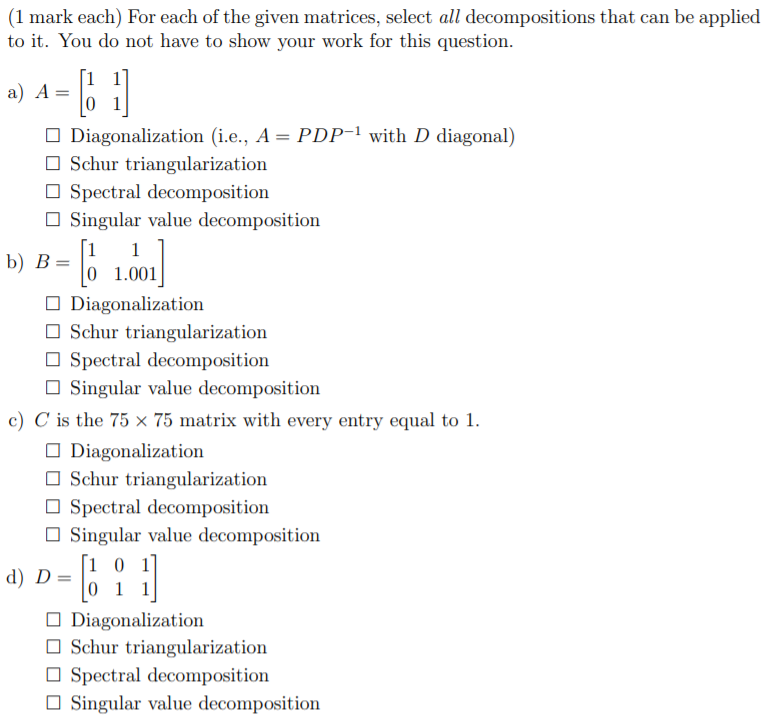
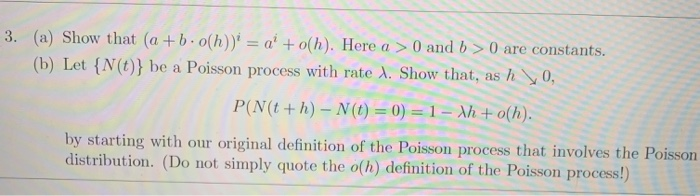
3. (a) Show that (a + b . o(h) ) = a' to(h). Here a > 0 and b > 0 are constants. (b) Let {N(t) } be a Poisson process with rate ). Show that, as h 0, P(N(t +h) - N() = 0) = 1- Ah + o(h). by starting with our original definition of the Poisson process that involves the Poisson distribution. (Do not simply quote the o(h) definition of the Poisson process!)1. Let {N1(t],t 33 0} he a Poisson Process with rate A. Can Z[t) = aN1(t) + 6N2(t] ever be a Poisson Process, where 0: and 3 are some non-zero constants. In other words, are there any values of o, ,8, and N2(t) such that {Z (t): 2 0} is a Poisson Process. Please note that {N2[t),t 2 U} is not allowed to be either a Poisson Process, and is also not allowed to be a trivial random process (eg.1 it is not a constant over all time). Carefully prove or disprove. 2. Spectral Versus Singular Value Decomposition: Consider a linear operator A with matrix representation 1 3 A _ [7 _1] (a) Compute the spectral decomposition and singular 1mlue decomposition of A. (1:) Sketch ANSI}, the image of the unit circle under .A. (c) Compare your answers to parts (a) and {b} and draw a conclusion. (1 mark each) For each of the given matrices, select all decompositions that can be applied to it. You do not have to show your work for this question. 2 ) A = [61 O Diagonalization (i.e., A = PDP-1 with D diagonal) O Schur triangularization O Spectral decomposition O Singular value decomposition b ) B = 0 1.001 Diagonalization O Schur triangularization O Spectral decomposition Singular value decomposition c) C is the 75 x 75 matrix with every entry equal to 1. Diagonalization Schur triangularization O Spectral decomposition Singular value decomposition d) D = 0 1 1 Diagonalization OSchur triangularization Spectral decomposition Singular value decomposition
Step by Step Solution
There are 3 Steps involved in it

Get step-by-step solutions from verified subject matter experts
 Study Help