







Question: Question list K Solve the following exponential equation. Express the solution set in terms of natural logarithms or common logarithms. Then, use a calculator
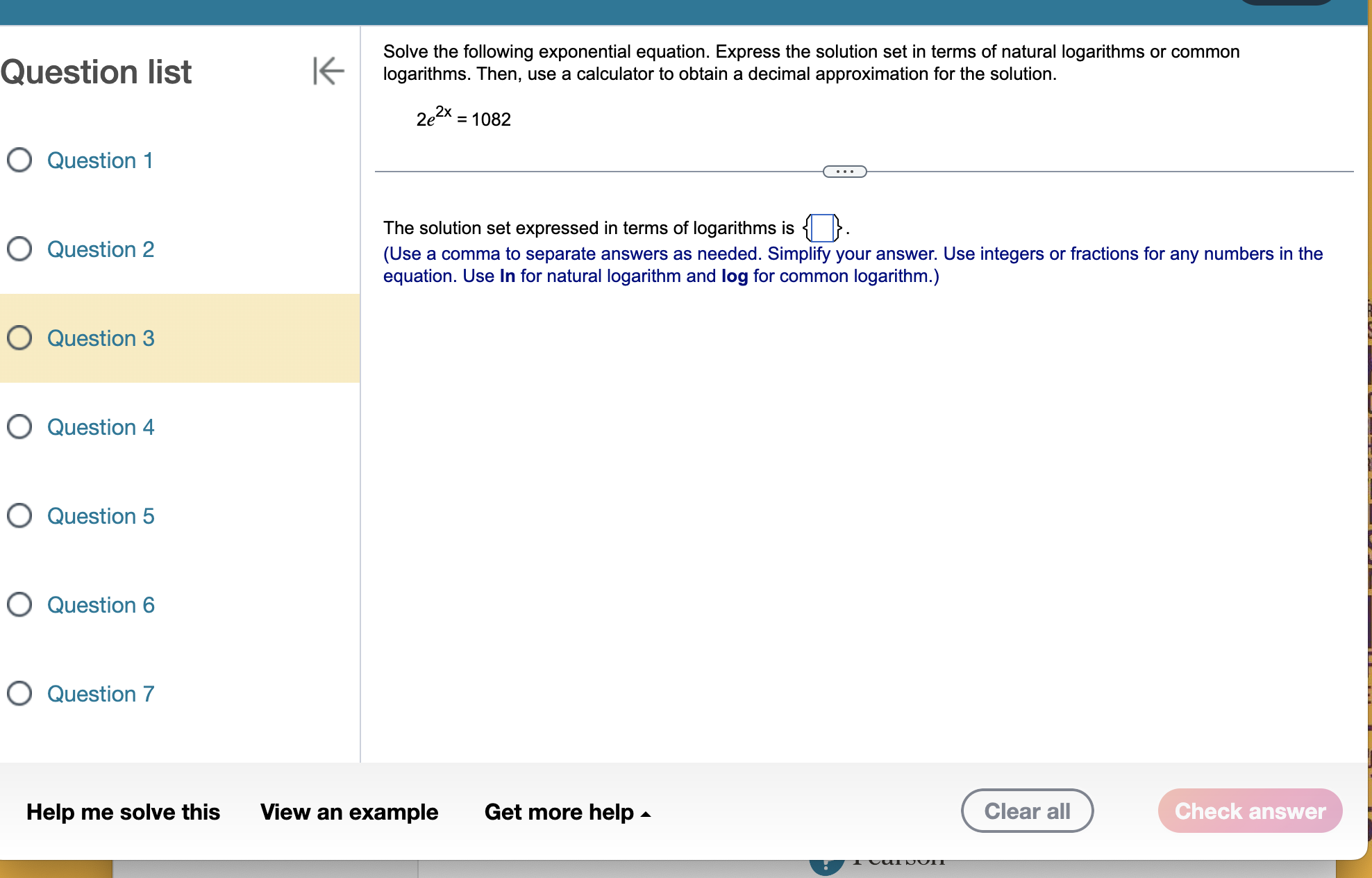
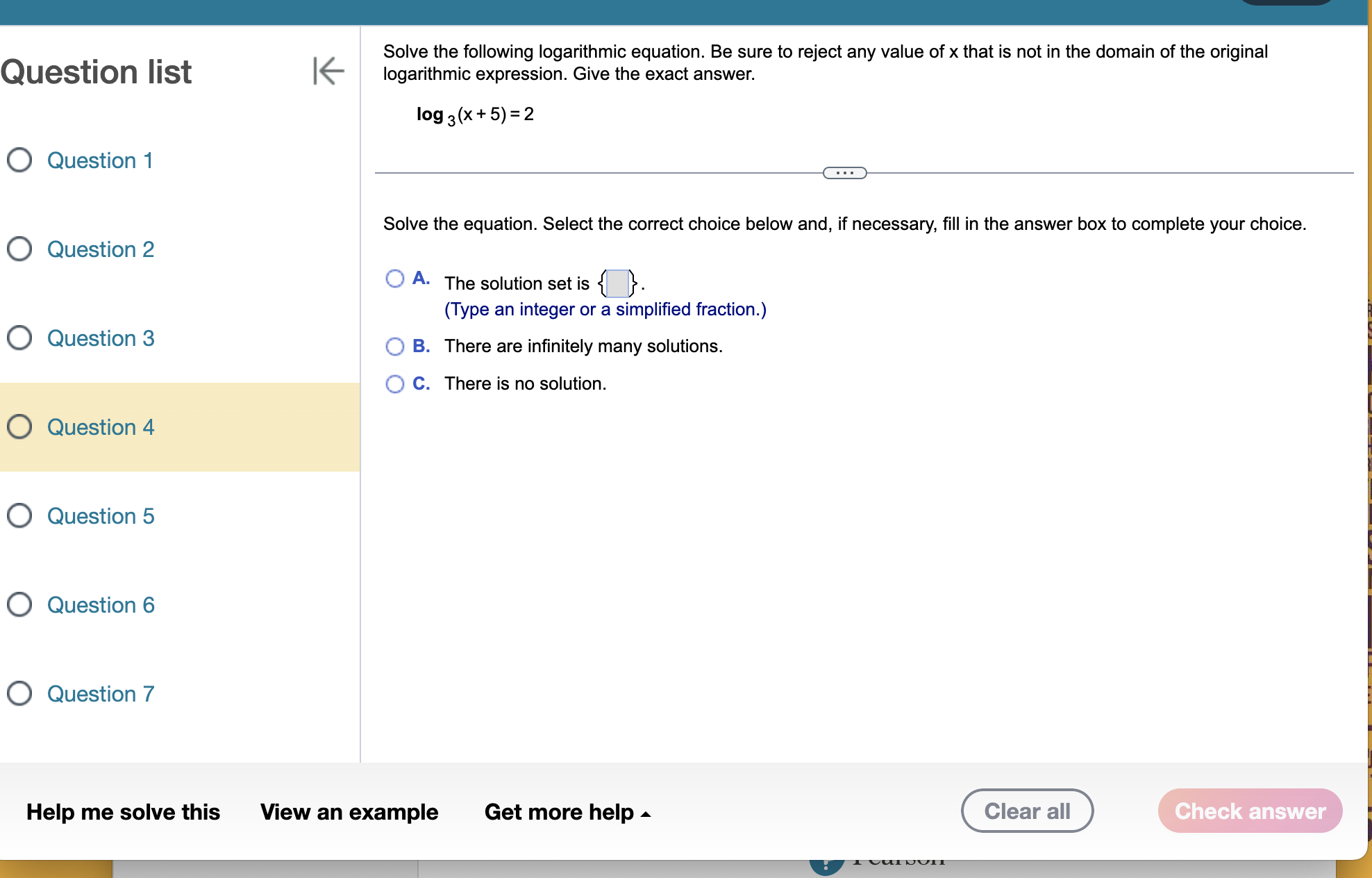
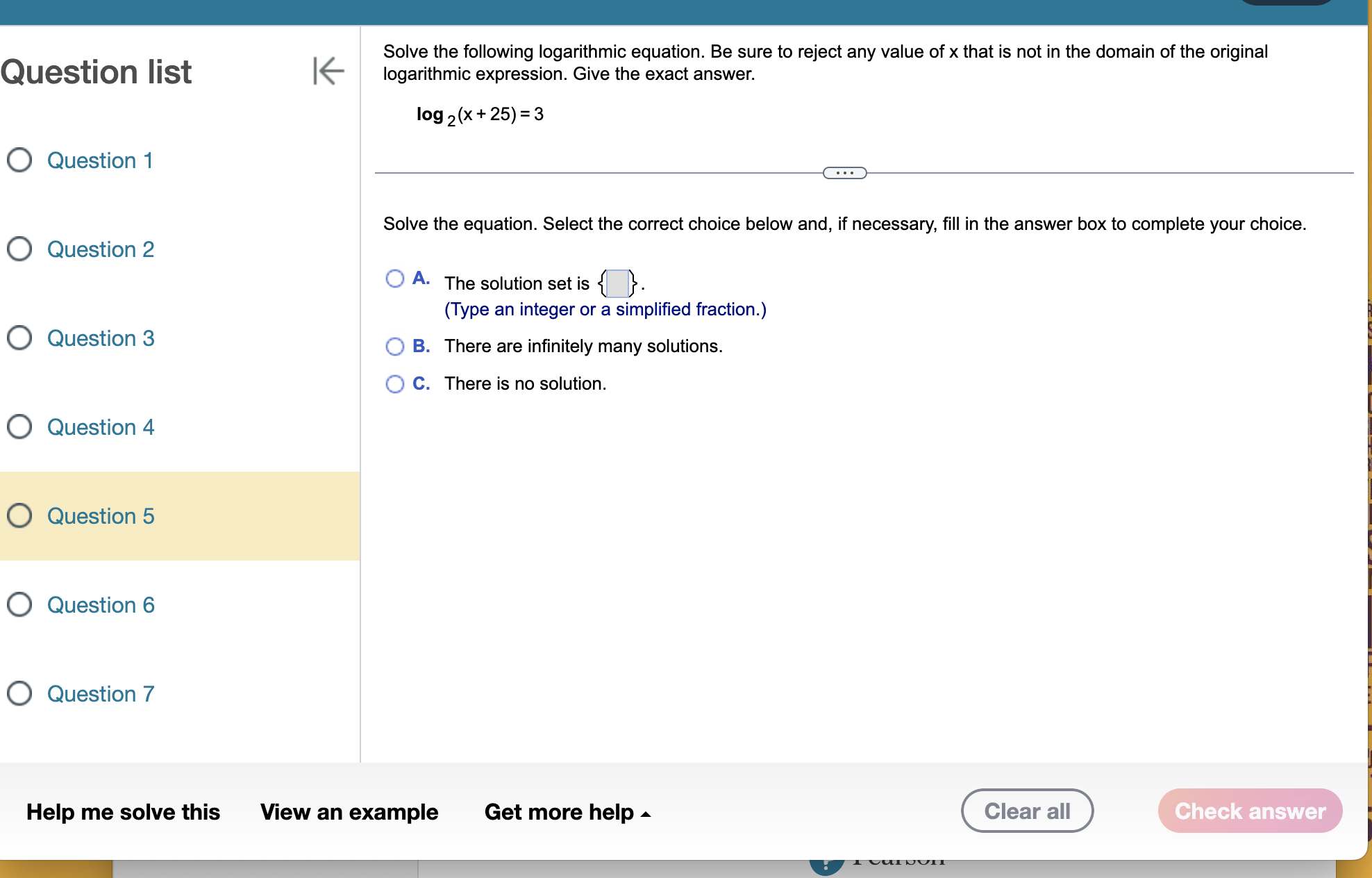
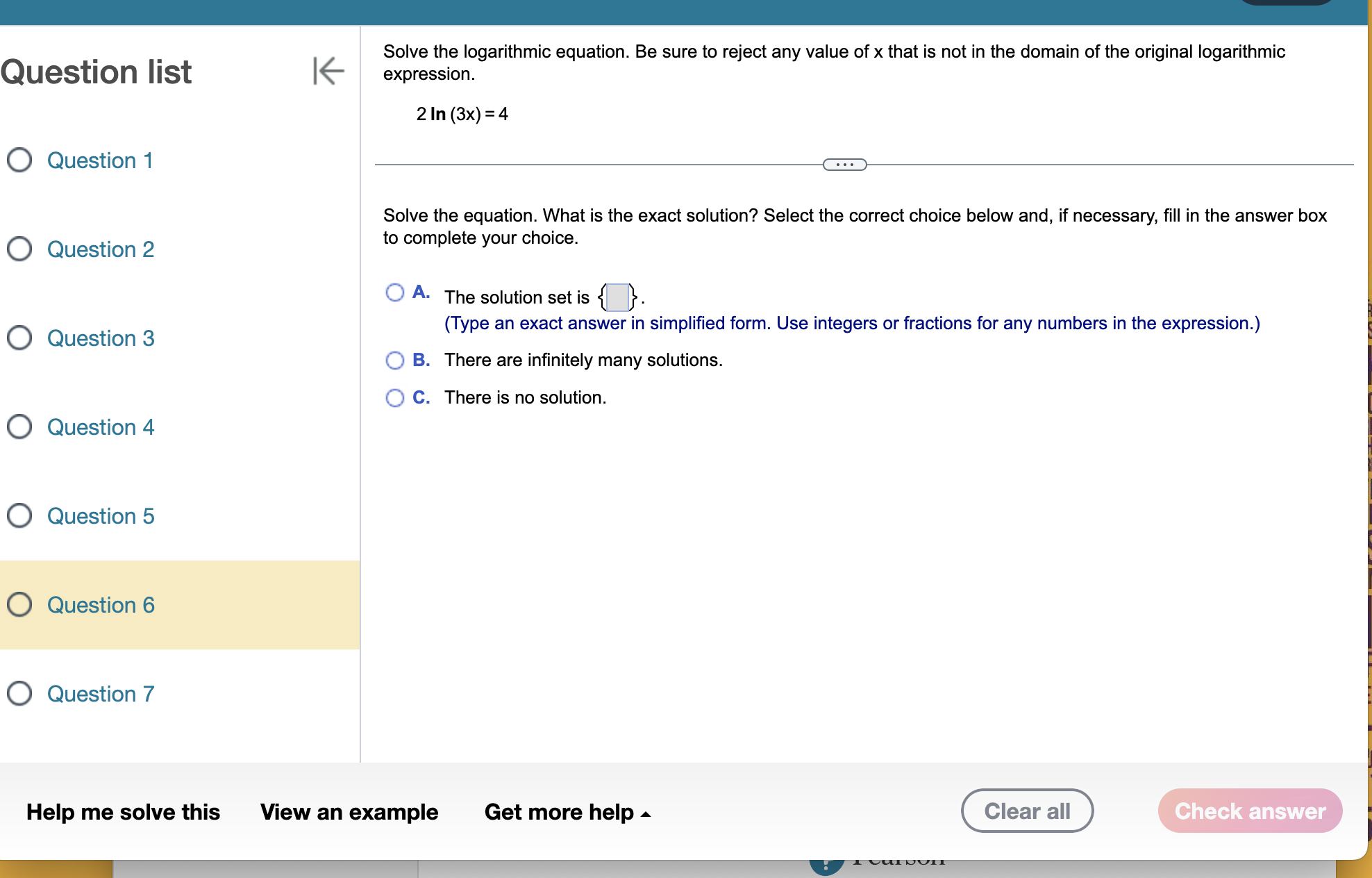
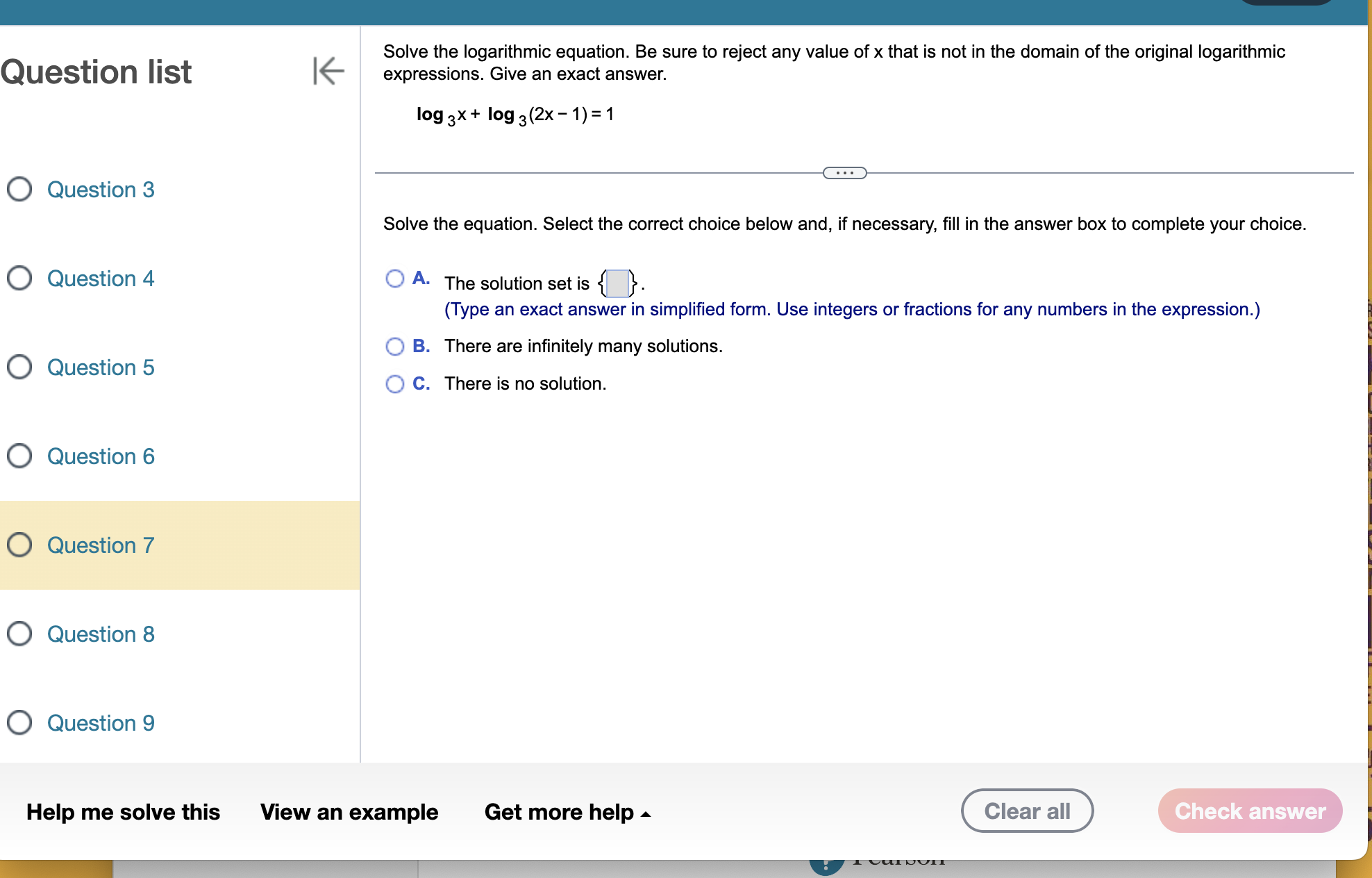
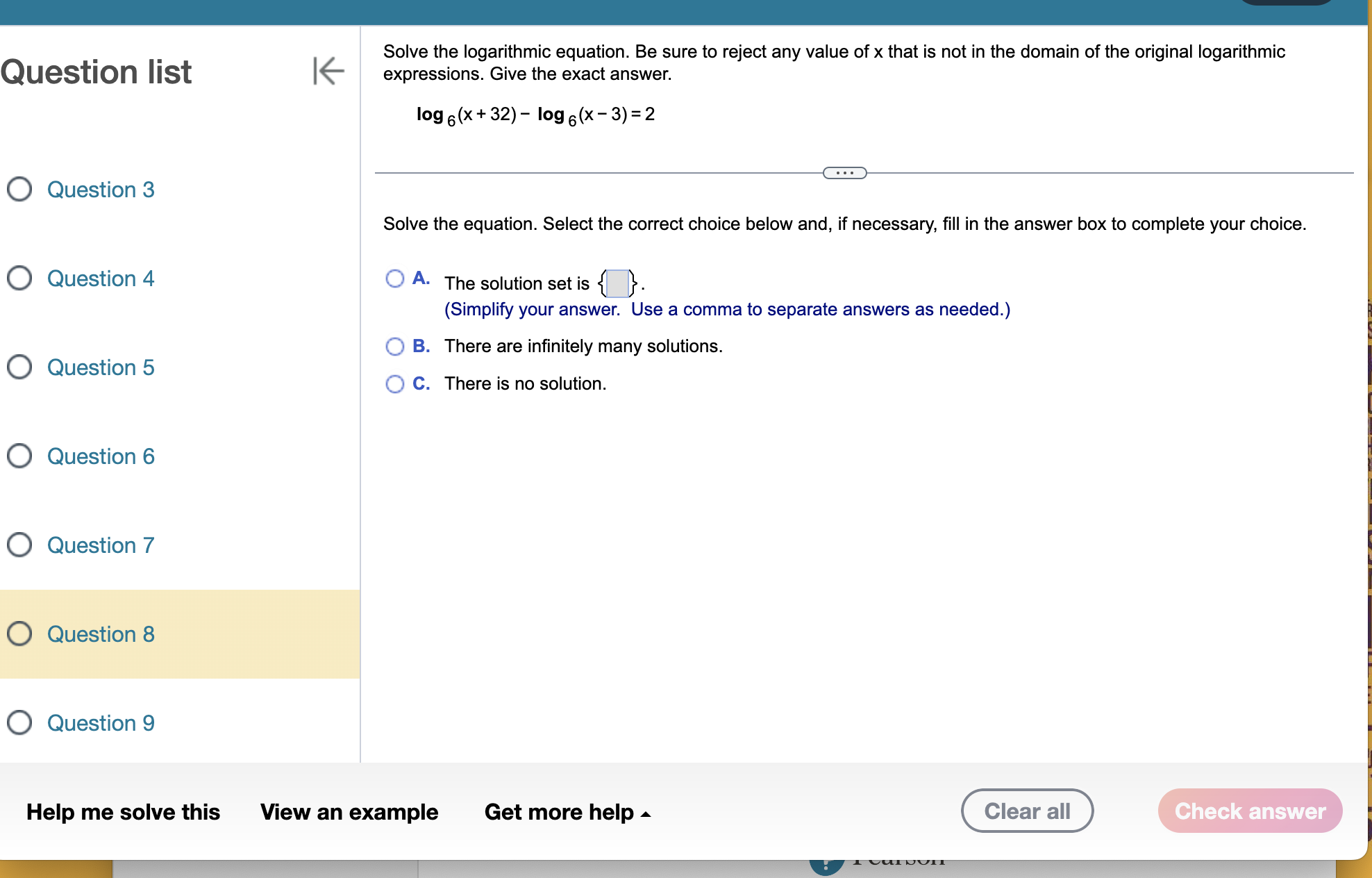
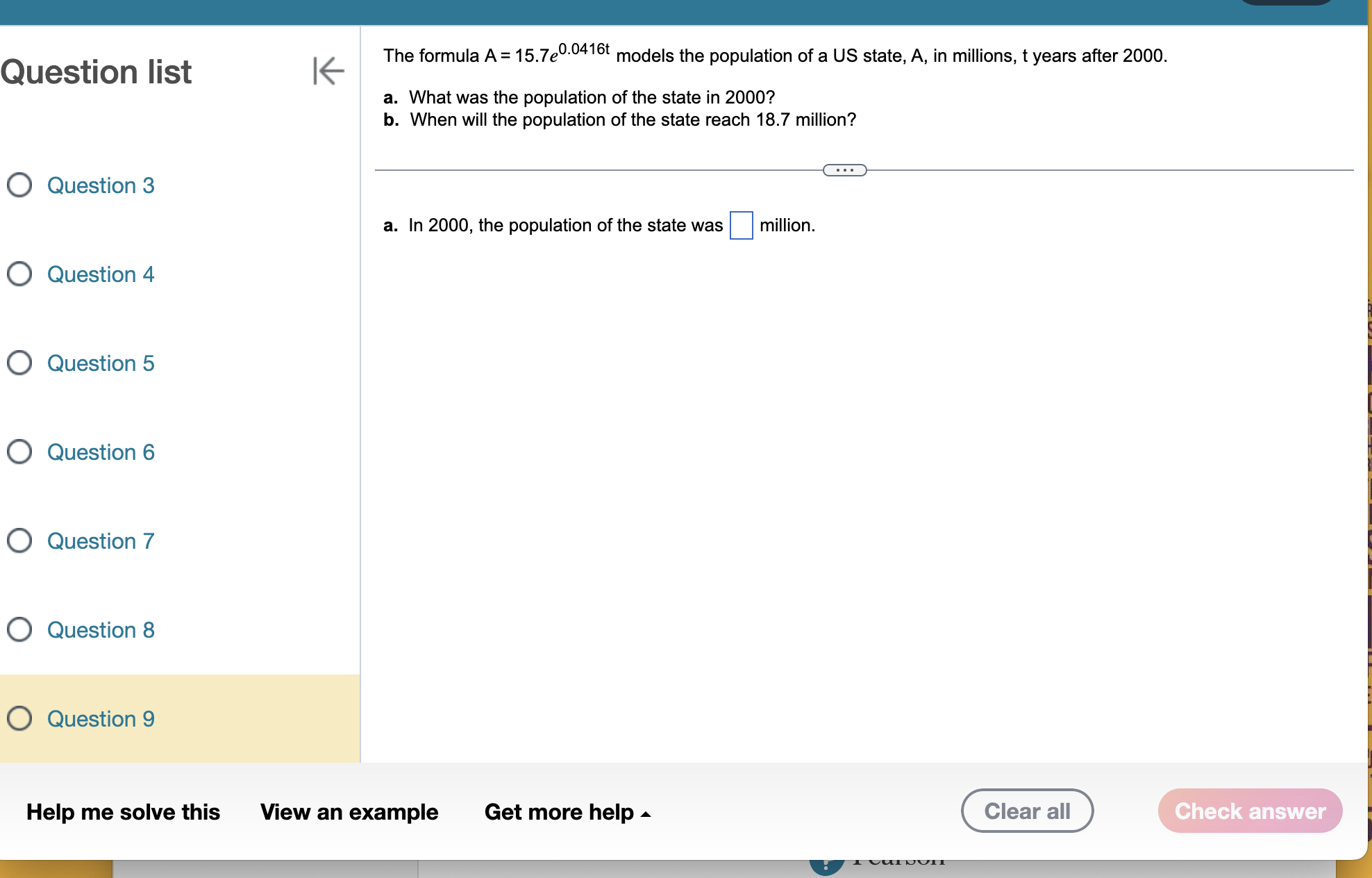
Question list K Solve the following exponential equation. Express the solution set in terms of natural logarithms or common logarithms. Then, use a calculator to obtain a decimal approximation for the solution. 2e2x=1082 Question 1 Question 2 The solution set expressed in terms of logarithms is ). (Use a comma to separate answers as needed. Simplify your answer. Use integers or fractions for any numbers in the equation. Use In for natural logarithm and log for common logarithm.) Question 3 Question 4 Question 5 Question 6 Question 7 Help me solve this View an example Get more help I cur Clear all Check answer Question list K Question 1 Question 2 Solve the following logarithmic equation. Be sure to reject any value of x that is not in the domain of the original logarithmic expression. Give the exact answer. log 3(x+5)=2 Solve the equation. Select the correct choice below and, if necessary, fill in the answer box to complete your choice. A. The solution set is { }. Question 3 (Type an integer or a simplified fraction.) B. There are infinitely many solutions. O C. There is no solution. Question 4 Question 5 Question 6 Question 7 Help me solve this View an example Get more help I cur Clear all Check answer Question list K Question 1 Question 2 Solve the following logarithmic equation. Be sure to reject any value of x that is not in the domain of the original logarithmic expression. Give the exact answer. log 2(x+25)=3 Solve the equation. Select the correct choice below and, if necessary, fill in the answer box to complete your choice. A. The solution set is { }. Question 3 (Type an integer or a simplified fraction.) B. There are infinitely many solutions. O C. There is no solution. Question 4 Question 5 Question 6 Question 7 Help me solve this View an example Get more help I cur Clear all Check answer Question list Question 1 Question 2 K Solve the logarithmic equation. Be sure to reject any value of x that is not in the domain of the original logarithmic expression. 2 In (3x) = 4 Solve the equation. What is the exact solution? Select the correct choice below and, if necessary, fill in the answer box to complete your choice. A. The solution set is { }. (Type an exact answer in simplified form. Use integers or fractions for any numbers in the expression.) B. There are infinitely many solutions. Question 3 O C. There is no solution. Question 4 Question 5 Question 6 Question 7 Help me solve this View an example Get more help I cur Clear all Check answer Question list K Question 3 Question 4 Question 5 Question 6 Question 7 Question 8 Question 9 Solve the logarithmic equation. Be sure to reject any value of x that is not in the domain of the original logarithmic expressions. Give an exact answer. log 3+ log 3 (2x-1)=1 Solve the equation. Select the correct choice below and, if necessary, fill in the answer box to complete your choice. A. The solution set is { (Type an exact answer in simplified form. Use integers or fractions for any numbers in the expression.) B. There are infinitely many solutions. O C. There is no solution. Help me solve this View an example Get more help I cur Clear all Check answer Question list K Question 3 Question 4 Solve the logarithmic equation. Be sure to reject any value of x that is not in the domain of the original logarithmic expressions. Give the exact answer. log 6(x+32) - log 6(x-3)=2 Solve the equation. Select the correct choice below and, if necessary, fill in the answer box to complete your choice. A. The solution set is { (Simplify your answer. Use a comma to separate answers as needed.) B. There are infinitely many solutions. Question 5 O C. There is no solution. Question 6 Question 7 Question 8 Question 9 Help me solve this View an example Get more help I cur Clear all Check answer Question list K The formula A = 15.7 0.0416t models the population of a US state, A, in millions, t years after 2000. a. What was the population of the state in 2000? b. When will the population of the state reach 18.7 million? Question 3 a. In 2000, the population of the state was million. Question 4 Question 5 Question 6 Question 7 Question 8 Question 9 Help me solve this View an example Get more help I cur Clear all Check answer
Step by Step Solution
There are 3 Steps involved in it

Get step-by-step solutions from verified subject matter experts
 Study Help