







Question: Question - Lorax Industrial operates one 12 hour shift per day for 220 days per year. It employs 315 people. The company records show a
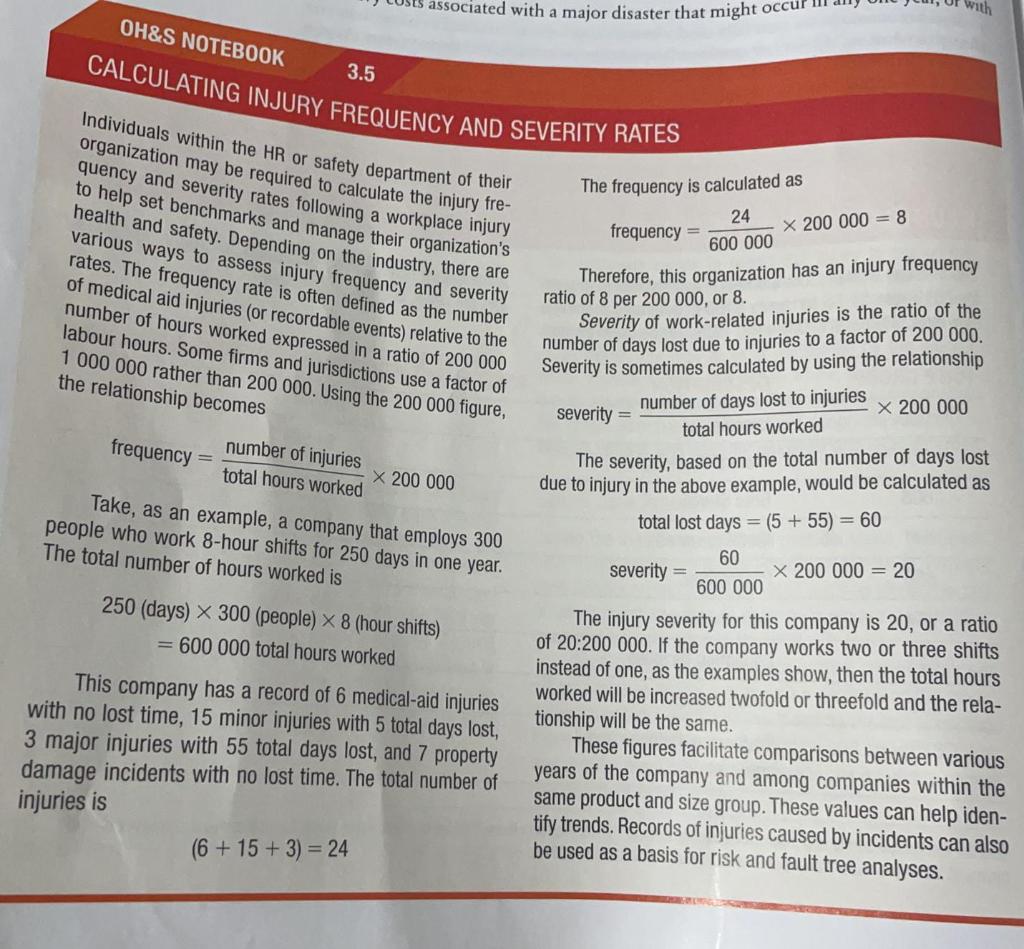
Question - Lorax Industrial operates one 12 hour shift per day for 220 days per year. It employs 315 people. The company records show a history of incidents and injuries:
- 3 medical aid injuries with no days lost
- 15 property damage incidents with a total 35 days lost
- 11 equipment failures that caused a total 20 days lost
- 19 injuries requiring medical attention with a total 75 days lost
CALCULATE THE FOLLOWING (REFER TO OH&S NOTEBOOK 3.5 FOR THE FORMULAS):
a. FREQUENCY
, b. SEVERITY
HR 302 OCCUPATIONAL HEALTH & SAFETY
associated with a major disaster that might occur with OH&S NOTEBOOK CALCULATING INJURY FREQUENCY AND SEVERITY RATES 3.5 X 200 000 = 8 Individuals within the HR or safety department of their organization may be required to calculate the injury fre- quency and severity rates following a workplace injury to help set benchmarks and manage their organization's health and safety. Depending on the industry, there are various ways to assess injury frequency and severity rates. The frequency rate is often defined as the number of medical aid injuries (or recordable events) relative to the number of hours worked expressed in a ratio of 200 000 labour hours. Some firms and jurisdictions use a factor of 1 000 000 rather than 200 000. Using the 200 000 figure, the relationship becomes number of injuries frequency = X 200 000 total hours worked The frequency is calculated as 24 frequency = 600 000 Therefore, this organization has an injury frequency ratio of 8 per 200 000, or 8. Severity of work-related injuries is the ratio of the number of days lost due to injuries to a factor of 200000. Severity is sometimes calculated by using the relationship severity number of days lost to injuries X 200 000 total hours worked The severity, based on the total number of days lost due to injury in the above example, would be calculated as total lost days = (5 + 55) = 60 60 severity x 200 000 = 20 600 000 Take, as an example, a company that employs 300 people who work 8-hour shifts for 250 days in one year. The total number of hours worked is 250 (days) X 300 (people) X 8 (hour shifts) = 600 000 total hours worked This company has a record of 6 medical-aid injuries with no lost time, 15 minor injuries with 5 total days lost, 3 major injuries with 55 total days lost, and 7 property damage incidents with no lost time. The total number of injuries is (6 + 15 + 3) = 24 The injury severity for this company is 20, or a ratio of 20:200 000. If the company works two or three shifts instead of one, as the examples show, then the total hours worked will be increased twofold or threefold and the rela- tionship will be the same. These figures facilitate comparisons between various years of the company and among companies within the same product and size group. These values can help iden- tify trends. Records of injuries caused by incidents can also be used as a basis for risk and fault tree analysesStep by Step Solution
There are 3 Steps involved in it
1 Expert Approved Answer
Step: 1 Unlock

Question Has Been Solved by an Expert!
Get step-by-step solutions from verified subject matter experts
Step: 2 Unlock
Step: 3 Unlock
 Study Help