





Question: Question no 1: Select only ONE option from the choices given below? (10 MARKS) 1. Which of the following is a disadvantage associated with advising?
Question no 1: Select only ONE option from the

Question no 1: Select only ONE option from the

Question no 1: Select only ONE option from the

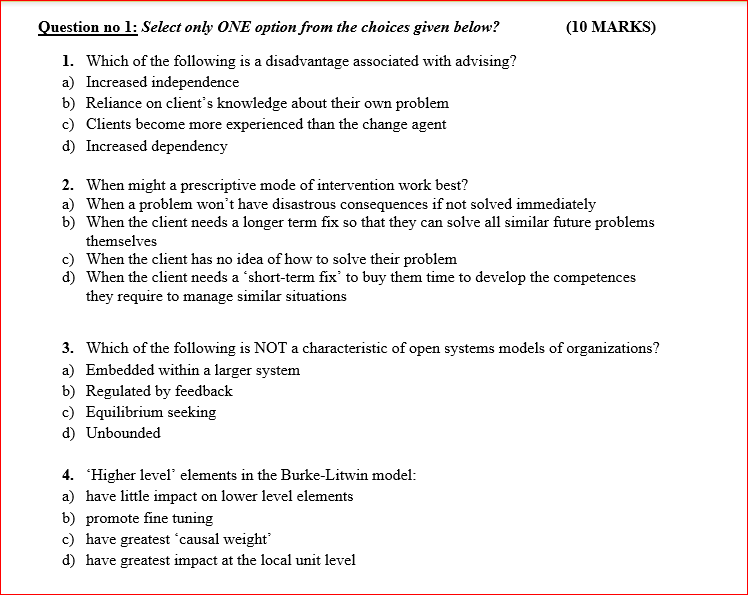
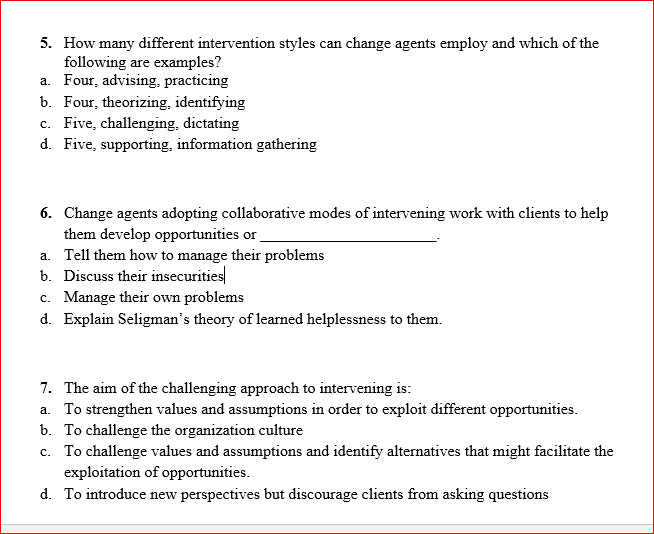
Question no 1: Select only ONE option from the choices given below? (10 MARKS) 1. Which of the following is a disadvantage associated with advising? a) Increased independence b) Reliance on client's knowledge about their own problem c) Clients become more experienced than the change agent d) Increased dependency 2. When might a prescriptive mode of intervention work best? a) When a problem won't have disastrous consequences if not solved immediately b) When the client needs a longer term fix so that they can solve all similar future problems themselves c) When the client has no idea of how to solve their problem d) When the client needs a short-term fix' to buy them time to develop the competences they require to manage similar situations 3. Which of the following is NOT a characteristic of open systems models of organizations? a) Embedded within a larger system b) Regulated by feedback c) Equilibrium seeking d) Unbounded 4. 'Higher level elements in the Burke-Litwin model: a) have little impact on lower level elements b) promote fine tuning c) have greatest 'causal weight d) have greatest impact at the local unit level 5. How many different intervention styles can change agents employ and which of the following are examples? a. Four, advising, practicing b. Four, theorizing, identifying c. Five, challenging, dictating d. Five, supporting, information gathering 6. Change agents adopting collaborative modes of intervening work with clients to help them develop opportunities or a. Tell them how to manage their problems b. Discuss their insecurities c. Manage their own problems d. Explain Seligman's theory of learned helplessness to them. 7. The aim of the challenging approach to intervening is: a. To strengthen values and assumptions in order to exploit different opportunities. b. To challenge the organization culture c. To challenge values and assumptions and identify alternatives that might facilitate the exploitation of opportunities. d. To introduce new perspectives but discourage clients from asking questions 8. Diagnostic models can be classified as: a. Complex or focused b. Component or holistic c. Holistic or open system d. Component or process 9. According to Kotter's integrative model of organizational dynamics the driving force for long term effectiveness is: a. The alignment of six structural elements b. The adaptability of six structural elements C. The quality of its information gathering and decision making process d. The alignment of key organizational processes
Step by Step Solution

There are 3 Steps involved in it

1 Expert Approved Answer
Step: 1 Unlock blur-text-image

Question Has Been Solved by an Expert!

Get step-by-step solutions from verified subject matter experts

Step: 2 Unlock
Step: 3 Unlock

Students Have Also Explored These Related General Management Questions!