



Question: Question No. 2 Brief and to the point answer required for the following Questions: 1. Suppose that you are highly risk averse but that you
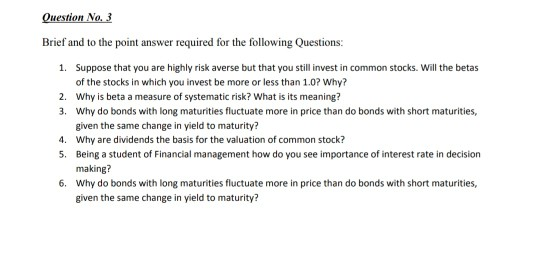
Question No. 2 Brief and to the point answer required for the following Questions: 1. Suppose that you are highly risk averse but that you still invest in common stocks. Will the betas of the stocks in which you invest be more or less than 1.0? Why? 2. Why is beta a measure of systematic risk? What is its meaning? 3. Why do bonds with long maturities fluctuate more in price than do bonds with short maturities, given the same change in yield to maturity? 4. Why are dividends the basis for the valuation of common stock? 5. Being a student of Financial management how do you see importance of interest rate in decision making? 6. Why do bonds with long maturities fluctuate more in price than do bonds with short maturities, given the same change in yield to maturity
Step by Step Solution
There are 3 Steps involved in it

Get step-by-step solutions from verified subject matter experts