







Question: Question Number 2. Please use IRAC Issue: Rule: Application: Conclusion: recover 1. Kyne was a betting commissione e He accepted bets, held the stakes, issued
Question Number 2. Please use IRAC
Issue:
Rule:
Application:
Conclusion:
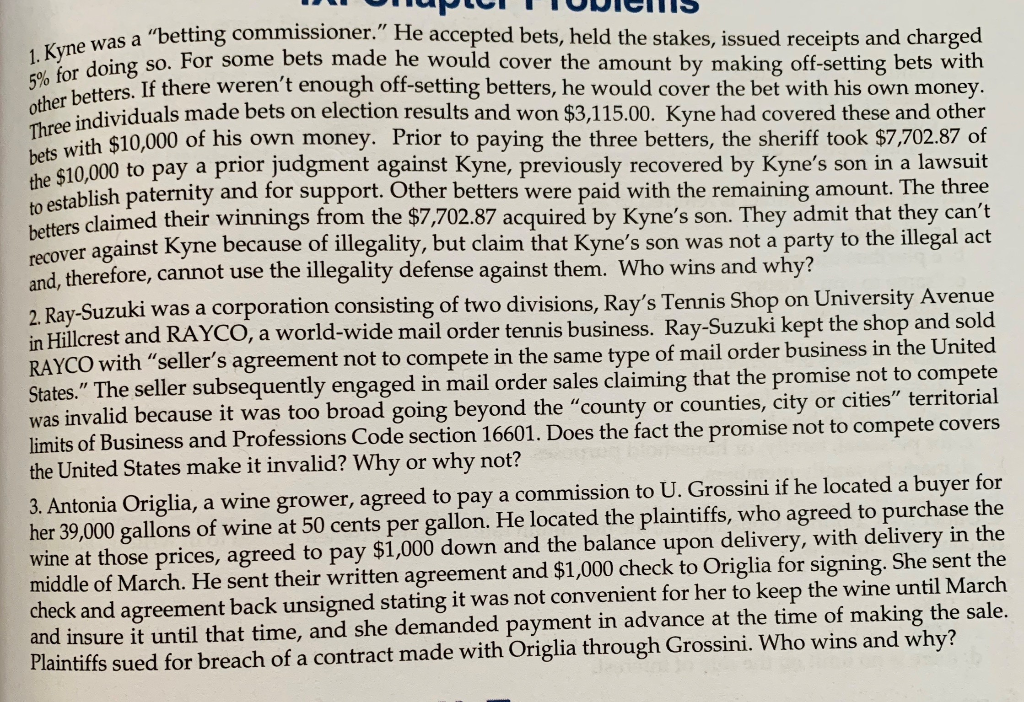
recover 1. Kyne was a "betting commissione e He accepted bets, held the stakes, issued receipts anders verein 1. For doing so. For some bets made he would cover the amount by making off-setting bets with . Seher betters. If there weren't enough off-setting betters, he would cover the bet with his own money. Three individuals made bets on election results and won $3,115.00. Kyne had covered these and other bets with $10,000 of his own money. Prior to paying the three betters, the sheriff took $7,702.87 of the $10,000 to pay a prior judgment against Kyne, previously recovered by Kyne's son in a lawsuit to establish paternity and for support. Other betters were paid with the remaining amount. The three betters claimed their winnings from the $7,702.87 acquired by Kyne's son. They admit that they can't e against Kyne because of illegality, but claim that Kyne's son was not a party to the illegal act and, therefore, cannot use the illegality defense against them. Who wins and why? 2. Ray-Suzuki was a corporation consisting of two divisions, Ray's Tennis Shop on University Avenue in Hillcrest and RAYCO, a world-wide mail order tennis business. Ray-Suzuki kept the shop and sold RAYCO with "seller's agreement not to compete in the same type of mail order business in the United States. The seller subsequently engaged in mail order sales claiming that the promise not to compete was invalid because it was too broad going beyond the "county or counties, city or cities territorial limits of Business and Professions Code section 16601. Does the fact the promise not to compete covers the United States make it invalid? Why or why not? 3. Antonia Origlia, a wine grower, agreed to pay a commission to U. Grossini if he located a buyer for her 39,000 gallons of wine at 50 cents per gallon. He located the plaintiffs, who agreed to purchase the wine at those prices, agreed to pay $1,000 down and the balance upon delivery, with delivery in the middle of March. He sent their written agreement and $1,000 check to Origlia for signing. She sent the check and agreement back unsigned stating it was not convenient for her to keep the wine until March and insure it until that time, and she demanded payment in advance at the time of making the sale. Plaintiffs sued for breach of a contract made with Origlia through Grossini. Who wins and whyStep by Step Solution
There are 3 Steps involved in it
1 Expert Approved Answer
Step: 1 Unlock

Question Has Been Solved by an Expert!
Get step-by-step solutions from verified subject matter experts
Step: 2 Unlock
Step: 3 Unlock
 Study Help