







Question: Question One 1 . 1 Demonstrate how Boeing can use the following tools to analyse and improve its process: 1 . 1 . 1 Flow
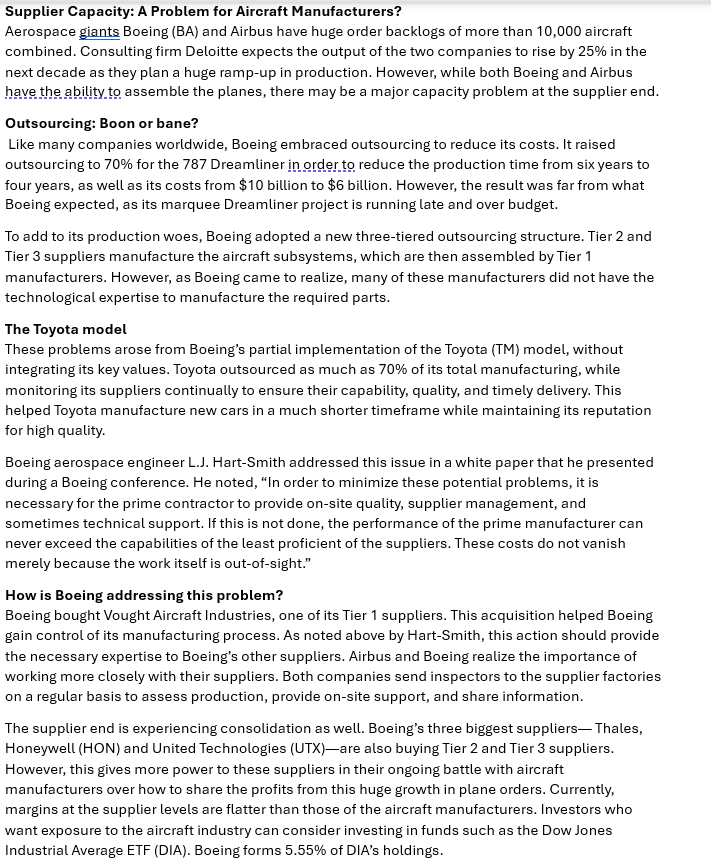
Question One Demonstrate how Boeing can use the following tools to analyse and improve its process: Flow diagrams Baseline Time Function Map and Service Blueprinting QUESTION TWO It is evident from the case study that Boeing used the Toyota Production System which is based on a JustinTime JIT philosophy. Assess: The key elements of a JIT system. The process Boeing or its suppliers need to follow to convert to a JIT system. QUESTION THREE Supplychain management is the integration of the activities that procure materials, transform them into products and deliver them to the customer via a distribution system. Using the case study: Determine what supply chain strategy would best suit Boeings operations. Do you believe Boeings strategy of outsourcing was a good one? Evaluate the reasons for making versus buying Supplier Capacity: A Problem for Aircraft Manufacturers? Aerospace giants Boeing BA and Airbus have huge order backlogs of more than aircraft combined. Consulting firm Deloitte expects the output of the two companies to rise by in the next decade as they plan a huge rampup in production. However, while both Boeing and Airbus have the ability to assemble the planes, there may be a major capacity problem at the supplier end. Outsourcing: Boon or bane? Like many companies worldwide, Boeing embraced outsourcing to reduce its costs. It raised outsourcing to for the Dreamliner in order to reduce the production time from six years to four years, as well as its costs from $ billion to $ billion. However, the result was far from what Boeing expected, as its marquee Dreamliner project is running late and over budget. To add to its production woes, Boeing adopted a new threetiered outsourcing structure. Tier and Tier suppliers manufacture the aircraft subsystems, which are then assembled by Tier manufacturers. However, as Boeing came to realize, many of these manufacturers did not have the technological expertise to manufacture the required parts. The Toyota model These problems arose from Boeing's partial implementation of the Toyota TM model, without integrating its key values. Toyota outsourced as much as of its total manufacturing, while monitoring its suppliers continually to ensure their capability, quality, and timely delivery. This helped Toyota manufacture new cars in a much shorter timeframe while maintaining its reputation for high quality. Boeing aerospace engineer LJ HartSmith addressed this issue in a white paper that he presented during a Boeing conference. He noted, In order to minimize these potential problems, it is necessary for the prime contractor to provide onsite quality, supplier management, and sometimes technical support. If this is not done, the performance of the prime manufacturer can never exceed the capabilities of the least profic
Step by Step Solution
There are 3 Steps involved in it
1 Expert Approved Answer
Step: 1 Unlock

Question Has Been Solved by an Expert!
Get step-by-step solutions from verified subject matter experts
Step: 2 Unlock
Step: 3 Unlock
 Study Help