







Question: Question One (worth two points) What backs up Treasury bonds? Question Two (worth five points) Assume we have a bond with a coupon rate of
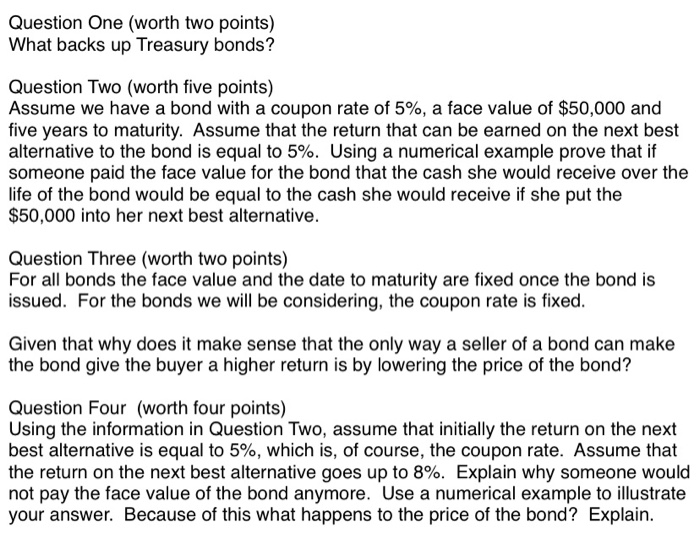
Question One (worth two points) What backs up Treasury bonds? Question Two (worth five points) Assume we have a bond with a coupon rate of 5%, a face value of $50,000 and five years to maturity. Assume that the return that can be earned on the next best alternative to the bond is equal to 5%. Using a numerical example prove that if someone paid the face value for the bond that the cash she would receive over the life of the bond would be equal to the cash she would receive if she put the $50,000 into her next best alternative. Question Three (worth two points) For all bonds the face value and the date to maturity are fixed once the bond is issued. For the bonds we will be considering, the coupon rate is fixed. Given that why does it make sense that the only way a seller of a bond can make the bond give the buyer a higher return is by lowering the price of the bond? Question Four (worth four points) Using the information in Question Two, assume that initially the return on the next best alternative is equal to 5%, which is, of course, the coupon rate. Assume that the return on the next best alternative goes up to 8%. Explain why someone would not pay the face value of the bond anymore. Use a numerical example to illustrate your answer. Because of this what happens to the price of the bond? Explain
Step by Step Solution
There are 3 Steps involved in it

Get step-by-step solutions from verified subject matter experts
 Study Help