Question: Question: Opportunity For Improvement Examples Rational & Resolution How does the organization assess workforce engagement? 5.2 Workforce Engagement 5.2a Workforce Engagement and Performance 5.2a(1) GG
| Question: | Opportunity For Improvement Examples | Rational & Resolution |
| How does the organization assess workforce engagement? | | |
| | | |
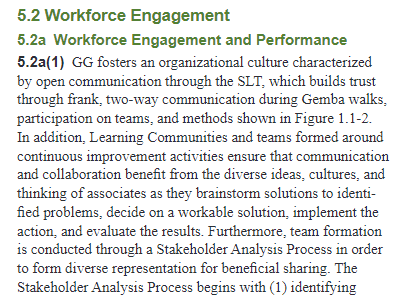
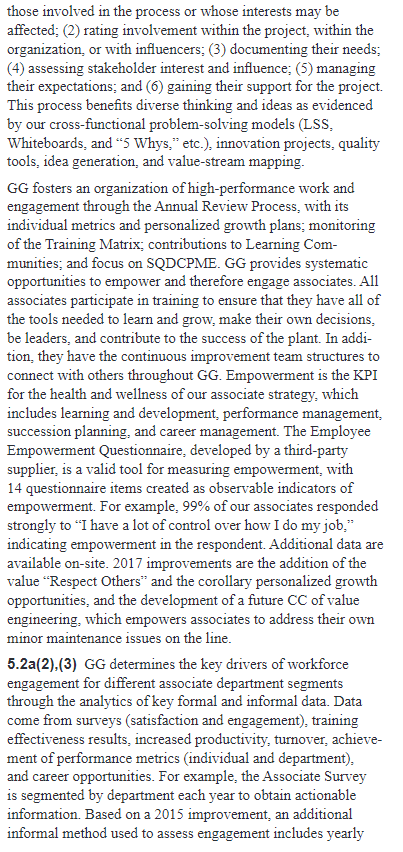
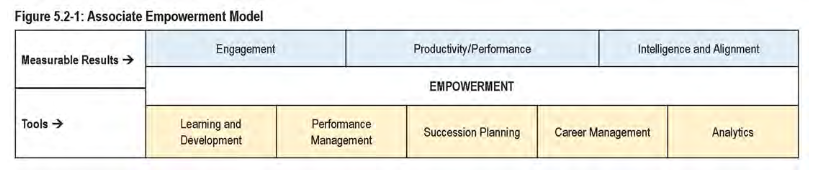
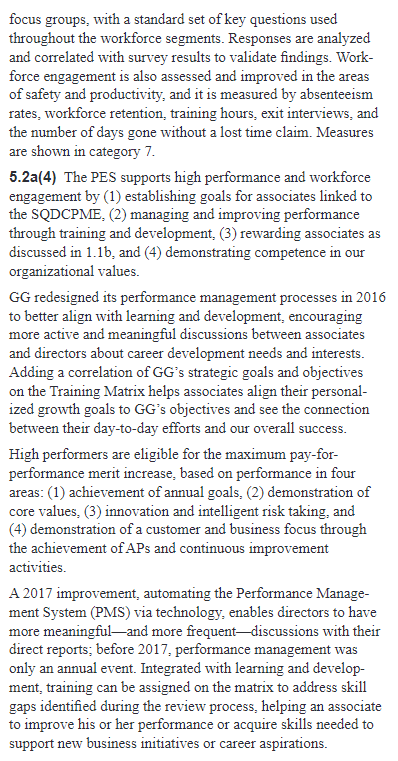
5.2 Workforce Engagement 5.2a Workforce Engagement and Performance 5.2a(1) GG fosters an organizational culture characterized by open communication through the SLT, which builds trust through frank, two-way communication during Gemba walks, participation on teams, and methods shown in Figure 1.1-2. In addition, Learning Communities and teams formed around continuous improvement activities ensure that communication and collaboration benefit from the diverse ideas, cultures, and thinking of associates as they brainstorm solutions to identi- fied problems, decide on a workable solution, implement the action, and evaluate the results. Furthermore, team formation is conducted through a Stakeholder Analysis Process in order to form diverse representation for beneficial sharing. The Stakeholder Analysis Process begins with (1) identifying those involved in the process or whose interests may be affected: (2) rating involvement within the project, within the organization, or with influencers; (3) documenting their needs; (4) assessing stakeholder interest and influence; (5) managing their expectations; and (6) gaining their support for the project. This process benefits diverse thinking and ideas as evidenced by our cross-functional problem-solving models (LSS. Whiteboards, and 5 Whys." etc.), innovation projects, quality tools, idea generation, and value-stream mapping. GG fosters an organization of high-performance work and engagement through the Annual Review Process, with its individual metrics and personalized growth plans; monitoring of the Training Matrix: contributions to Learning Com- munities; and focus on SRDCPME. GG provides systematic opportunities to empower and therefore engage associates. All associates participate in training to ensure that they have all of the tools needed to learn and grow, make their own decisions, be leaders, and contribute to the success of the plant. In addi- tion, they have the continuous improvement team structures to connect with others throughout GG. Empowerment is the KPI for the health and wellness of our associate strategy, which includes learning and development, performance management, succession planning, and career management. The Employee Empowerment Questionnaire developed by a third-party supplier, is a valid tool for measuring empowerment, with 14 questionnaire items created as observable indicators of empowerment. For example, 99% of our associates responded strongly to "I have a lot of control over how I do my job. *** indicating empowerment in the respondent. Additional data are available on-site. 2017 improvements are the addition of the value "Respect Others" and the corollary personalized growth opportunities, and the development of a future CC of value engineering, which empowers associates to address their own minor maintenance issues on the line. 5.2a(2),(3) GG determines the key drivers of workforce engagement for different associate department segments through the analytics of key formal and informal data. Data come from surveys (satisfaction and engagement), training effectiveness results, increased productivity, turnover, achieve- ment of performance metrics (individual and department). and career opportunities. For example, the Associate Survey is segmented by department each year to obtain actionable information. Based on a 2015 improvement, an additional informal method used to assess engagement includes yearly Figure 5.2-1: Associate Empowerment Model Engagement Productivity/Performance Intelligence and Alignment Measurable Results EMPOWERMENT Tools Learning and Development Performance Management Succession Planning Career Management Analytics focus groups, with a standard set of key questions used throughout the workforce segments. Responses are analyzed and correlated with survey results to validate findings. Work- force engagement is also assessed and improved in the areas of safety and productivity, and it is measured by absenteeism rates, workforce retention, training hours, exit interviews, and the number of days gone without a lost time claim. Measures are shown in category 7. 5.2a(4) The PES supports high performance and workforce engagement by (1) establishing goals for associates linked to the SQDCPME, (2) managing and improving performance through training and development, (3) rewarding associates as discussed in 1.1b, and (4) demonstrating competence in our organizational values. GG redesigned its performance management processes in 2016 to better align with learning and development, encouraging more active and meaningful discussions between associates and directors about career development needs and interests. Adding a correlation of GG's strategic goals and objectives on the Training Matrix helps associates align their personal- ized growth goals to GG's objectives and see the connection between their day-to-day efforts and our overall success. High performers are eligible for the maximum pay-for- performance merit increase, based on performance in four areas: (1) achievement of annual goals, (2) demonstration of core values, (3) innovation and intelligent risk taking, and (4) demonstration of a customer and business focus through the achievement of APs and continuous improvement activities. A 2017 improvement, automating the Performance Manage- ment System (PMS) via technology, enables directors to have more meaningfuland more frequentdiscussions with their direct reports; before 2017, performance management was only an annual event. Integrated with learning and develop- ment, training can be assigned on the matrix to address skill gaps identified during the review process, helping an associate to improve his or her performance or acquire skills needed to support new business initiatives or career aspirations. 5.2 Workforce Engagement 5.2a Workforce Engagement and Performance 5.2a(1) GG fosters an organizational culture characterized by open communication through the SLT, which builds trust through frank, two-way communication during Gemba walks, participation on teams, and methods shown in Figure 1.1-2. In addition, Learning Communities and teams formed around continuous improvement activities ensure that communication and collaboration benefit from the diverse ideas, cultures, and thinking of associates as they brainstorm solutions to identi- fied problems, decide on a workable solution, implement the action, and evaluate the results. Furthermore, team formation is conducted through a Stakeholder Analysis Process in order to form diverse representation for beneficial sharing. The Stakeholder Analysis Process begins with (1) identifying those involved in the process or whose interests may be affected: (2) rating involvement within the project, within the organization, or with influencers; (3) documenting their needs; (4) assessing stakeholder interest and influence; (5) managing their expectations; and (6) gaining their support for the project. This process benefits diverse thinking and ideas as evidenced by our cross-functional problem-solving models (LSS. Whiteboards, and 5 Whys." etc.), innovation projects, quality tools, idea generation, and value-stream mapping. GG fosters an organization of high-performance work and engagement through the Annual Review Process, with its individual metrics and personalized growth plans; monitoring of the Training Matrix: contributions to Learning Com- munities; and focus on SRDCPME. GG provides systematic opportunities to empower and therefore engage associates. All associates participate in training to ensure that they have all of the tools needed to learn and grow, make their own decisions, be leaders, and contribute to the success of the plant. In addi- tion, they have the continuous improvement team structures to connect with others throughout GG. Empowerment is the KPI for the health and wellness of our associate strategy, which includes learning and development, performance management, succession planning, and career management. The Employee Empowerment Questionnaire developed by a third-party supplier, is a valid tool for measuring empowerment, with 14 questionnaire items created as observable indicators of empowerment. For example, 99% of our associates responded strongly to "I have a lot of control over how I do my job. *** indicating empowerment in the respondent. Additional data are available on-site. 2017 improvements are the addition of the value "Respect Others" and the corollary personalized growth opportunities, and the development of a future CC of value engineering, which empowers associates to address their own minor maintenance issues on the line. 5.2a(2),(3) GG determines the key drivers of workforce engagement for different associate department segments through the analytics of key formal and informal data. Data come from surveys (satisfaction and engagement), training effectiveness results, increased productivity, turnover, achieve- ment of performance metrics (individual and department). and career opportunities. For example, the Associate Survey is segmented by department each year to obtain actionable information. Based on a 2015 improvement, an additional informal method used to assess engagement includes yearly Figure 5.2-1: Associate Empowerment Model Engagement Productivity/Performance Intelligence and Alignment Measurable Results EMPOWERMENT Tools Learning and Development Performance Management Succession Planning Career Management Analytics focus groups, with a standard set of key questions used throughout the workforce segments. Responses are analyzed and correlated with survey results to validate findings. Work- force engagement is also assessed and improved in the areas of safety and productivity, and it is measured by absenteeism rates, workforce retention, training hours, exit interviews, and the number of days gone without a lost time claim. Measures are shown in category 7. 5.2a(4) The PES supports high performance and workforce engagement by (1) establishing goals for associates linked to the SQDCPME, (2) managing and improving performance through training and development, (3) rewarding associates as discussed in 1.1b, and (4) demonstrating competence in our organizational values. GG redesigned its performance management processes in 2016 to better align with learning and development, encouraging more active and meaningful discussions between associates and directors about career development needs and interests. Adding a correlation of GG's strategic goals and objectives on the Training Matrix helps associates align their personal- ized growth goals to GG's objectives and see the connection between their day-to-day efforts and our overall success. High performers are eligible for the maximum pay-for- performance merit increase, based on performance in four areas: (1) achievement of annual goals, (2) demonstration of core values, (3) innovation and intelligent risk taking, and (4) demonstration of a customer and business focus through the achievement of APs and continuous improvement activities. A 2017 improvement, automating the Performance Manage- ment System (PMS) via technology, enables directors to have more meaningfuland more frequentdiscussions with their direct reports; before 2017, performance management was only an annual event. Integrated with learning and develop- ment, training can be assigned on the matrix to address skill gaps identified during the review process, helping an associate to improve his or her performance or acquire skills needed to support new business initiatives or career aspirations









 Study Help