





Question: Question: - Please note that this problem has TWO Independent parts (I and II). - You may need to scroll the screen down and navigate
Question: - Please note that this problem has TWO

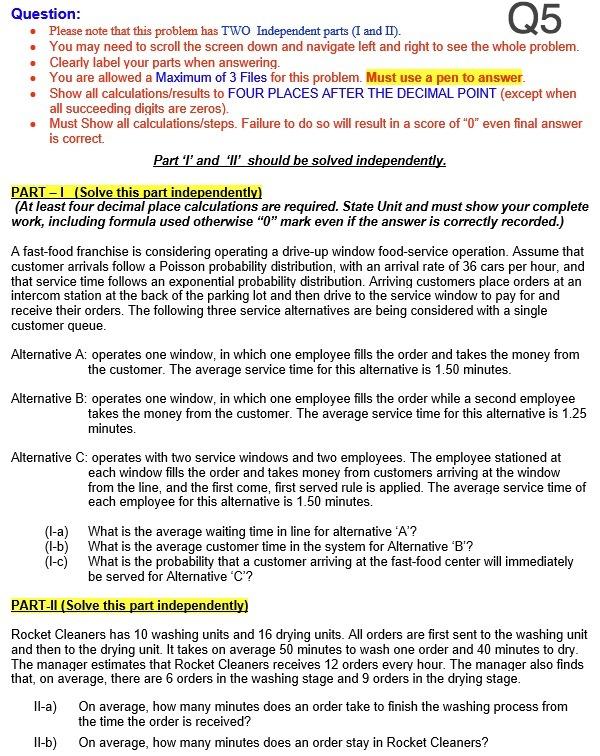
Question: - Please note that this problem has TWO Independent parts (I and II). - You may need to scroll the screen down and navigate left and right to see the whole problem. - Clearly label your parts when answering. - You are allowed a Maximum of 3 Files for this problem. Must use a pen to answer. - Show all calculations/results to FOUR PLACES AFTER THE DECIMAL POINT (except when all succeeding digits are zeros). - Must Show all calculations/steps. Failure to do so will result in a score of " 0 " even final answer is correct. Part ' l ' and 'II' should be solved independently. PART - I (Solve this part independently) (At least four decimal place calculations are required. State Unit and must show your complete work, including formula used otherwise "0" mark even if the answer is correctly recorded.) A fast-food franchise is considering operating a drive-up window food-service operation. Assume that customer arrivals follow a Poisson probability distribution, with an arrival rate of 36 cars per hour, and that service time follows an exponential probability distribution. Arriving customers place orders at an intercom station at the back of the parking lot and then drive to the service window to pay for and receive their orders. The following three service alternatives are being considered with a single customer queue. Alternative A: operates one window, in which one employee fills the order and takes the money from the customer. The average service time for this alternative is 1.50 minutes. Alternative B: operates one window, in which one employee fills the order while a second employee takes the money from the customer. The average service time for this alternative is 1.25 minutes. Alternative C: operates with two service windows and two employees. The employee stationed at each window fills the order and takes money from customers arriving at the window from the line, and the first come, first served rule is applied. The average service time of each employee for this alternative is 1.50 minutes. (I-a) What is the average waiting time in line for alternative ' A '? (I-b) What is the average customer time in the system for Alternative 'B'? (I-c) What is the probability that a customer arriving at the fast-food center will immediately be served for Alternative 'C'? PART-II (Solve this part independently) Rocket Cleaners has 10 washing units and 16 drying units. All orders are first sent to the washing unit and then to the drying unit. It takes on average 50 minutes to wash one order and 40 minutes to dry. The manager estimates that Rocket Cleaners receives 12 orders every hour. The manager also finds that, on average, there are 6 orders in the washing stage and 9 orders in the drying stage. II-a) On average, how many minutes does an order take to finish the washing process from the time the order is received? II-b) On average, how many minutes does an order stay in Rocket Cleaners

Step by Step Solution

There are 3 Steps involved in it

1 Expert Approved Answer
Step: 1 Unlock blur-text-image

Question Has Been Solved by an Expert!

Get step-by-step solutions from verified subject matter experts

Step: 2 Unlock
Step: 3 Unlock

Students Have Also Explored These Related General Management Questions!