Question: Question: Please read the article and answer the question. Classroom Case Studies Teaching Science as Inquiry A teacher wanted to see inquiry in action, so
Question: Please read the article and answer the question.
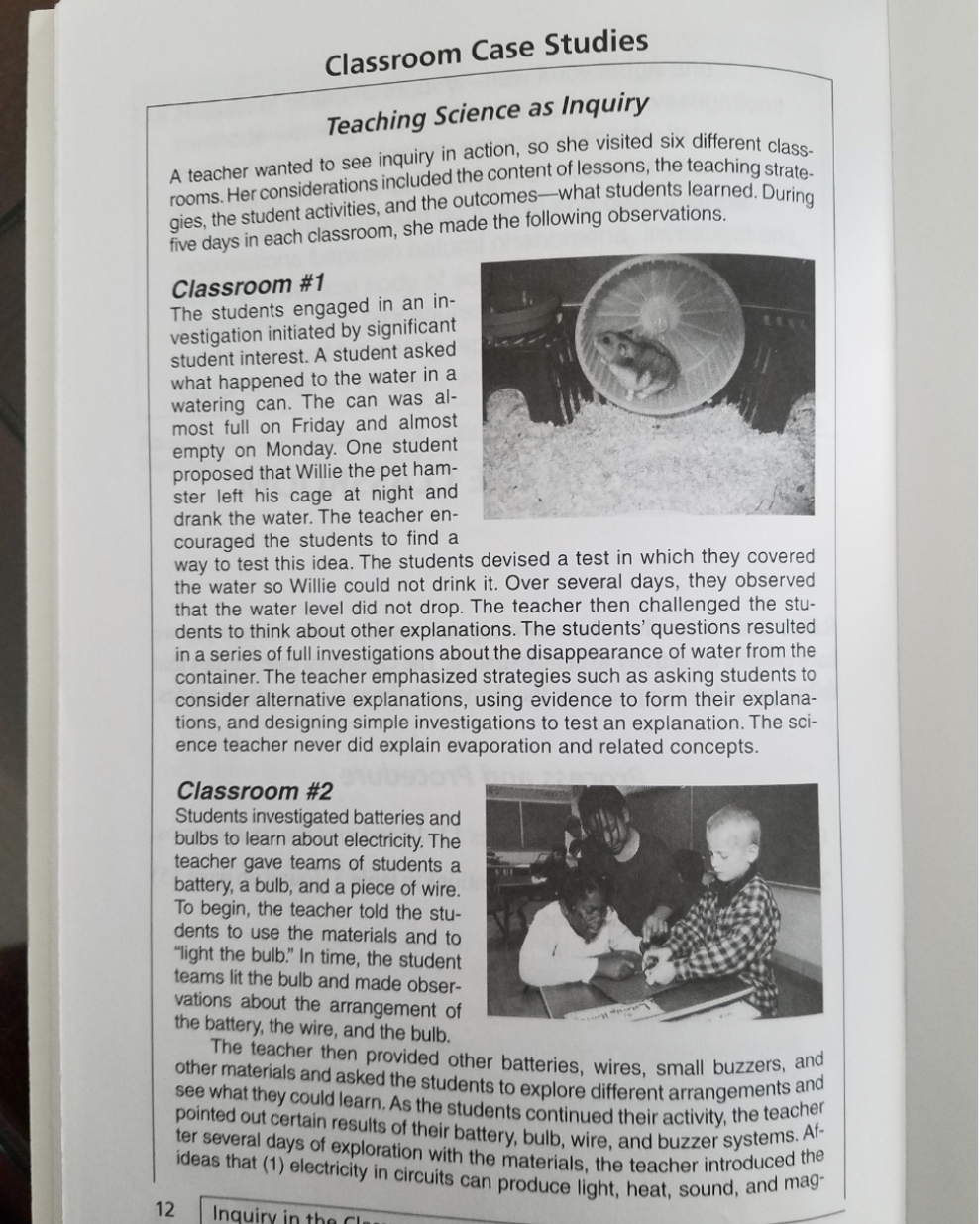
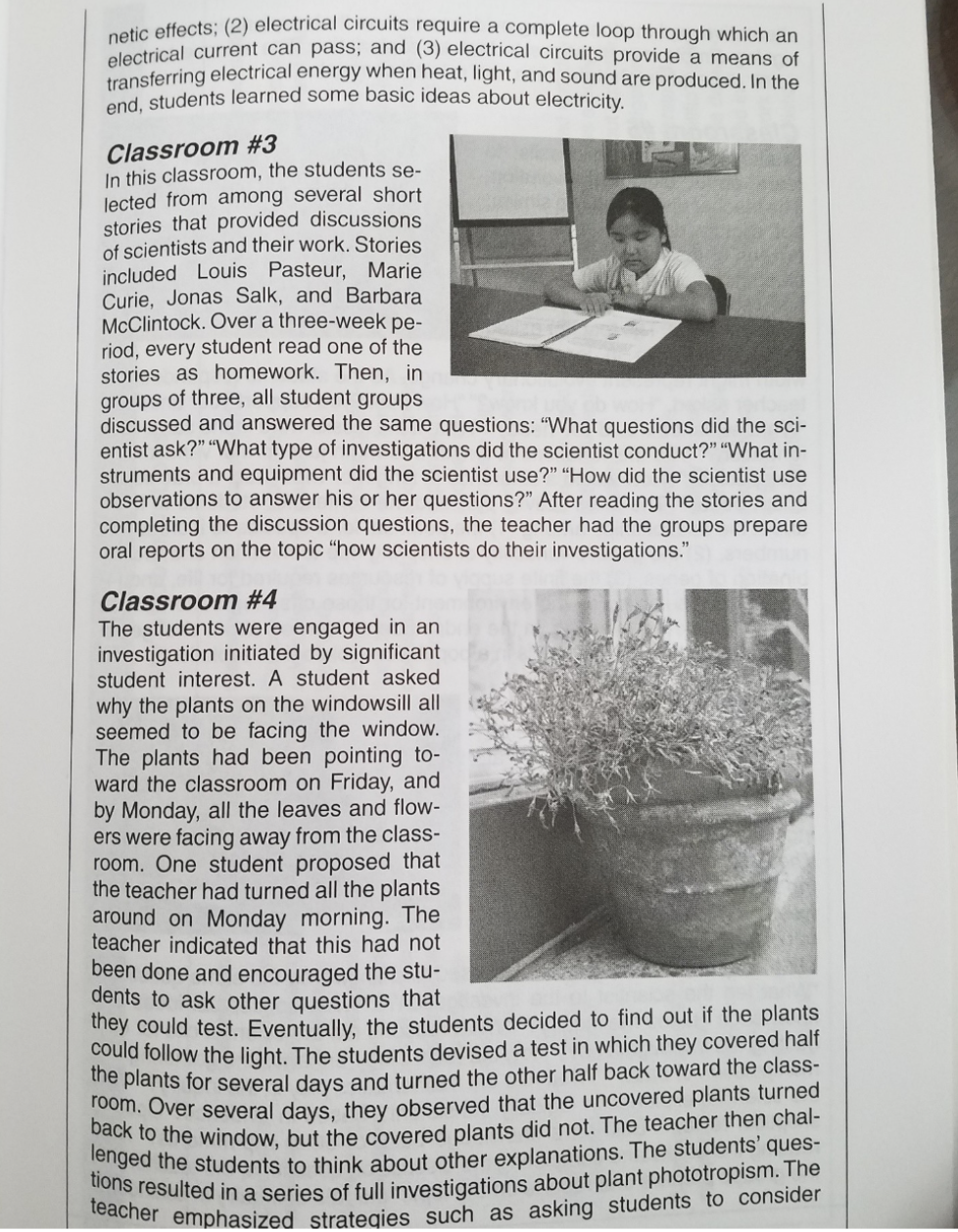
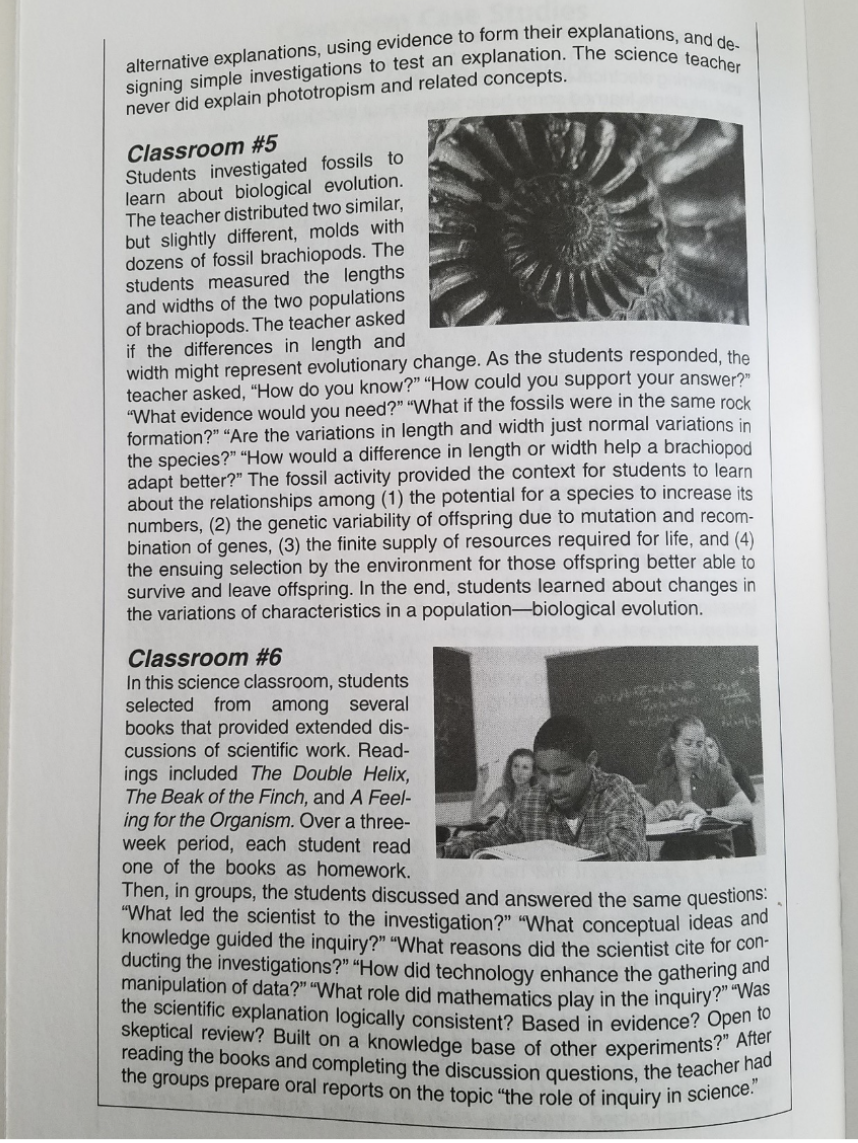
Classroom Case Studies Teaching Science as Inquiry A teacher wanted to see inquiry in action, so she visited six different class- rooms. Her considerations included the content of lessons, the teaching strate- During the student activities, five days in each classroom, she made the following observations. Classroom #1 The students engaged in an in- vestigation initiated by significant student interest. A student asked what happened to the water in a watering can. The can was al- most full on Friday and almost empty on Monday. One student proposed that Willie the pet ham- ster left his cage at night and drank the water. The teacher en- couraged the students to find a way to test this idea. The students devised a test in which they covered the water so Willie could not drink it. Over several days, they observed that the water level did not drop. The teacher then challenged the stu- dents to think about other explanations. The students' questions resulted in a series of full investigations about the disappearance of water from the container. The teacher emphasized strategies such as asking students to consider alternative explanations, using evidence to form their explana- tions, and designing simple investigations to test an explanation. The sci- ence teacher never did explain evaporation and related concepts. Classroom #2 Students investigated batteries and bulbs to learn about electricity. The teacher gave teams of students battery, a bulb, and a piece of wire. To begin, the teacher told the stu- dents to use the materials and to "light the bulb." In time, the student teams lit the bulb and made obser- vations about the arrangement of the battery, the wire, and the bulb. The teacher then provided other batteries, wires, small buzzers, and other materials and asked the students to explore different arrangements and see what they could learn. As the students continued their activity, the teacher pointed out certain results of their battery, bulb, wire, and buzzer systems. Af- ter several days of exploration with the materials, the teacher introduced the ideas that (1) electricity in circuits can produce light, heat, sound, and mag- 12 Inquiry in the Cla netic effects; (2) electrical circuits require a complete loop through which an electrical current can pass; and (3) electrical circuits provide a means of transferring electrical energy when heat, light, and sound are produced. In the end, students learned some basic ideas about electricity. Classroom #3 In this classroom, the students se- lected from among several short stories that provided discussions of scientists and their work. Stories included Louis Pasteur, Marie Curie, Jonas Salk, and Barbara McClintock. Over a three-week pe- riod, every student read one of the stories as homework. Then, in groups of three, all student groups discussed and answered the same questions: "What questions did the sci- entist ask?" "What type of investigations did the scientist conduct?" "What in- struments and equipment did the scientist use?" "How did the scientist use observations to answer his or her questions?" After reading the stories and completing the discussion questions, the teacher had the groups prepare oral reports on the topic "how scientists do their investigations." Classroom #4 The students were engaged in an investigation initiated by significant student interest. A student asked why the plants on the windowsill all seemed to be facing the window. The plants had been pointing to- ward the classroom on Friday, and by Monday, all the leaves and flow- ers were facing away from the class- room. One student proposed that the teacher had turned all the plants around on Monday morning. The teacher indicated that this had not been done and encouraged the stu- dents to ask other questions that they could test. Eventually, the students decided to find out if the plants could follow the light. The students devised a test in which they covered half the plants for several days and turned the other half back toward the class- room. Over several days, they observed that the uncovered plants turned back to the window, but the covered plants did not. The teacher then chal- lenged the students to think about other explanations. The students' ques- tions resulted in a series of full investigations about plant phototropism. The teacher emphasized strategies such as asking students to consider alternative explanations, using evidence to form their explanations, and de- signing simple investigations to test an explanation. The science teacher never did explain phototropism and related concepts. Classroom #5 Students investigated fossils to learn about biological evolution. The teacher distributed two similar, but slightly different, molds with dozens of fossil brachiopods. The students measured the lengths and widths of the two populations of brachiopods. The teacher asked if the differences in length and width might represent evolutionary change. As the students responded, the teacher asked, "How do you know?" "How could you support your answer?" "What evidence would you need?" "What if the fossils were in the same rock formation?" "Are the variations in length and width just normal variations in the species?" "How would a difference in length or width help a brachiopod adapt better?" The fossil activity provided the context for students to learn about the relationships among (1) the potential for a species to increase its numbers, (2) the genetic variability of offspring due to mutation and recom- bination of genes, (3) the finite supply of resources required for life, and (4) the ensuing selection by the environment for those offspring better able to survive and leave offspring. In the end, students learned about changes in the variations of characteristics in a population-biological evolution. Classroom #6 Zna In this science classroom, students selected from among several books that provided extended dis- cussions of scientific work. Read- ings included The Double Helix, The Beak of the Finch, and A Feel- ing for the Organism. Over a three- week period, each student read one of the books as homework. Then, in groups, the students discussed and answered the same questions: "What led the scientist to the investigation?" "What conceptual ideas and knowledge guided the inquiry?" "What reasons did the scientist cite for con- ducting the investigations?" "How did technology enhance the gathering and manipulation of data?" "What role did mathematics play in the inquiry?" "Was the scientific explanation logically consistent? Based in evidence? Open to skeptical review? Built on a knowledge base of other experiments?" After the groups prepare oral reports on the topic "the role of inquiry in science." reading the books and completing the discussion questions, the teacher had A 4. Suppose the teacher continues observing the classrooms for another week. What would you recommend she look for in order to formulate an answer to the question, "What is teaching science as inquiry?" A. What the students learned about scientific inquiry B. What teaching strategies the teacher used C. What science information, concepts, and principles the students learned D. What inquiry abilities the students developed E. What teachers should know and do to achieve the different learning goals of scientific inquiry 5. Based on the observations of these classrooms, which of the following generalizations about teaching science as inquiry would you make? A. Overuse of one teaching strategy may constrain opportunities to learn some science subject matter. B. There may be benefits and trade-offs of different teaching strategies and student activities. C. The potential learning outcomes for any one sequence of lessons may be greater than the sum of the individual lessons. D. Different learning outcomes may require different teaching strategies. E. All of the above 6. Based on these observations, the science teacher proposes that teach- ing science as inquiry may have multiple meanings. Which of the fol- lowing would you recommend as a next step in her investigation? A. Explore how others have answered the question, "What is teaching science as inquiry?" B. See how the National Science Education Standards explain science as inquiry. C. Elaborate on the implications of teaching science as inquiry in the context of classrooms. D. Try teaching science as inquiry in order to evaluate the approach in school science programs. E. All of the above w of Inquiry









 Study Help