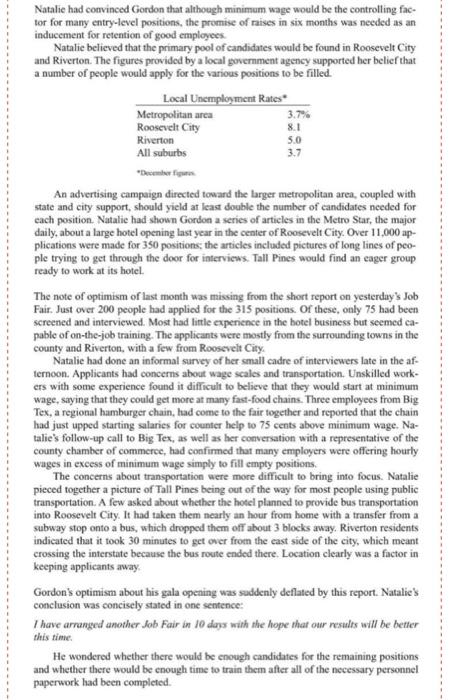
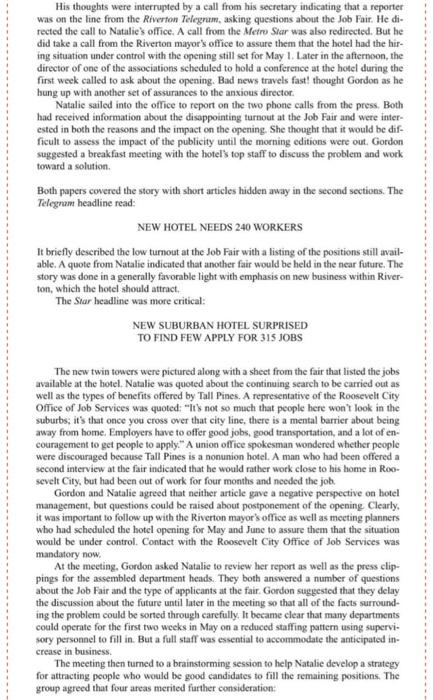
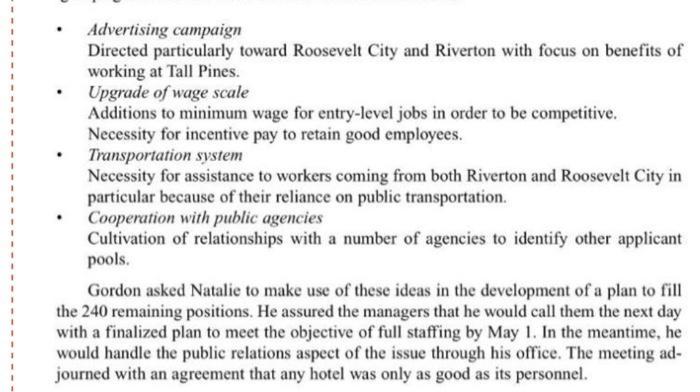
Question: question: point out the deficiencies in the current human resource management activities in the area of recruitment and training and provide some suggestions. Riverton comprised
question: point out the deficiencies in the current human resource management activities in the area of recruitment and training and provide some suggestions.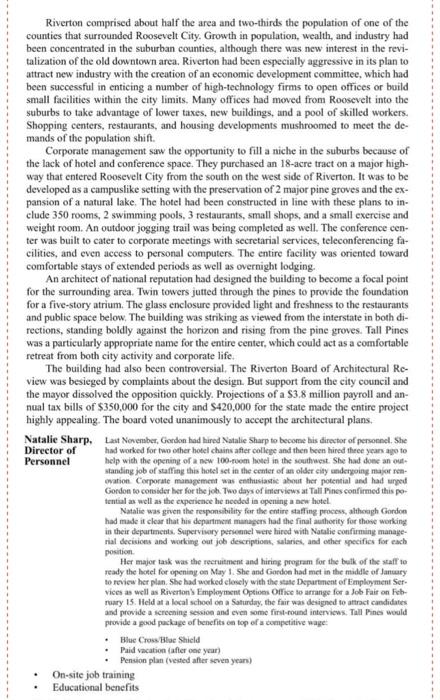
Riverton comprised about half the area and two-thirds the population of one of the counties that surrounded Roosevelt City. Growth in population, wealth, and industry had been concentrated in the suburban counties, although there was new interest in the revi- talization of the old downtown area. Riverton had been especially aggressive in its plan to attract new industry with the creation of an economic development committee, which had been successful in enticing a number of high-technology firms to open offices or build small facilities within the city limits. Many offices had moved from Roosevelt into the suburbs to take advantage of lower taxes, new buildings, and a pool of skilled workers. Shopping centers, restaurants, and housing developments mushroomed to meet the de mands of the population shift. Corporate management saw the opportunity to fill a niche in the suburbs because of the lack of hotel and conference space. They purchased an 18-acre tract on a major high- way that entered Roosevelt City from the south on the west side of Riverton. It was to be developed as a campuslike setting with the preservation of 2 major pine groves and the ex- pansion of a natural lake. The hotel had been constructed in line with these plans to in- clude 350 rooms, 2 swimming pools, 3 restaurants, small shops, and a small exercise and weight room. An outdoor jogging trail was being completed as well. The conference cen- ter was built to cater to corporate meetings with secretarial services, teleconferencing fa- cilities, and even access to personal computers. The entire facility was oriented toward comfortable stays of extended periods as well as overnight lodging. An architect of national reputation had designed the building to become a focal point for the surrounding area. Twin Towers jutted through the pines to provide the foundation for a five-story atrium. The glass enclosure provided light and freshness to the restaurants and public space below. The building was striking as viewed from the interstate in both di- rections, standing boldly against the horizon and rising from the pine groves. Tall Pines was a particularly appropriate name for the entire center, which could act as a comfortable retreat from both city activity and corporate life. The building had also been controversial. The Riverton Board of Architectural Rc- view was besieged by complaints about the design. But support from the city council and the mayor dissolved the opposition quickly. Projections of a $3.8 million payroll and an nual tax bills of $350,000 for the city and S420,000 for the state made the entire project highly appealing. The board voted unanimously to accept the architectural plans, Natalie Sharp, Last November, Gordon had hired Natalie Sharp to become his director of personnel. She Director of had worked for two other hotel chains after college and then been hired three years ago to Personnel help with the opening of a new 100-foom here in the southwest. She had done an out standing job of staffing this hotel set in the center of an older city undergoing major ren- ovation Corporate management was enthusiastic about her potential and had urged Gordon to consider her for the job. Two days of interviews at Tall Pines confirmed this po tential as well as the experience he needed in opening a new hotel Natalie was given the responsibility for the entire staffing process, although Gordon had made it clear that his department managers had the final authority for those working in their departments Supervisory personnel were hired with Natalie confirming manage rial decisions and working out job descriptions, salaries, and other specifies for each position Her major task was the recruitment and hiring program for the bulk of the staff to ready the hotel for opening on May 1. She and Gordon had met in the middle of January to review her plan. She had worked closely with the state Department of Employment Ser. vices as well as Riverton's Employment Options Office to arrange for a Job Fair on fich ruary 15. Held at a local school on a Saturday, the fair was designed to attract candidates and provide a screening session and even some first round interviews. Till Pines would provide a good package of benefits on top of a competitive wage Blue Cross Blue Shield Paid vacation after one year) Pension plan (vested after seven years) On-site job training Educational benefits 1 Natalie had convinced Gordon that although minimum wage would be the controlling fac- tor for many entry-level positions, the promise of raises in six months was needed as an inducement for retention of good employees Natalie believed that the primary pool of candidates would be found in Roosevelt City and Riverton. The figures provided by a local government agency supported her belief that a number of people would apply for the various positions to be filled. Local Unemployment Rates Metropolitan area 3.7% Roosevelt City 8.1 Riverton 5.0 All suburbs 3.7 An advertising campaign directed toward the larger metropolitan area, coupled with state and city support should yield at least double the number of candidates needed for cach position. Natalie had shown Gordon a series of articles in the Metro Star, the major daily, about a large hotel opening last year in the center of Roosevelt City. Over 11,000 ap- plications were made for 350 positions, the articles included pictures of long lines of peo- ple trying to get through the door for interviews. Tall Pines would find an eager group ready to work at its hotel. The note of optimism of last month was missing from the short report on yesterday's Job Fair. Just over 200 people had applied for the 315 positions. Of these, only 75 had been screened and interviewed. Most had little experience in the hotel business but seemed ca- pable of on-the-job training. The applicants were mostly from the surrounding towns in the county and Riverton, with a few from Roosevelt City Natalie had done an informal survey of her small cadre of interviewers late in the af- lernoon. Applicants had concerns about wage scales and transportation. Unskilled work ers with some experience found it difficult to believe that they would start at minimum wage, saying that they could get more at many fast-food chains. Three employees from Big Tex, a regional hamburger chain, had come to the fair together and reported that the chain had just upped starting salaries for counter help to 75 cents above minimum wage. Na- talie's follow-up call to Big Tex, as well as her conversation with a representative of the county chamber of commerce, had confirmed that many employers were offering hourly wages in excess of minimum wage simply to fill empty positions The concerns about transportation were more difficult to bring into focus. Natalie pieced together a picture of Tall Pines being out of the way for most people using public transportation. A few asked about whether the hotel planned to provide bus transportation into Roosevelt City. It had taken them nearly an hour from home with a transfer from a subway stop onto a bus, which dropped them off about 3 blocks away. Riverton residents indicated that it took 30 minutes to get over from the cast side of the city, which meant crossing the interstate because the bus route ended there. Location clearly was a factor in keeping applicants away Gordon's optimism about his gala opening was suddenly deflated by this report. Natalie's conclusion was concisely stated in one sentence: I have arranged another Job Fair in 10 days with the hope that our results will be better this time He wondered whether there would be enough candidates for the remaining positions and whether there would be enough time to train them after all of the necessary personnel paperwork had been completed. His thoughts were interrupted by a call from his secretary indicating that a reporter was on the line from the Riverton Telegram, asking questions about the Job Fair. He di- rected the call to Natalie's office. A call from the Metro Star was also redirected. But he did take a call from the Riverton mayor's office to assure them that the hotel had the hir- ing situation under control with the opening still set for May 1. Later in the afternoon, the director of one of the associations scheduled to hold a conference at the hotel during the first week called to ask about the opening. Bad news travels fast! thought Gordon as he hung up with another set of assurances to the anxious director Natalie sailed into the office to report on the two phone calls from the press. Both had received information about the disappointing turnout at the Job Fair and were inter- ested in both the reasons and the impact on the opening. She thought that it would be dif- ficult to assess the impact of the publicity until the morning editions were out. Gordon suggested a breakfast meeting with the hotel's top staff to discuss the problem and work toward a solution Both papers covered the story with short articles hidden away in the second sections. The Telegram headline read: NEW HOTEL NEEDS 240 WORKERS It briefly described the low turnout at the Job Fair with a listing of the positions still avail- able. A quote from Natalie indicated that another fair would be held in the near future. The story was done in a generally favorable light with emphasis on new business within River ton, which the hotel should attract The Star headline was more critical: NEW SUBURBAN HOTEL SURPRISED TO FIND FEW APPLY FOR 315 JOBS The new twin towers were pictured along with a sheet from the fair that listed the jobs available at the hotel. Natalie was quoted about the continuing search to be carried out as well as the types of benefits offered by Tall Pines. A representative of the Roosevelt City Office of Job Services was quoted: "It's not so much that people here won't look in the suburbs; it's that once you cross over that city line, there is a mental barrier about being away from home. Employers have to offer good jobs, good transportation, and a lot of en- couragement to get people to apply." A union office spokesman wondered whether people were discouraged because Tall Pines is a nonunion hotel. A man who had been offered a second interview at the fair indicated that he would rather work close to his home in Roo- sevelt City, but had been out of work for four months and needed the job, Gordon and Natalie agreed that neither article gave a negative perspective on hotel management, but questions could be raised about postponement of the opening Clearly, it was important to follow up with the Riverton mayor's office as well as meeting planners who had scheduled the hotel opening for May and June to assure them that the situation would be under control. Contact with the Roosevelt City Office of Job Services was mandatory now At the meeting. Gordon asked Natalie to review her report as well as the press clip- pings for the assembled department heads. They both answered a number of questions about the Job Fair and the type of applicants at the fair. Gordon suggested that they delay the discussion about the future until later in the meeting so that all of the facts surround- ing the problem could be sorted through carefully. It became clear that many departments could operate for the first two weeks in May on a reduced staffing pattern using supervi- sory personnel to fill in. But a full staff was essential to accommodate the anticipated in crease in business The meeting then turned to a brainstorming session to help Natalie develop a strategy for attracting poople who would be good candidates to fill the remaining positions. The group agreed that four areas merited further consideration: Advertising campaign Directed particularly toward Roosevelt City and Riverton with focus on benefits of working at Tall Pines. Upgrade of wage scale Additions to minimum wage for entry-level jobs in order to be competitive. Necessity for incentive pay to retain good employees. Transportation system Necessity for assistance to workers coming from both Riverton and Roosevelt City in particular because of their reliance on public transportation. Cooperation with public agencies Cultivation of relationships with a number of agencies to identify other applicant pools. Gordon asked Natalie to make use of these ideas in the development of a plan to fill the 240 remaining positions. He assured the managers that he would call them the next day with a finalized plan to meet the objective of full staffing by May 1. In the meantime, he would handle the public relations aspect of the issue through his office. The meeting ad- journed with an agreement that any hotel was only as good as its personnel