







Question: Question: Quantitative , SWOT analysis and ROI analysis Oak Industrial Products: Grippy In early April 2023, Darrell Robinson, marketing director of the New Products Division
Question:
Quantitative , SWOT analysis and ROI analysis
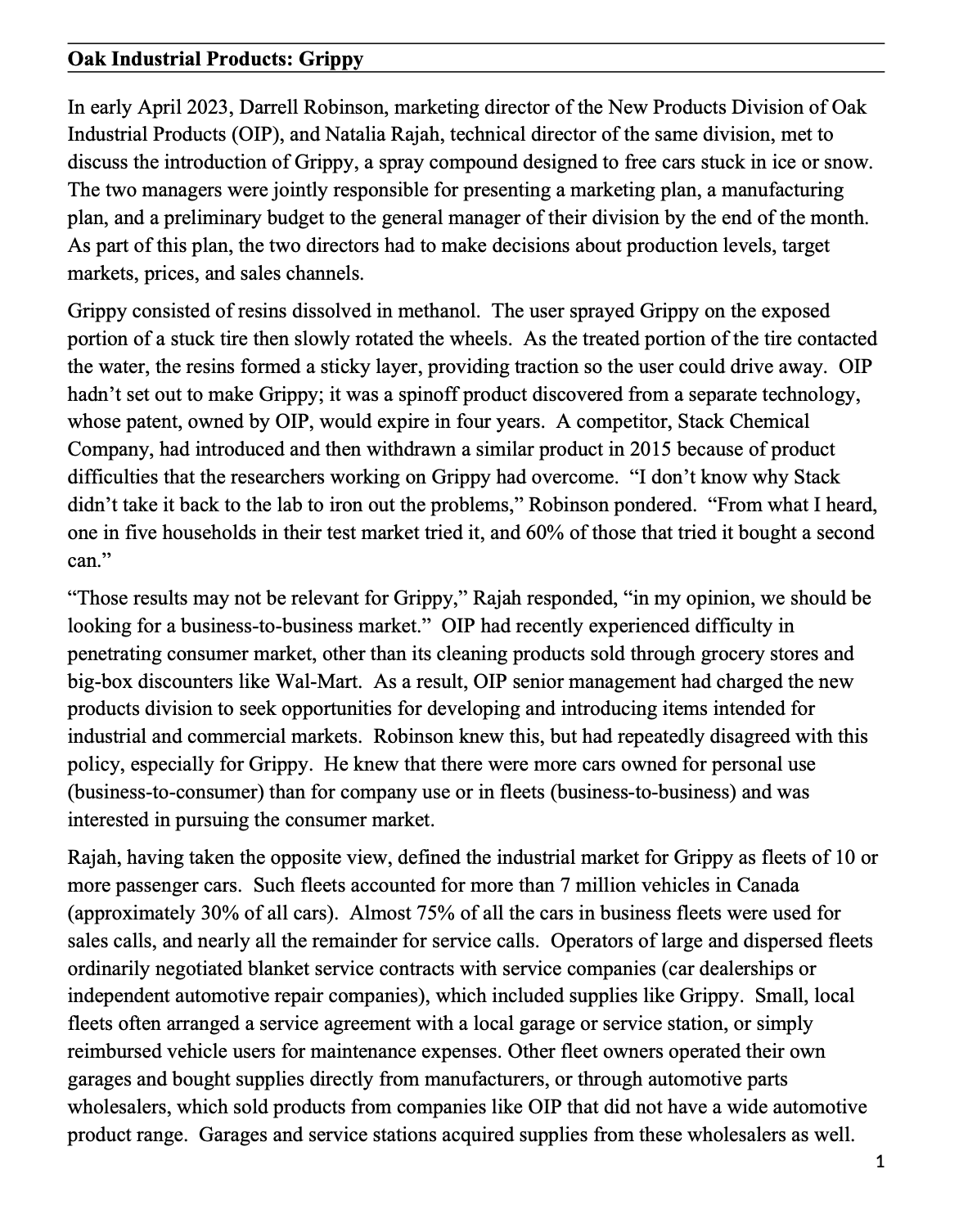
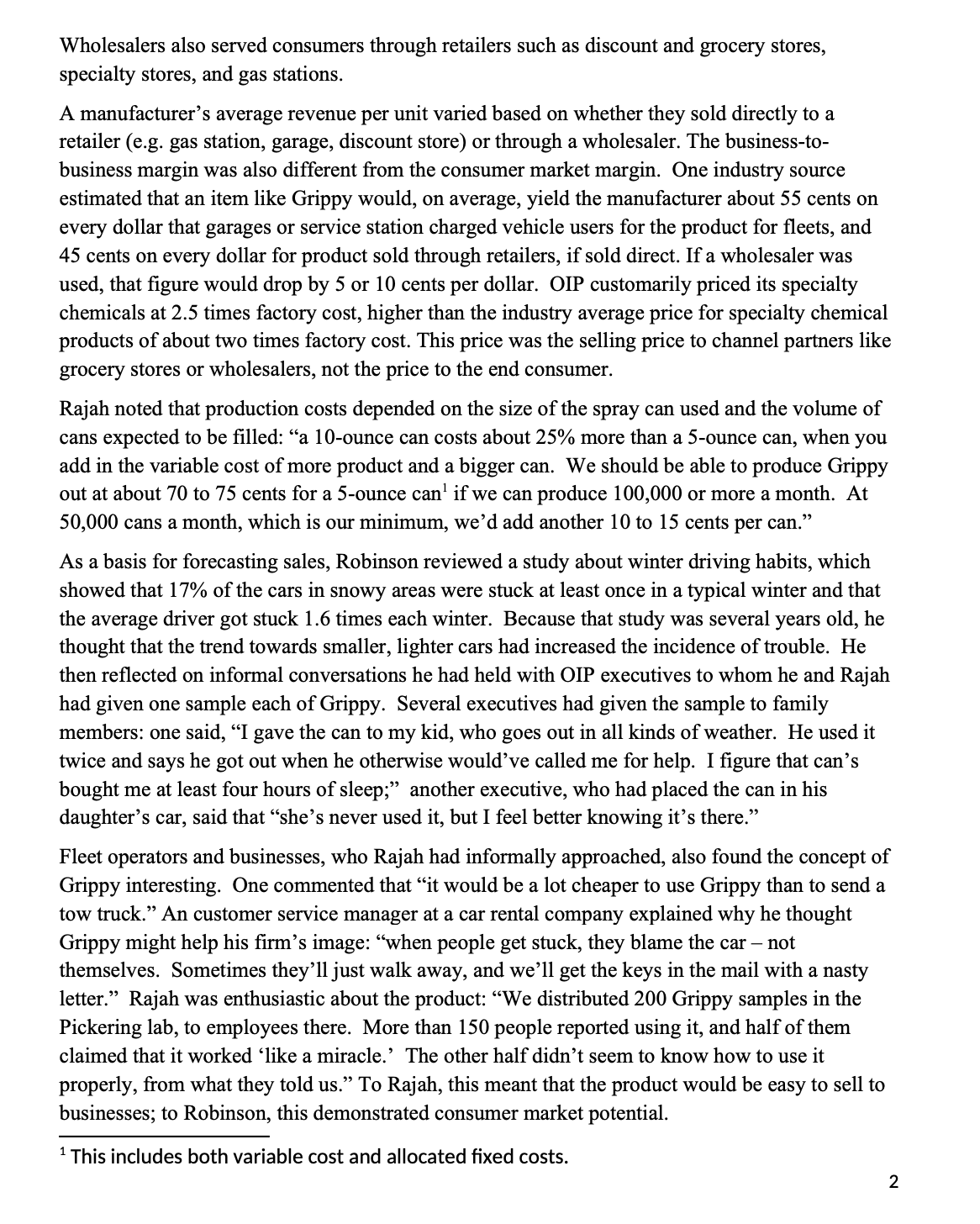
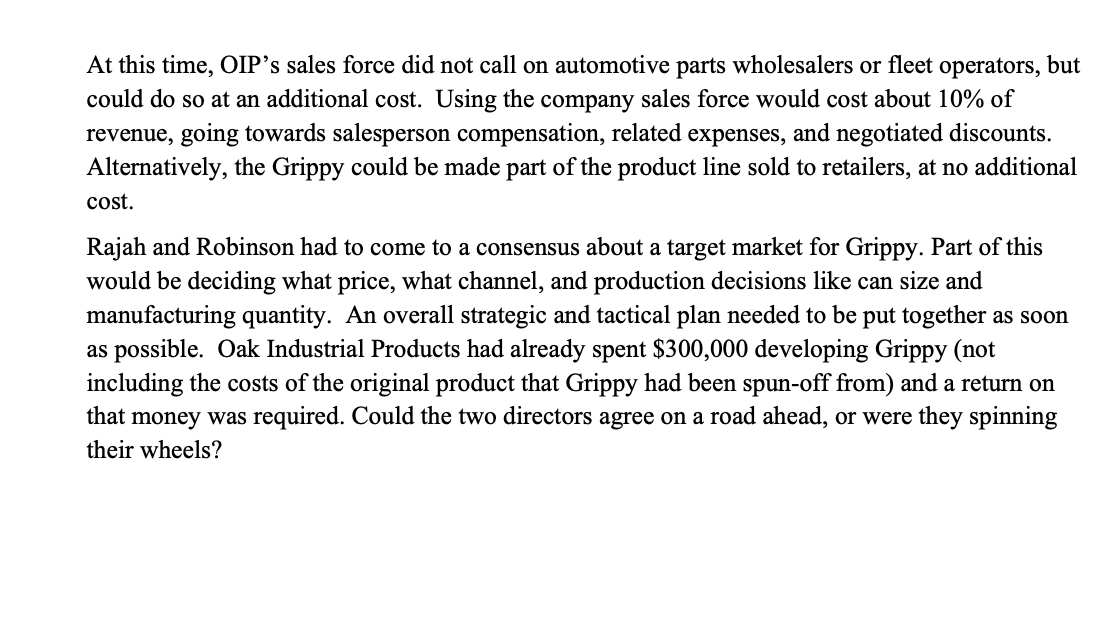
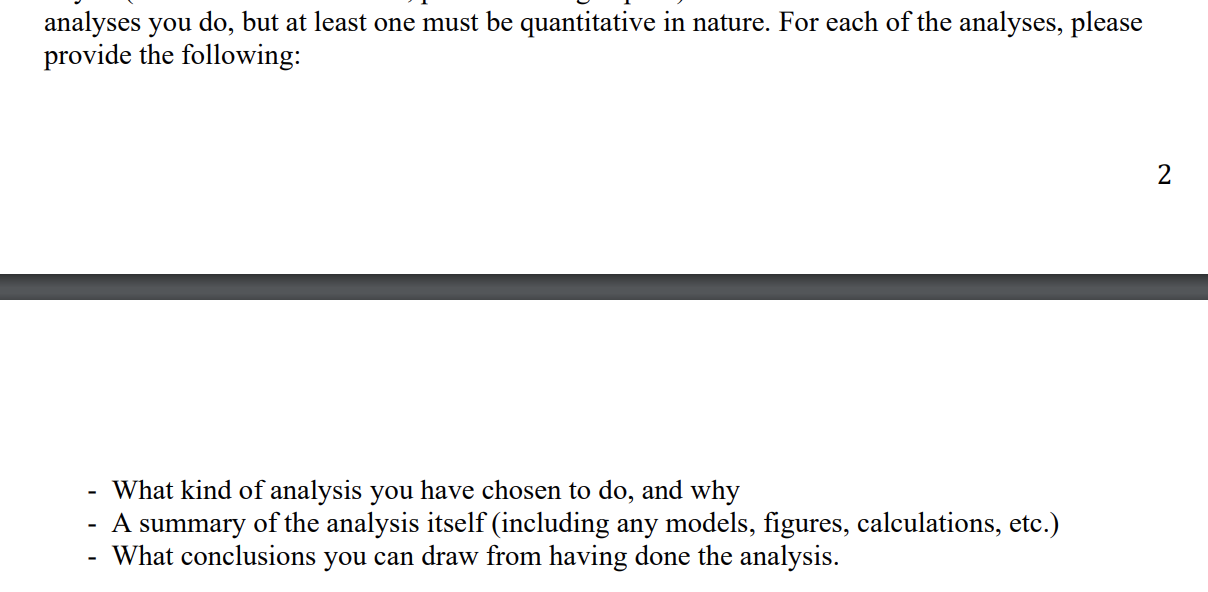
Oak Industrial Products: Grippy In early April 2023, Darrell Robinson, marketing director of the New Products Division of Oak Industrial Products (OIP), and Natalia Rajah, technical director of the same division, met to discuss the introduction of Grippy, a spray compound designed to free cars stuck in ice or snow. The two managers were jointly responsible for presenting a marketing plan, a manufacturing plan, and a preliminary budget to the general manager of their division by the end of the month. As part of this plan, the two directors had to make decisions about production levels, target markets, prices, and sales channels. Grippy consisted of resins dissolved in methanol. The user sprayed Grippy on the exposed portion of a stuck tire then slowly rotated the wheels. As the treated portion of the tire contacted the water, the resins formed a sticky layer, providing traction so the user could drive away. OIP hadn't set out to make Grippy; it was a spinoff product discovered from a separate technology, whose patent, owned by OIP, would expire in four years. A competitor, Stack Chemical Company, had introduced and then withdrawn a similar product in 2015 because of product difficulties that the researchers working on Grippy had overcome. "I don't know why Stack didn't take it back to the lab to iron out the problems," Robinson pondered. "From what I heard, one in five households in their test market tried it, and 60% of those that tried it bought a second can." "Those results may not be relevant for Grippy," Rajah responded, "in my opinion, we should be looking for a business-to-business market." OIP had recently experienced difficulty in penetrating consumer market, other than its cleaning products sold through grocery stores and big-box discounters like Wal-Mart. As a result, OIP senior management had charged the new products division to seek opportunities for developing and introducing items intended for industrial and commercial markets. Robinson knew this, but had repeatedly disagreed with this policy, especially for Grippy. He knew that there were more cars owned for personal use (business-to-consumer) than for company use or in fleets (business-to-business) and was interested in pursuing the consumer market. Rajah, having taken the opposite view, defined the industrial market for Grippy as fleets of 10 or more passenger cars. Such fleets accounted for more than 7 million vehicles in Canada (approximately 30% of all cars). Almost 75% of all the cars in business fleets were used for sales calls, and nearly all the remainder for service calls. Operators of large and dispersed fleets ordinarily negotiated blanket service contracts with service companies (car dealerships or independent automotive repair companies), which included supplies like Grippy. Small, local fleets often arranged a service agreement with a local garage or service station, or simply reimbursed vehicle users for maintenance expenses. Other fleet owners operated their own garages and bought supplies directly from manufacturers, or through automotive parts wholesalers, which sold products from companies like OIP that did not have a wide automotive product range. Garages and service stations acquired supplies from these wholesalers as well. 1 analyses you do, but at least one must be quantitative in nature. For each of the analyses, please provide the following: - What kind of analysis you have chosen to do, and why - A summary of the analysis itself (including any models, figures, calculations, etc.) - What conclusions you can draw from having done the analysis. At this time, OIP's sales force did not call on automotive parts wholesalers or fleet operators, but could do so at an additional cost. Using the company sales force would cost about 10% of revenue, going towards salesperson compensation, related expenses, and negotiated discounts. Alternatively, the Grippy could be made part of the product line sold to retailers, at no additional cost. Rajah and Robinson had to come to a consensus about a target market for Grippy. Part of this would be deciding what price, what channel, and production decisions like can size and manufacturing quantity. An overall strategic and tactical plan needed to be put together as soon as possible. Oak Industrial Products had already spent $300,000 developing Grippy (not including the costs of the original product that Grippy had been spun-off from) and a return on that money was required. Could the two directors agree on a road ahead, or were they spinning their wheels? Wholesalers also served consumers through retailers such as discount and grocery stores, specialty stores, and gas stations. A manufacturer's average revenue per unit varied based on whether they sold directly to a retailer (e.g. gas station, garage, discount store) or through a wholesaler. The business-tobusiness margin was also different from the consumer market margin. One industry source estimated that an item like Grippy would, on average, yield the manufacturer about 55 cents on every dollar that garages or service station charged vehicle users for the product for fleets, and 45 cents on every dollar for product sold through retailers, if sold direct. If a wholesaler was used, that figure would drop by 5 or 10 cents per dollar. OIP customarily priced its specialty chemicals at 2.5 times factory cost, higher than the industry average price for specialty chemical products of about two times factory cost. This price was the selling price to channel partners like grocery stores or wholesalers, not the price to the end consumer. Rajah noted that production costs depended on the size of the spray can used and the volume of cans expected to be filled: "a 10 -ounce can costs about 25% more than a 5-ounce can, when you add in the variable cost of more product and a bigger can. We should be able to produce Grippy out at about 70 to 75 cents for a 5 -ounce can 1 if we can produce 100,000 or more a month. At 50,000 cans a month, which is our minimum, we'd add another 10 to 15 cents per can." As a basis for forecasting sales, Robinson reviewed a study about winter driving habits, which showed that 17% of the cars in snowy areas were stuck at least once in a typical winter and that the average driver got stuck 1.6 times each winter. Because that study was several years old, he thought that the trend towards smaller, lighter cars had increased the incidence of trouble. He then reflected on informal conversations he had held with OIP executives to whom he and Rajah had given one sample each of Grippy. Several executives had given the sample to family members: one said, "I gave the can to my kid, who goes out in all kinds of weather. He used it twice and says he got out when he otherwise would've called me for help. I figure that can's bought me at least four hours of sleep;" another executive, who had placed the can in his daughter's car, said that "she's never used it, but I feel better knowing it's there." Fleet operators and businesses, who Rajah had informally approached, also found the concept of Grippy interesting. One commented that "it would be a lot cheaper to use Grippy than to send a tow truck." An customer service manager at a car rental company explained why he thought Grippy might help his firm's image: "when people get stuck, they blame the car - not themselves. Sometimes they'll just walk away, and we'll get the keys in the mail with a nasty letter." Rajah was enthusiastic about the product: "We distributed 200 Grippy samples in the Pickering lab, to employees there. More than 150 people reported using it, and half of them claimed that it worked 'like a miracle.' The other half didn't seem to know how to use it properly, from what they told us." To Rajah, this meant that the product would be easy to sell to businesses; to Robinson, this demonstrated consumer market potential. 1 This includes both variable cost and allocated fixed costs. 2
Step by Step Solution
There are 3 Steps involved in it

Get step-by-step solutions from verified subject matter experts
 Study Help