







Question: Question The basic New Keynesian model is summarized by the following system: The Phillips curve: It = BE It+1 + KXt The dynamic IS curve:
Question
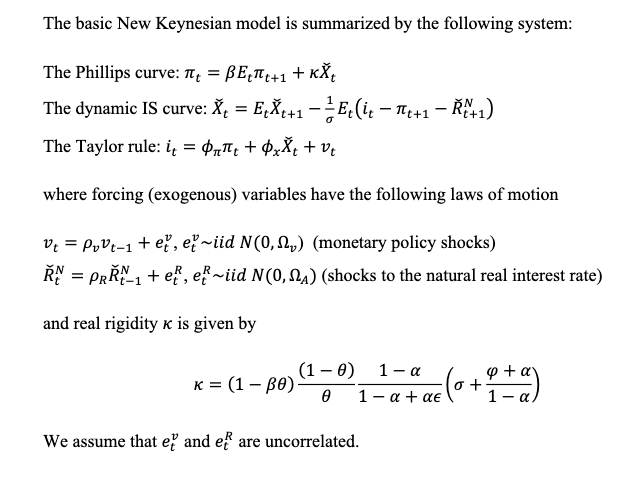
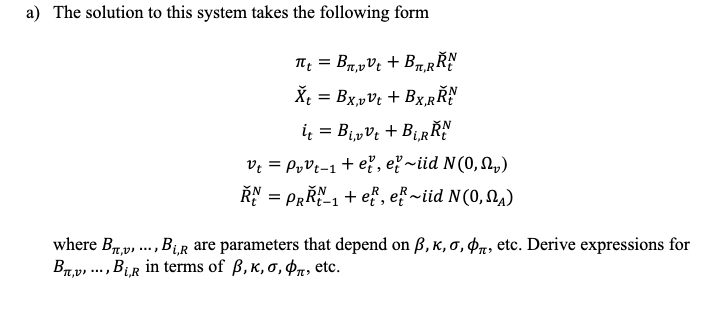
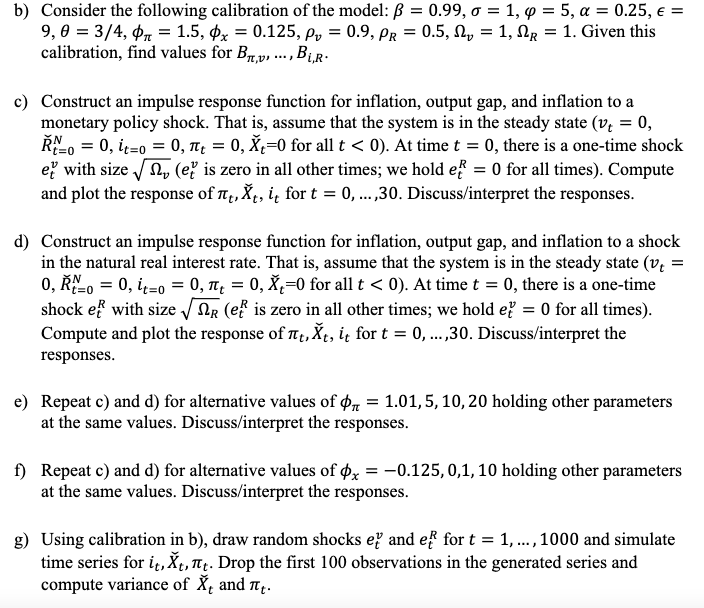
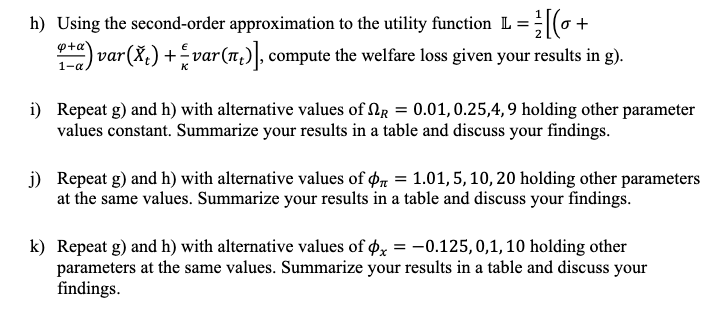
The basic New Keynesian model is summarized by the following system: The Phillips curve: It = BE It+1 + KXt The dynamic IS curve: Xt = EXt+1 - Et (it - nt+1 - Rit1) The Taylor rule: it = Pull, + QxX, + v. where forcing (exogenous) variables have the following laws of motion Vt = PpVt-1+ ey, er-iid N(0, Q,) (monetary policy shocks) RY = PRRN , + ep, ep~iid N(0, n,) (shocks to the natural real interest rate) and real rigidity k is given by (1- 0) 1 - a K = (1 - Be) e 1 - a + de 1 - a We assume that ey and ef are uncorrelated.a) The solution to this system takes the following form It = BR,DVt + BARRN Xt = BXput + BXRRy it = BivVe + BERRY Vt = Pyle- tep, ep~iid N(0, Q) RN = PRRi_1 + er, ep ~iid N(0, QA) where BID. ..., BAR are parameters that depend on B, K, , 47, etc. Derive expressions for BI,D. ..., BAR in terms of B, K, o, $7, etc.b) Consider the following calibration of the model: B = 0.99, o = 1, p = 5, a = 0.25, 6 = 9, 0 = 3/4, $7 = 1.5, 4x = 0.125, py = 0.9, PR = 0.5, 0, = 1, OR = 1. Given this calibration, find values for Br,D. ..., Bi,R. c) Construct an impulse response function for inflation, output gap, and inflation to a monetary policy shock. That is, assume that the system is in the steady state (V, = 0, Re-0 = 0, it=0 = 0, It = 0, Xt=0 for all t
Step by Step Solution
There are 3 Steps involved in it

Get step-by-step solutions from verified subject matter experts
 Study Help