Question: question the protocol stack. Is there an equivalent notion of header information that is added to passengers and baggage as they move down the airline
question
the protocol stack. Is there an equivalent notion of header information that is added to passengers and baggage as they move down the airline protocol stack? P31. In modern packet-switched networks, including the Internet, the source host segments long, application-layer messages (for example, an image or a music file) into smaller packets and sends the packets into the network. The receiver then reassembles the packets back into the original message. We refer to this process as message segmentation. Figure 1.27 illustrates the end-to-end transport of a message with and without message segmentation. Consider a message that is 8 106 bits long that is to be sent from source to destination in Figure 1.27. Suppose each link in the figure is 2 Mbps. Ignore propagation, queuing, and processing delays. a. Consider sending the message from source to destination without message segmentation. How long does it take to move the message from the source host to the first packet switch? Keeping in mind that each switch uses store-and-forward packet switching, what is the total time to move the message from source host to destination host? b. Now suppose that the message is segmented into 800 packets, with each packet being 10,000 bits long. How long does it take to move the first packet from source host to the first switch? When the first packet is being sent from the first switch to the second switch, the second packet is being sent from the source host to the first switch. At what time will the second packet be fully received at the first switch? c. How long does it take to move the file from source host to destination host when message segmentation is used? Compare this result with your answer in part (a) and comment.
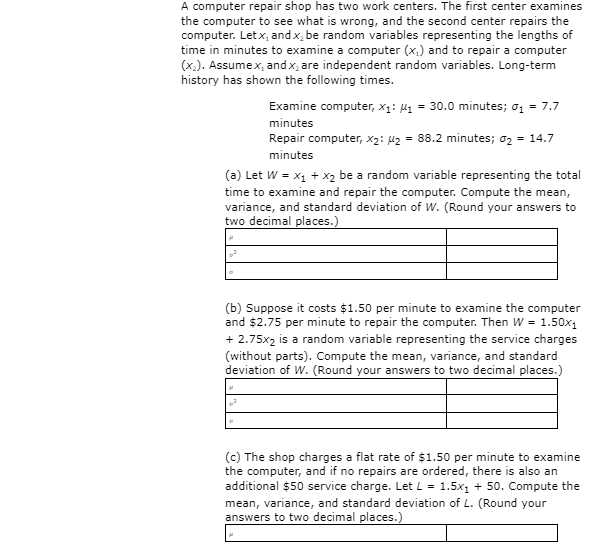
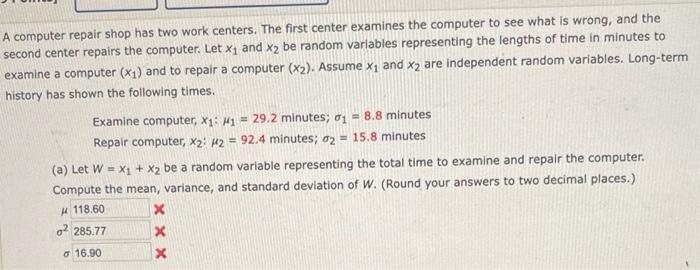
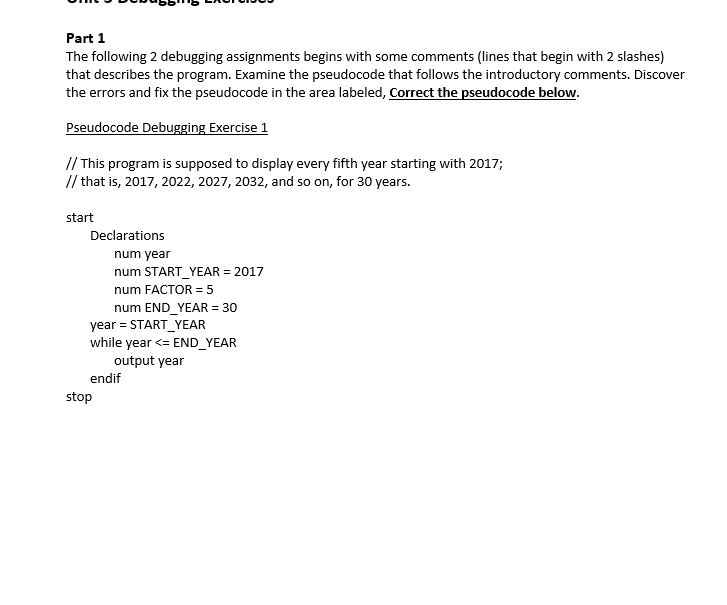
A computer repair shop has two work centers. The first center examines the computer to see what is wrong, and the second center repairs the computer. Letx, and x, be random variables representing the lengths of time in minutes to examine a computer (x, ) and to repair a computer (x ). Assume x, and x are independent random variables. Long-term history has shown the following times. Examine computer, X1: M1 = 30.0 minutes; 01 = 7.7 minutes Repair computer, X2: M2 = 88.2 minutes; 02 = 14.7 minutes (a) Let W = x1 + x2 be a random variable representing the total time to examine and repair the computer. Compute the mean, variance, and standard deviation of W. (Round your answers to two decimal places.) (b) Suppose it costs $1.50 per minute to examine the computer and $2.75 per minute to repair the computer, Then W = 1.50x1 + 2.75x2 is a random variable representing the service charges (without parts). Compute the mean, variance, and standard deviation of W. (Round your answers to two decimal places.) (c) The shop charges a flat rate of $1.50 per minute to examine the computer, and if no repairs are ordered, there is also an additional $50 service charge. Let & = 1.5x, + 50. Compute the mean, variance, and standard deviation of L. (Round your answers to two decimal places.)A computer repair shop has two work centers. The first center examines the computer to see what is wrong, and the second center repairs the computer. Let x, and x2 be random variables representing the lengths of time in minutes to examine a computer (x1) and to repair a computer (x2). Assume x, and x2 are independent random variables. Long-term history has shown the following times. Examine computer, x1: #1 = 29.2 minutes; of = 8.8 minutes Repair computer, x2: #2 = 92.4 minutes; 02 = 15.8 minutes (a) Let W = x1 + x2 be a random variable representing the total time to examine and repair the computer. Compute the mean, variance, and standard deviation of W. (Round your answers to two decimal places.) "# 118.60 X 02 285.77 X 16.90 XPart 1 The following 2 debugging assignments begins with some comments (lines that begin with 2 slashes) that describes the program. Examine the pseudocode that follows the introductory comments. Discover the errors and fix the pseudocode in the area labeled, Correct the pseudocode below. Pseudocode Debugging Exercise 1 // This program is supposed to display every fifth year starting with 2017; // that is, 2017, 2022, 2027, 2032, and so on, for 30 years. start Declarations num year num START YEAR = 2017 num FACTOR = 5 num END_YEAR = 30 year = START_YEAR while year
Step by Step Solution
There are 3 Steps involved in it
1 Expert Approved Answer
Step: 1 Unlock
Question Has Been Solved by an Expert!
Get step-by-step solutions from verified subject matter experts
Step: 2 Unlock
Step: 3 Unlock
Students Have Also Explored These Related General Management Questions!









 Study Help