







Question: QUESTION: There are 4 structures that is mentioned in the case. Initial structure, 1st, 2nd, 3rd and final structure. According to these structures (Whichever is
QUESTION:
There are 4 structures that is mentioned in the case. Initial structure, 1st, 2nd, 3rd and final structure.
According to these structures (Whichever is in the case): Functional Structure, Divisional Structure, Initial structure, Multidivisional structure , Product Structure, Mechanistic structure, Organizational structure, Product Team Structure, Matrix Structure, Hybrid Structure, Network Structure)
Explain the transformation reasons for each structure in the case.
Explain the advantages & disadvantages of each structure that GM built.
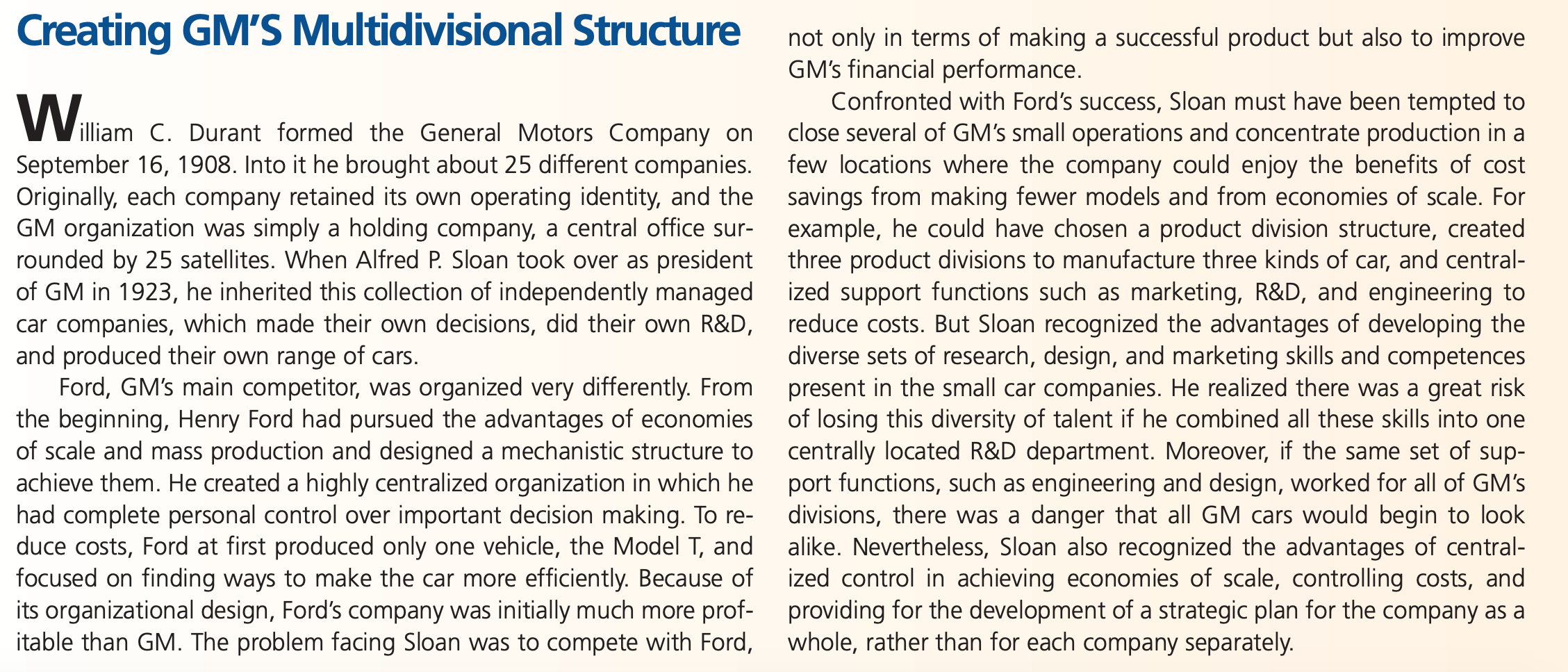
William C. Durant formed the General Motors Company on Creating GM'S Multidivisional Structure not only in terms of making a successful product but also to improve GM's financial performance. Confronted with Ford's success, Sloan must have been tempted to close several of GM's small operations and concentrate production in a September 16, 1908. Into it he brought about 25 different companies. few locations where the company could enjoy the benefits of cost Originally, each company retained its own operating identity, and the savings from making fewer models and from economies of scale. For GM organization was simply a holding company, a central office sur- example, he could have chosen a product division structure, created rounded by 25 satellites. When Alfred P. Sloan took over as president three product divisions to manufacture three kinds of car, and central- of GM in 1923, he inherited this collection of independently managed ized support functions such as marketing, R&D, and engineering to car companies, which made their own decisions, did their own R&D, reduce costs. But Sloan recognized the advantages of developing the and produced their own range of cars. diverse sets of research, design, and marketing skills and competences Ford, GM's main competitor, was organized very differently. From present in the small car companies. He realized there was a great risk the beginning, Henry Ford had pursued the advantages of economies of losing this diversity of talent if he combined all these skills into one of scale and mass production and designed a mechanistic structure to centrally located R&D department. Moreover, if the same set of sup- achieve them. He created a highly centralized organization in which he port functions, such as engineering and design, worked for all of GM's had complete personal control over important decision making. To re- divisions, there was a danger that all GM cars would begin to look duce costs, Ford at first produced only one vehicle, the Model T, and alike. Nevertheless, Sloan also recognized the advantages of central- focused on finding ways to make the car more efficiently. Because of ized control in achieving economies of scale, controlling costs, and its organizational design, Ford's company was initially much more prof- providing for the development of a strategic plan for the company as a itable than GM. The problem facing Sloan was to compete with Ford, whole, rather than for each company separately. So Sloan searched for an organizational structure that would allow him to achieve all these objectives simultaneously, and he found his answer in the multidivisional structure, which had been used success- fully by DuPont Chemicals. In 1920, he instituted this change, noting that GM "needs to find a principle for coordination without losing the advantages of decentralization."6 All of GM's different car companies were placed in one of five self- contained operating divisions (Chevrolet, Pontiac, Oldsmobile, Buick, and Cadillac) with support services like sales, production, engineering, and fi- nance. Each division became a profit center and was evaluated on its re- turn on investment. Sloan was quite clear about the main advantage of linking decentralization to return on investment: It raised the visibility of each division's performance. And, Sloan observed, it (1) "increases the morale of the organization by placing each operation on its own founda- tion,... assuming its own responsibility and contributing its share to the final result"; (2) "develops statistics correctly reflecting... the true meas- ure of efficiency"; and (3) "enables the corporation to direct the placing of additional capital where it will result in the greatest benefit to the cor- poration as a whole."7 Sloan recommended that transactions between divisions be set by a transfer pricing scheme based on cost plus some predetermined rate of return. However, to avoid protecting an inefficient high-cost internal supplier, he also recommended a number of steps involving analysis of the operations of outside competitors to determine the fair price. Sloan established a strong, professional, centralized headquarters management staff to perform such calculations. Corporate manage- ment's primary role was to audit divisional performance and to plan strategy for the total organization. Divisional managers were to be re- sponsible for all product-related decisions. In the 1980s, after fierce competition from the Japanese, GM took a hard look at its multidivisional structure. The duplication of R&D and en- gineering, and the purchasing of inputs by each division independently, were costing the company billions of extra dollars. In 1984, GM's five autonomous car divisions were combined into two groups: Chevrolet and Pontiac would concentrate on small cars; Buick, Oldsmobile, and Cadillac would focus on large cars. GM hoped that the reorganization would reduce costs and speed product development, but it was a disaster. With control of success. Cadillac's management moved quickly to establish a new design and engineering more centralized at the group level, the product identity and design new models. During the 1990s, GM re- cars of the different divisions started to look the same. Nobody duced the number of different models it produced, and in 2004 it could tell a Buick from a Cadillac or an Oldsmobile. Sales plum- closed down its Oldsmobile division to reduce overhead costs. meted. Moreover, the reorganization did not speed decision mak- However, it was not able to recover by 2008 and make the innovative ing. It increased the number of levels in the hierarchy by introduc- cars U.S. customers want and, after the financial crisis of 2009, it was ing the group level into the organization. As a result, GM had 13 forced into bankruptcy. As we described in an earlier chapter, during levels in its hierarchy, as compared with Toyota, for example, which its reorganization GM closed down its Saturn and Pontiac divisions and had just 5. Once again the company was in trouble: Before the sold off its global car divisions to create a streamlined multidivisional reorganization, it had been too decentralized; now it was too cen- structure that would allow it to make innovative cars and compete tralized. What to do? effectively on price. By 2011, the new GM reported that it was once Realizing its mistake, GM moved to return control over product again profitable and that its new models of cars were selling briskly design to the divisions while continuing to centralize high-cost func- because it had finally found ways to control its organizational structure tions like engineering and purchasing. This restructuring has had some effectively. 10 Stockphoto.com/Hillary FoxStep by Step Solution
There are 3 Steps involved in it
1 Expert Approved Answer
Step: 1 Unlock

Question Has Been Solved by an Expert!
Get step-by-step solutions from verified subject matter experts
Step: 2 Unlock
Step: 3 Unlock
 Study Help