







Question: Question: There is a need for change that involves: culture shift, improved controls, restoring trust, and complying with regulations. Explain these using examples from the
Question: There is a need for change that involves: culture shift, improved controls, restoring trust, and complying with regulations. Explain these using examples from the case.
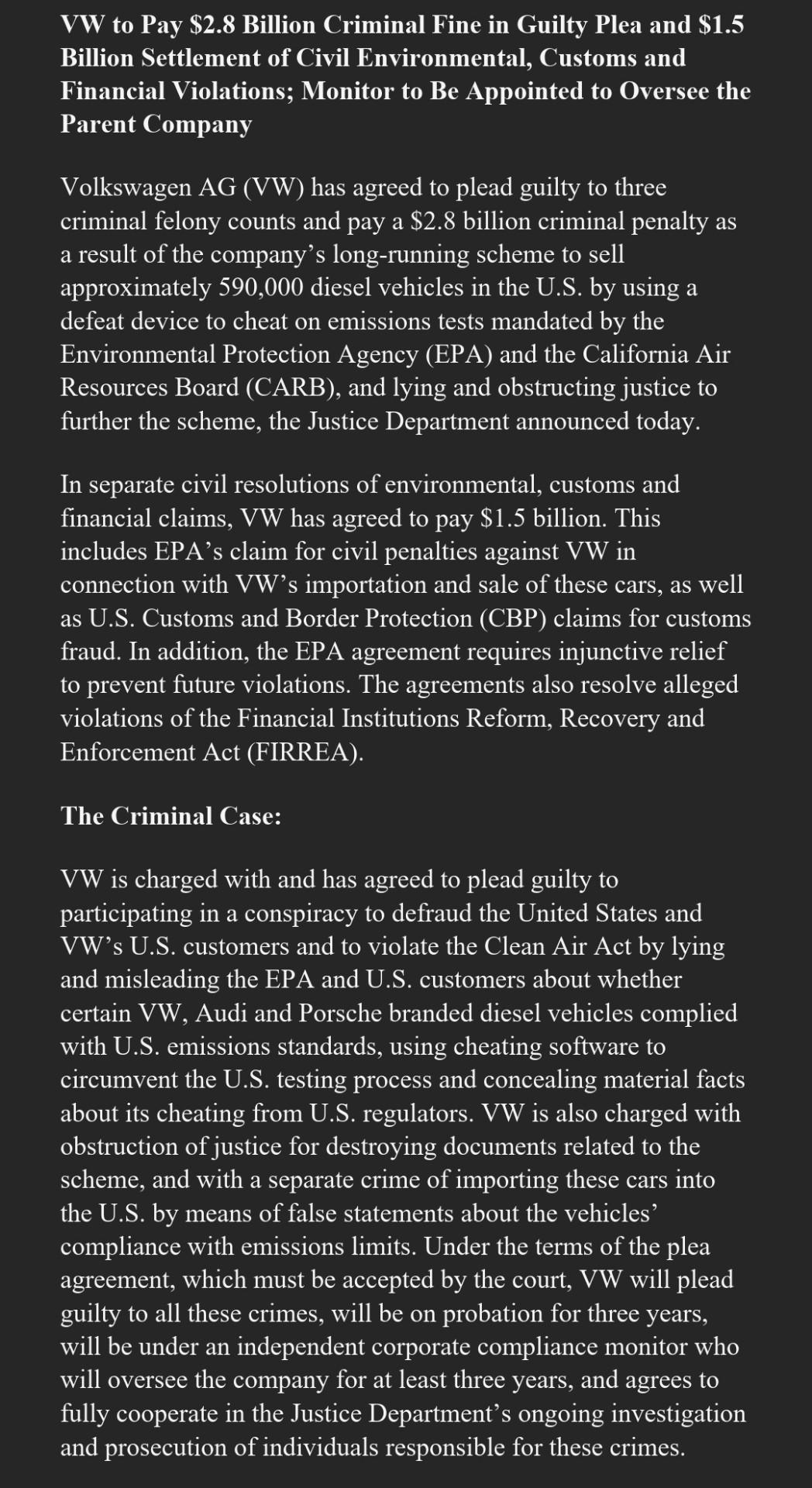
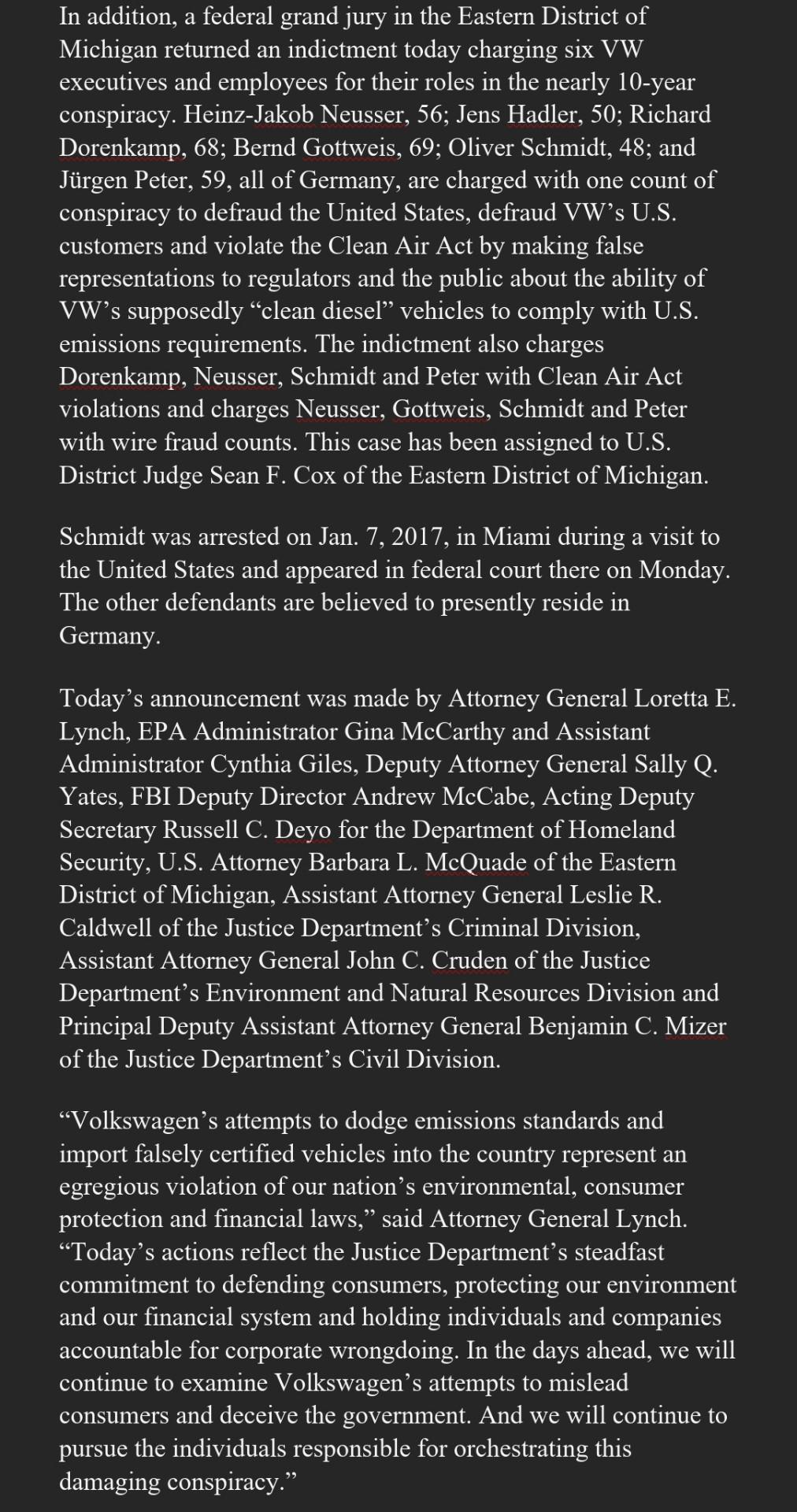
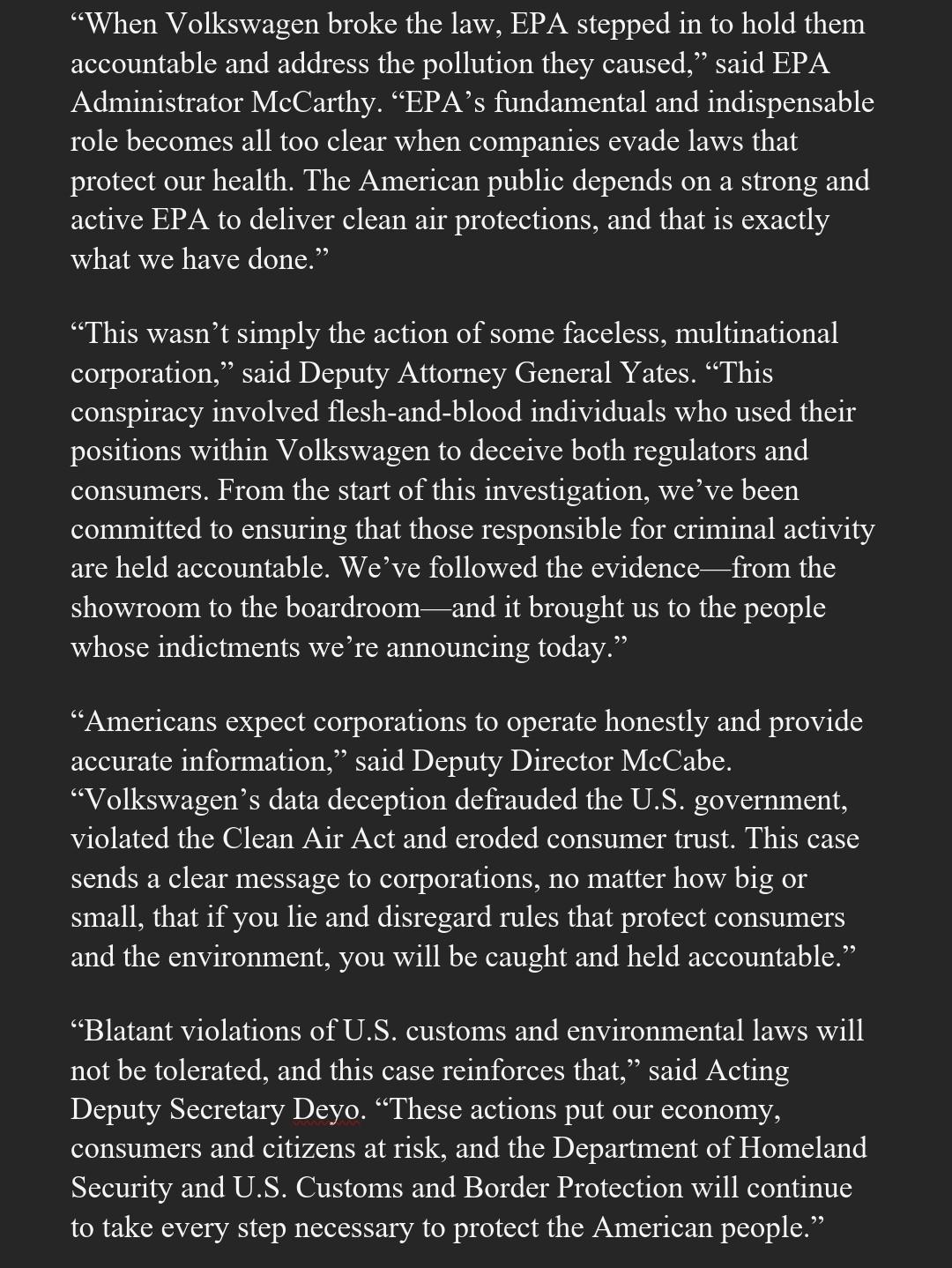
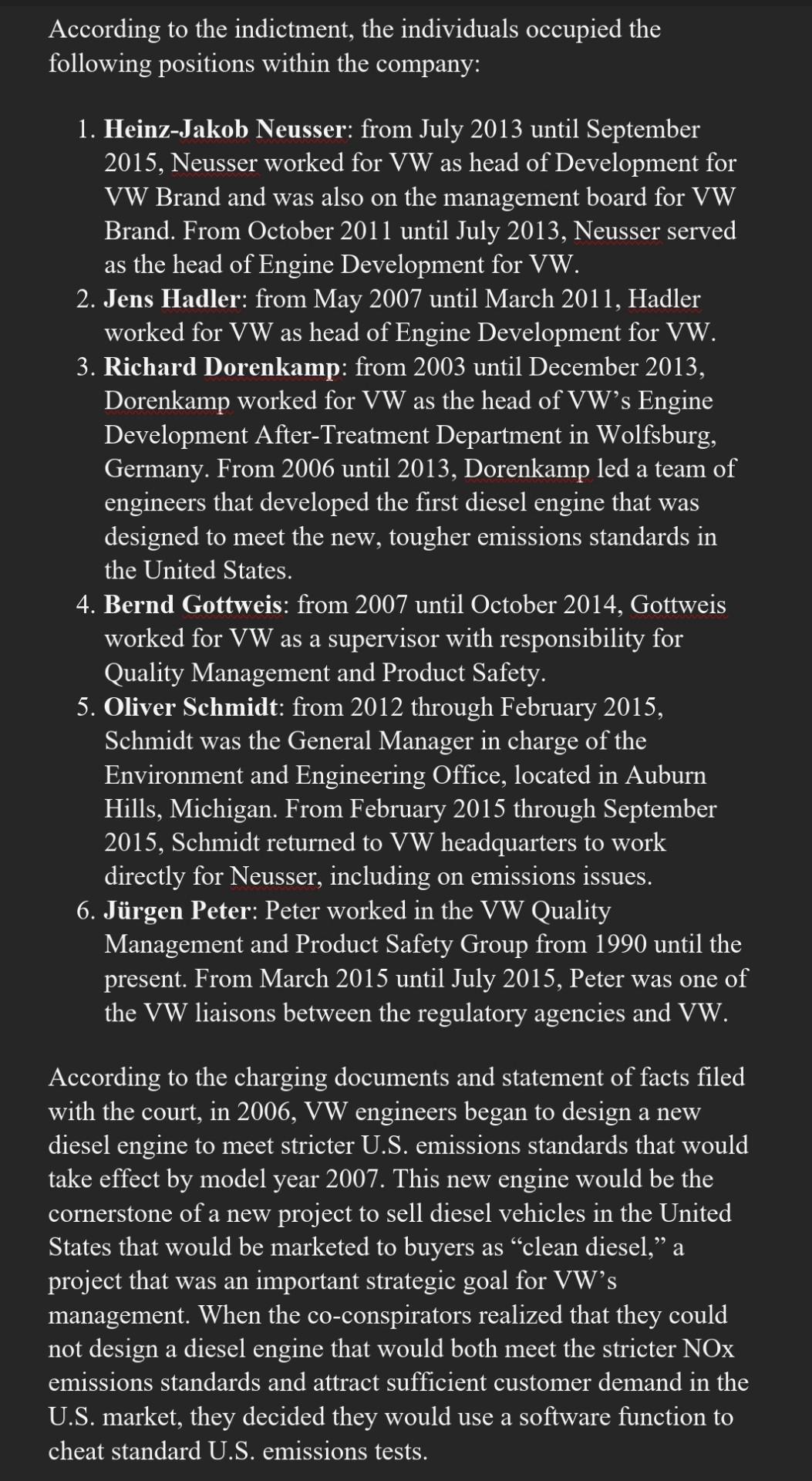
"When Volkswagen broke the law, EPA stepped in to hold them accountable and address the pollution they caused," said EPA Administrator McCarthy. "EPA's fundamental and indispensable role becomes all too clear when companies evade laws that protect our health. The American public depends on a strong and active EPA to deliver clean air protections, and that is exactly what we have done." "This wasn't simply the action of some faceless, multinational corporation," said Deputy Attorney General Yates. "This conspiracy involved flesh-and-blood individuals who used their positions within Volkswagen to deceive both regulators and consumers. From the start of this investigation, we've been committed to ensuring that those responsible for criminal activity are held accountable. We've followed the evidence-from the showroom to the boardroom - and it brought us to the people whose indictments we're announcing today." "Americans expect corporations to operate honestly and provide accurate information," said Deputy Director McCabe. "Volkswagen's data deception defrauded the U.S. government, violated the Clean Air Act and eroded consumer trust. This case sends a clear message to corporations, no matter how big or small, that if you lie and disregard rules that protect consumers and the environment, you will be caught and held accountable." "Blatant violations of U.S. customs and environmental laws will not be tolerated, and this case reinforces that," said Acting Deputy Secretary Deyo. "These actions put our economy, consumers and citizens at risk, and the Department of Homeland Security and U.S. Customs and Border Protection will continue to take every step necessary to protect the American people." According to the indictment, the individuals occupied the following positions within the company: 1. Heinz-Jakob Neusser: from July 2013 until September 2015, Neusser worked for VW as head of Development for VW Brand and was also on the management board for VW Brand. From October 2011 until July 2013, Neusser served as the head of Engine Development for VW. 2. Jens Hadler: from May 2007 until March 2011, Hadler worked for VW as head of Engine Development for VW. 3. Richard Dorenkamp: from 2003 until December 2013, Dorenkamp worked for VW as the head of VW's Engine Development After-Treatment Department in Wolfsburg, Germany. From 2006 until 2013, Dorenkamp led a team of engineers that developed the first diesel engine that was designed to meet the new, tougher emissions standards in the United States. 4. Bernd Gottweis: from 2007 until October 2014, Gottweis worked for VW as a supervisor with responsibility for Quality Management and Product Safety. 5. Oliver Schmidt: from 2012 through February 2015, Schmidt was the General Manager in charge of the Environment and Engineering Office, located in Auburn Hills, Michigan. From February 2015 through September 2015, Schmidt returned to VW headquarters to work directly for Neusser, including on emissions issues. 6. Jrgen Peter: Peter worked in the VW Quality Management and Product Safety Group from 1990 until the present. From March 2015 until July 2015, Peter was one of the VW liaisons between the regulatory agencies and VW. According to the charging documents and statement of facts filed with the court, in 2006, VW engineers began to design a new diesel engine to meet stricter U.S. emissions standards that would take effect by model year 2007. This new engine would be the cornerstone of a new project to sell diesel vehicles in the United States that would be marketed to buyers as "clean diesel," a project that was an important strategic goal for VW's management. When the co-conspirators realized that they could not design a diesel engine that would both meet the stricter NOx emissions standards and attract sufficient customer demand in the U.S. market, they decided they would use a software function to cheat standard U.S. emissions tests. Following the ICCT study, CARB, in coordination with the EPA, attempted to work with VW to determine the cause for the higher NOx emissions in VW diesel vehicles when being driven on the road as opposed to on the dynamometer undergoing standard emissions test cycles. To do this, CARB, in coordination with the EPA, repeatedly asked VW questions that became increasingly more specific and detailed, and tested the vehicles themselves. In implementing their strategy of disclosing as little as possible, Neusser, Gottweis, Schmidt, Peter and their co-conspirators provided EPA and CARB with testing results, data, presentations and statements in an attempt to make it appear that there were innocent mechanical and technological problems to blame, while secretly knowing that the primary reason for the discrepancy was their cheating software that was installed in every VW diesel vehicle sold in the United States. The co-conspirators continued this back-and-forth with the EPA and CARB for over 18 months, obstructing the regulators' attempts to uncover the truth. The charges in the indictment are merely accusations and each defendant is presumed innocent unless and until proven guilty. The case was investigated by the FBI and EPA-CID. The prosecution and corporate investigation are being handled by Securities and Financial Fraud Unit Chief Benjamin D. Singer and Trial Attorneys David Fuhr, Alison Anderson, Christopher Fenton and Gary Winters of the Criminal Division's Fraud Section; Trial Attorney Jennifer Blackwell of the Environment and Natural Resources Division's Environmental Crimes Section; and from the U.S. Attorney's Office for the Eastern District of Michigan, Criminal Division Chief Mark Chutkow and White Collar Crime Unit Chief John K. Neal and Assistant U.S. Attorney Timothy J. Wyse. The Justice Department's Office of International Affairs also assisted in the case. The Justice Department also extends its thanks to the Office of the Public Prosecutor in Braunschweig, Germany. VW to Pay \$2.8 Billion Criminal Fine in Guilty Plea and \$1.5 Billion Settlement of Civil Environmental, Customs and Financial Violations; Monitor to Be Appointed to Oversee the Parent Company Volkswagen AG (VW) has agreed to plead guilty to three criminal felony counts and pay a $2.8 billion criminal penalty as a result of the company's long-running scheme to sell approximately 590,000 diesel vehicles in the U.S. by using a defeat device to cheat on emissions tests mandated by the Environmental Protection Agency (EPA) and the California Air Resources Board (CARB), and lying and obstructing justice to further the scheme, the Justice Department announced today. In separate civil resolutions of environmental, customs and financial claims, VW has agreed to pay $1.5 billion. This includes EPA's claim for civil penalties against VW in connection with VW's importation and sale of these cars, as well as U.S. Customs and Border Protection (CBP) claims for customs fraud. In addition, the EPA agreement requires injunctive relief to prevent future violations. The agreements also resolve alleged violations of the Financial Institutions Reform, Recovery and Enforcement Act (FIRREA). The Criminal Case: VW is charged with and has agreed to plead guilty to participating in a conspiracy to defraud the United States and VW's U.S. customers and to violate the Clean Air Act by lying and misleading the EPA and U.S. customers about whether certain VW, Audi and Porsche branded diesel vehicles complied with U.S. emissions standards, using cheating software to circumvent the U.S. testing process and concealing material facts about its cheating from U.S. regulators. VW is also charged with obstruction of justice for destroying documents related to the scheme, and with a separate crime of importing these cars into the U.S. by means of false statements about the vehicles' compliance with emissions limits. Under the terms of the plea agreement, which must be accepted by the court, VW will plead guilty to all these crimes, will be on probation for three years, will be under an independent corporate compliance monitor who will oversee the company for at least three years, and agrees to fully cooperate in the Justice Department's ongoing investigation and prosecution of individuals responsible for these crimes. VW engineers working under Dorenkamp and Hadler designed and implemented a software to recognize whether a vehicle was undergoing standard U.S. emissions testing on a dynamometer or it was being driven on the road under normal driving conditions. The software accomplished this by recognizing the standard published drive cycles. Based on these inputs, if the vehicle's software detected that it was being tested, the vehicle performed in one mode, which satisfied U.S. NOx emissions standards. If the software detected that the vehicle was not being tested, it operated in a different mode, in which the vehicle's emissions control systems were reduced substantially, causing the vehicle to emit NOx up to 40 times higher than U.S. standards. Disagreements over the direction of the project were articulated at a meeting over which Hadler presided, and which Dorenkamp attended. Hadler authorized Dorenkamp to proceed with the project knowing that only the use of the defeat device software would enable VW diesel vehicles to pass U.S. emissions tests. Starting with the first model year 2009 of VW's new "clean diesel" engine through model year 2016, Dorenkamp, Neusser, Hadler and their co-conspirators installed, or caused to be installed, the defeat device software into the vehicles imported and sold in the United States. In order to sell their "clean diesel" vehicles in the United States, the co-conspirators lied to the EPA about the existence of their test-cheating software, hiding it from the EPA, CARB, VW customers and the U.S. public. Dorenkamp, Neusser, Hadler, Gottweis, Schmidt, Peter and their co-conspirators then marketed, and caused to be marketed, VW diesel vehicles to the U.S. public as "clean diesel" and environmentally-friendly. Around 2012, hardware failures developed in certain of the diesel vehicles. VW engineers believed the increased stress on the exhaust system from being driven in the "dyno mode" could be the cause of the hardware failures. In July 2012, VW engineers met with Neusser and Gottweis to explain what they believed to be the cause of the hardware failures and explained the defeat device. Gottweis and Neusser each encouraged further concealment of the software. In 2014, the co-conspirators perfected their cheating software by starting the vehicle in "street mode," and, when the defeat device realized the vehicle was being tested, switching to the "dyno mode." To increase the ability of the vehicle's software to recognize that it was being tested on the dynamometer, the VW engineers activated a "steering wheel angle recognition feature." With these alterations, it was believed the stress on the exhaust system would be reduced because the engine would not be operating for as long in "dyno mode." The new function was installed in existing vehicles through software updates. The defendants and other co-conspirators falsely represented, and caused to be represented, to U.S. regulators, U.S. customers and others that the software update was intended to improve durability and emissions issues in the vehicles when, in fact, they knew it was used to more quickly deactivate emission control systems when the vehicle was not undergoing emissions tests. After years of VW selling their "clean diesel" vehicles in the United States that had the cheating software, in March 2014, West Virginia University's Center for Alternative Fuels, Engines and Emissions published the results of a study commissioned by the International Council on Clean Transportation (ICCT). The ICCT study identified substantial discrepancies in the NOx emissions from certain VW vehicles when tested on the road compared to when these vehicles were undergoing EPA and CARB standard drive cycle tests on a dynamometer. Rather than tell the truth, VW employees, including Neusser, Gottweis, Schmidt and Peter, pursued a strategy to disclose as little as possible - to continue to hide the existence of the software from U.S. regulators, U.S. customers and the U.S. public
Step by Step Solution
There are 3 Steps involved in it

Get step-by-step solutions from verified subject matter experts
 Study Help