



Question: QUESTION THREE (a) A firm manufactures three products P1, P, and Pz. The minimum number of units of P,,P, and P, that must be produced
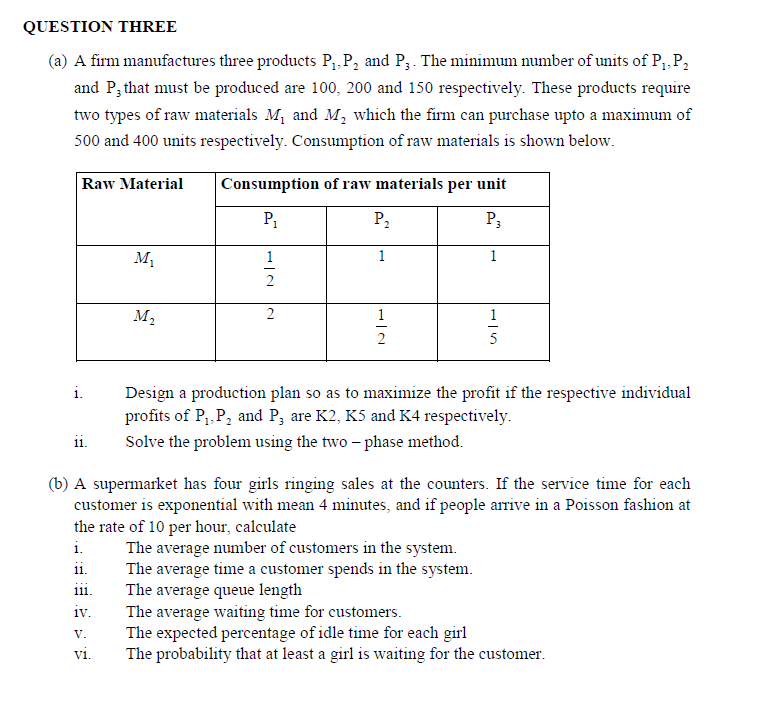
QUESTION THREE (a) A firm manufactures three products P1, P, and Pz. The minimum number of units of P,,P, and P, that must be produced are 100, 200 and 150 respectively. These products require two types of raw materials M, and M, which the firm can purchase upto a maximum of 500 and 400 units respectively. Consumption of raw materials is shown below. Raw Material Consumption of raw materials per unit P P2 P M 1 1 1 M 2 1 2. 1 5 i. Design a production plan so as to maximize the profit if the respective individual profits of P., P, and P, are K2, K5 and K4 respectively. Solve the problem using the two-phase method. 11. (b) A supermarket has four girls ringing sales at the counters. If the service time for each customer is exponential with mean 4 minutes, and if people arrive in a Poisson fashion at the rate of 10 per hour, calculate i. The average number of customers in the system. 11. The average time a customer spends in the system. The average queue length The average waiting time for customers. The expected percentage of idle time for each girl vi. The probability that at least a girl is waiting for the customer. 111 iv. V. QUESTION THREE (a) A firm manufactures three products P1, P, and Pz. The minimum number of units of P,,P, and P, that must be produced are 100, 200 and 150 respectively. These products require two types of raw materials M, and M, which the firm can purchase upto a maximum of 500 and 400 units respectively. Consumption of raw materials is shown below. Raw Material Consumption of raw materials per unit P P2 P M 1 1 1 M 2 1 2. 1 5 i. Design a production plan so as to maximize the profit if the respective individual profits of P., P, and P, are K2, K5 and K4 respectively. Solve the problem using the two-phase method. 11. (b) A supermarket has four girls ringing sales at the counters. If the service time for each customer is exponential with mean 4 minutes, and if people arrive in a Poisson fashion at the rate of 10 per hour, calculate i. The average number of customers in the system. 11. The average time a customer spends in the system. The average queue length The average waiting time for customers. The expected percentage of idle time for each girl vi. The probability that at least a girl is waiting for the customer. 111 iv. V
Step by Step Solution
There are 3 Steps involved in it

Get step-by-step solutions from verified subject matter experts