Question: Question Two (10 marks) Moss Manufacturing has just completed a major change in its quality control (QC) process. Previously, products had been reviewed by QC
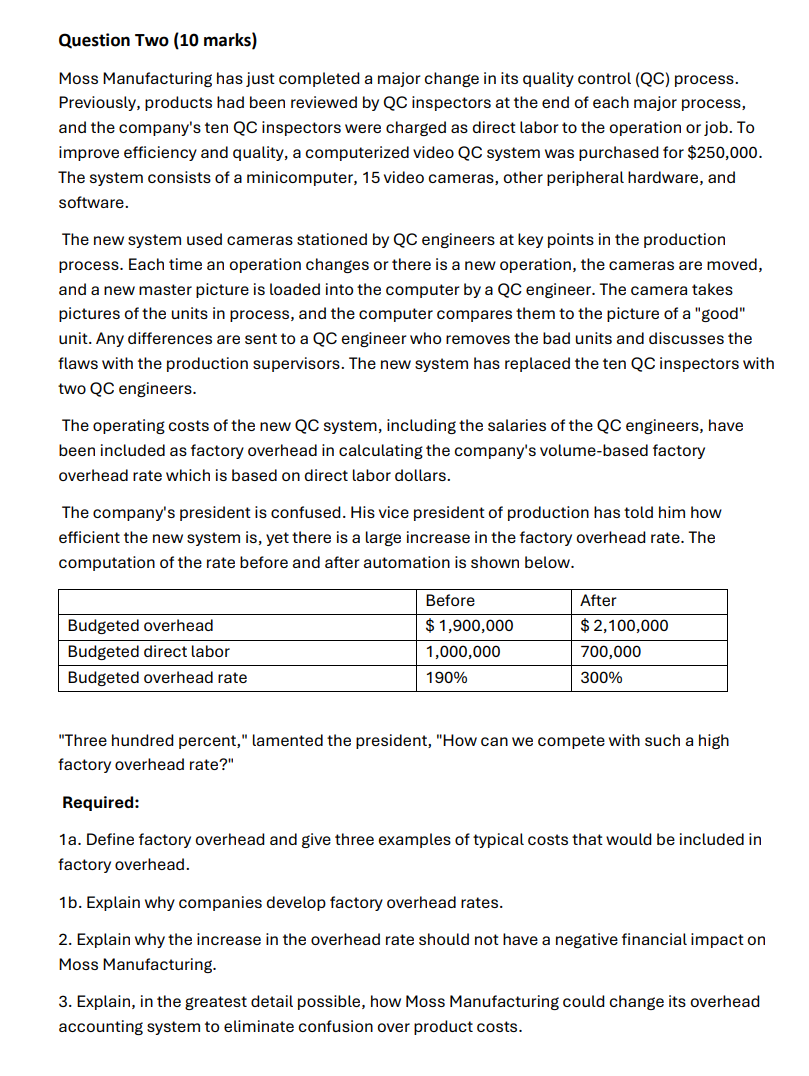
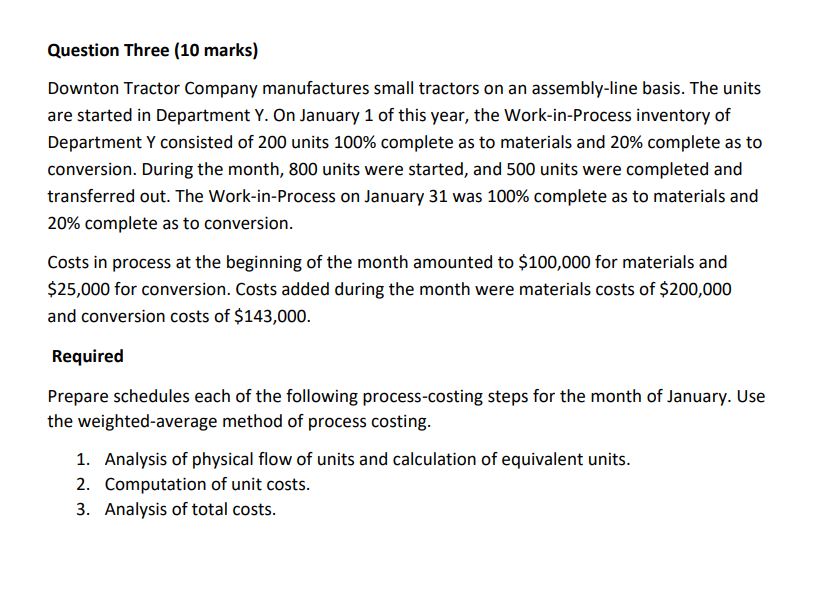
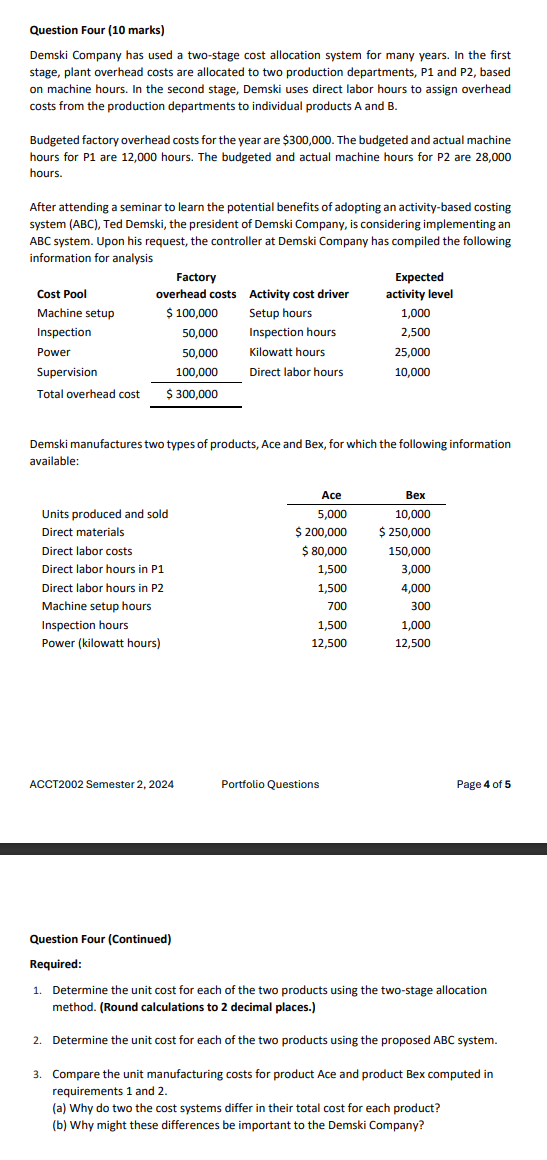
Question Two (10 marks) Moss Manufacturing has just completed a major change in its quality control (QC) process. Previously, products had been reviewed by QC inspectors at the end of each major process, and the company's ten QC inspectors were charged as direct labor to the operation or job. To improve efficiency and quality, a computerized video QC system was purchased for $250,000. The system consists of a minicomputer, 15 video cameras, other peripheral hardware, and software. The new system used cameras stationed by QC engineers at key points in the production process. Each time an operation changes or there is a new operation, the cameras are moved, and a new master picture is loaded into the computer by a QC engineer. The camera takes pictures of the units in process, and the computer compares them to the picture of a "good" unit. Any differences are sent to a QC engineer who removes the bad units and discusses the flaws with the production supervisors. The new system has replaced the ten QC inspectors with two QC engineers. The operating costs of the new QC system, including the salaries of the QC engineers, have been included as factory overhead in calculating the company's volume-based factory overhead rate which is based on direct labor dollars. The company's president is confused. His vice president of production has told him how efficient the new system is, yet there is a large increase in the factory overhead rate. The computation of the rate before and after automation is shown below. e [Ame ] Budgeted overhead $ 1,900,000 $ 2,100,000 Budgeted direct labor 1,000,000 700,000 Budgeted overhead rate 190% 300% "Three hundred percent," lamented the president, "How can we compete with such a high factory overhead rate?" Required: 1a. Define factory overhead and give three examples of typical costs that would be included in factory overhead. 1b. Explain why companies develop factory overhead rates. 2. Explain why the increase in the overhead rate should not have a negative financial impact on Moss Manufacturing. 3. Explain, in the greatest detail possible, how Moss Manufacturing could change its overhead accounting system to eliminate confusion over product costs. Question Three (10 marks) Downton Tractor Company manufactures small tractors on an assembly-line basis. The units are started in Department Y. On January 1 of this year, the Work-in-Process inventory of Department Y consisted of 200 units 100% complete as to materials and 20% complete as to conversion. During the month, 800 units were started, and 500 units were completed and transferred out. The Work-in-Process on January 31 was 100% complete as to materials and 20% complete as to conversion. Costs in process at the beginning of the month amounted to $100,000 for materials and $25,000 for conversion. Costs added during the month were materials costs of $200,000 and conversion costs of $143,000. Required Prepare schedules each of the following process-costing steps for the month of January. Use the weighted-average method of process costing. 1. Analysis of physical flow of units and calculation of equivalent units. 2. Computation of unit costs. 3. Analysis of total costs. Question Four (10 marks) Demski Company has used a two-stage cost allocation system for many years. In the first stage, plant overhead costs are allocated to two production departments, P1 and P2, based on machine hours. In the second stage, Demski uses direct labor hours to assign overhead costs from the production departments to individual products A and B. Budgeted factory overhead costs for the year are $300,000. The budgeted and actual machine hours for P1 are 12,000 hours. The budgeted and actual machine hours for P2 are 28,000 hours. After attending a seminar to lear the potential benefits of adopting an activity-based costing system (ABC), Ted Demski, the president of Demski Company, is considering implementing an ABC system. Upon his request, the controller at Demski Company has compiled the following information for analysis Factory Expected Cost Pool overhead costs Activity cost driver activity level Machine setup $ 100,000 Setup hours 1,000 Inspection 50,000 Inspection haurs 2,500 Power 50,000 Kilowatt hours 25,000 Supervision 100,000 Direct labor hours 10,000 Total overhead cost $ 300,000 Demski manufactures two types of products, Ace and Bex, for which the following information available: Units produced and sold Direct materials Direct labor costs Direct labor hours in P1 Direct labor hours in P2 Machine setup hours Inspection hours Power (kilowatt hours) ACCT2002 Semester 2, 2024 Question Four (Continued) Required: Ace Bex 5,000 10,000 $200,000 $250,000 $ 80,000 150,000 1,500 3,000 1,500 4,000 700 300 1,500 1,000 12,500 12,500 Portfolio Questions Pagedof 5 1. Determine the unit cost for each of the two products using the two-stage allocation method. [Round calculations to 2 decimal places.) 2. Determine the unit cost for each of the two products using the proposed ABC system. 3. Compare the unit manufacturing costs for product Ace and product Bex computed in requirements 1and 2. {a) Why do two the cost systems differ in their total cost for each product? {b) Why might these differences be important to the Demski Company
Step by Step Solution
There are 3 Steps involved in it
1 Expert Approved Answer
Step: 1 Unlock
Question Has Been Solved by an Expert!
Get step-by-step solutions from verified subject matter experts
Step: 2 Unlock
Step: 3 Unlock
Students Have Also Explored These Related Accounting Questions!









 Study Help