







Question: QUESTION: Use simulation to evaluate and compare all the alternatives, including the status quo and the various combinations of proposals. Then, make your recommendation to
QUESTION: Use simulation to evaluate and compare all the alternatives, including the status quo and the various combinations of proposals. Then, make your recommendation to management.
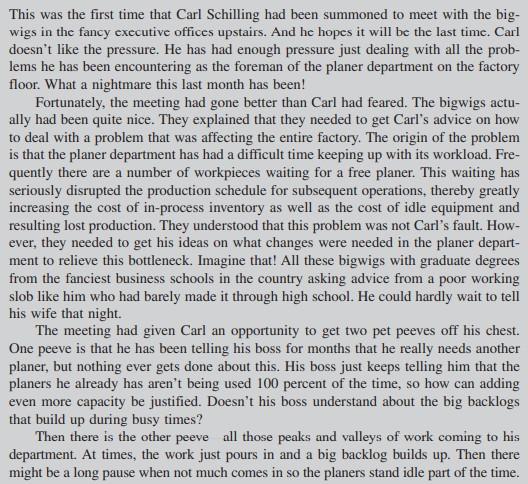
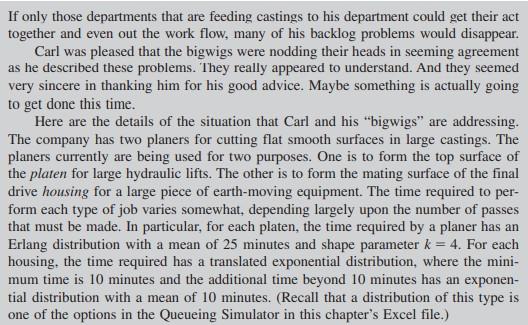
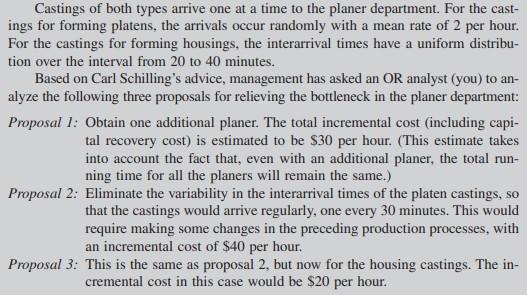
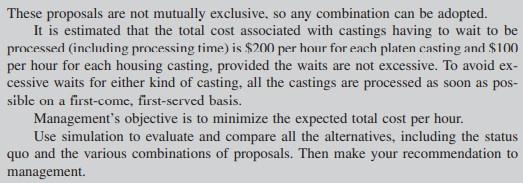
This was the first time that Carl Schilling had been summoned to meet with the big- wigs in the fancy executive offices upstairs. And he hopes it will be the last time. Carl doesn't like the pressure. He has had enough pressure just dealing with all the prob- lems he has been encountering as the foreman of the planer department on the factory floor. What a nightmare this last month has been! Fortunately, the meeting had gone better than Carl had feared. The bigwigs actu- ally had been quite nice. They explained that they needed to get Carl's advice on how to deal with a problem that was affecting the entire factory. The origin of the problem is that the planer department has had a difficult time keeping up with its workload. Fre- quently there are a number of workpieces waiting for a free planer. This waiting has seriously disrupted the production schedule for subsequent operations, thereby greatly increasing the cost of in-process inventory as well as the cost of idle equipment and resulting lost production. They understood that this problem was not Carl's fault. How- ever, they needed to get his ideas on what changes were needed in the planer depart- ment to relieve this bottleneck. Imagine that! All these bigwigs with graduate degrees from the fanciest business schools in the country asking advice from a poor working slob like him who had barely made it through high school. He could hardly wait to tell his wife that night. The meeting had given Carl an opportunity to get two pet peeves off his chest. One peeve is that he has been telling his boss for months that he really needs another planer, but nothing ever gets done about this. His boss just keeps telling him that the planers he already has aren't being used 100 percent of the time, so how can adding even more capacity be justified. Doesn't his boss understand about the big backlogs that build up during busy times? Then there is the other peeve all those peaks and valleys of work coming to his department. At times, the work just pours in and a big backlog builds up. Then there might be a long pause when not much comes in so the planers stand idle part of the time. If only those departments that are feeding castings to his department could get their act together and even out the work flow, many of his backlog problems would disappear. Carl was pleased that the bigwigs were nodding their heads in seeming agreement as he described these problems. They really appeared to understand. And they seemed very sincere in thanking him for his good advice. Maybe something is actually going to get done this time. Here are the details of the situation that Carl and his "bigwigs are addressing. The company has two planers for cutting flat smooth surfaces in large castings. The planers currently are being used for two purposes. One is to form the top surface of the platen for large hydraulic lifts. The other is to form the mating surface of the final drive housing for a large piece of earth-moving equipment. The time required to per- form each type of job varies somewhat, depending largely upon the number of passes that must be made. In particular, for each platen, the time required by a planer has an Erlang distribution with a mean of 25 minutes and shape parameter k = 4. For each housing, the time required has a translated exponential distribution, where the mini- mum time is 10 minutes and the additional time beyond 10 minutes has an exponen- tial distribution with a mean of 10 minutes. (Recall that a distribution of this type is one of the options in the Queueing Simulator in this chapter's Excel file.) Castings of both types arrive one at a time to the planer department. For the cast- ings for forming platens, the arrivals occur randomly with a mean rate of 2 per hour. For the castings for forming housings, the interarrival times have a uniform distribu- tion over the interval from 20 to 40 minutes. Based on Carl Schilling's advice, management has asked an OR analyst (you) to an- alyze the following three proposals for relieving the bottleneck in the planer department: Proposal 1: Obtain one additional planer. The total incremental cost (including capi- tal recovery cost) is estimated to be $30 per hour. (This estimate takes into account the fact that, even with an additional planer, the total run- ning time for all the planers will remain the same.) Proposal 2: Eliminate the variability in the interarrival times of the platen castings, so that the castings would arrive regularly, one every 30 minutes. This would require making some changes in the preceding production processes, with an incremental cost of $40 per hour. Proposal 3: This is the same as proposal 2, but now for the housing castings. The in- cremental cost in this case would be $20 per hour. These proposals are not mutually exclusive. so any combination can be adopted. It is estimated that the total cost associated with castings having to wait to be processed (including processing time) is $200 per hour for each platen casting and $100 per hour for each housing casting, provided the waits are not excessive. To avoid ex- cessive waits for either kind of casting, all the castings are processed as soon as pos- sible on a first-come, first-served basis. Management's objective is to minimize the expected total cost per hour. Use simulation to evaluate and compare all the alternatives, including the status quo and the various combinations of proposals. Then make your recommendation to managementStep by Step Solution
There are 3 Steps involved in it
1 Expert Approved Answer
Step: 1 Unlock

Question Has Been Solved by an Expert!
Get step-by-step solutions from verified subject matter experts
Step: 2 Unlock
Step: 3 Unlock
 Study Help