



Question: Question: Use the Cars93 data set from the built-in package MASS available in R. You are to analyse the data using unsupervised learning. 1)) Principal
Question:
Use the Cars93 data set from the built-in package "MASS" available in R.
You are to analyse the data using unsupervised learning.
1)) Principal Components Analysis
****Any packages and functions referred to below are just suggestions. You can use different methods/packages/functions
Principal Components Analysis (25%)
Perform PCA on your Cars93 Data.
Display and report on your findings (this is totally up to you).
Use your graphics, and explain how you choose 3 possible cars to suggest to each of the following customers:
(a) A student wants a cheap, fuel-efficient car, and is not concerned of its origin.
(b) A mom with four young children can only drive automatic and loves US cars.
(c) A middle-aged executive wants a sporty, non-US vehicle. For him, price is not a factor.
(d) A consulate wants a luxury midsize sedan for its personnel. They are not willing to purchase US-made vehicles because of a political situation.
(e) A family of 6-footers who want a midsize car, not a van.
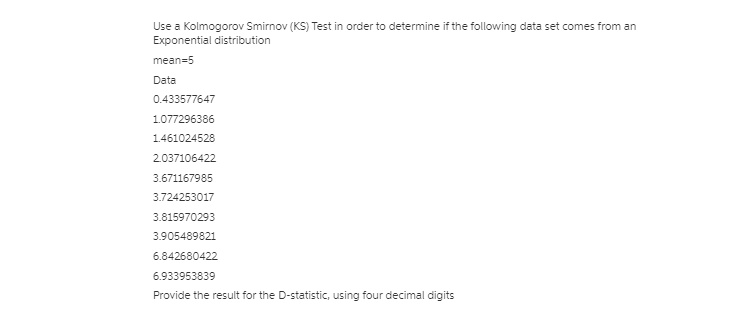
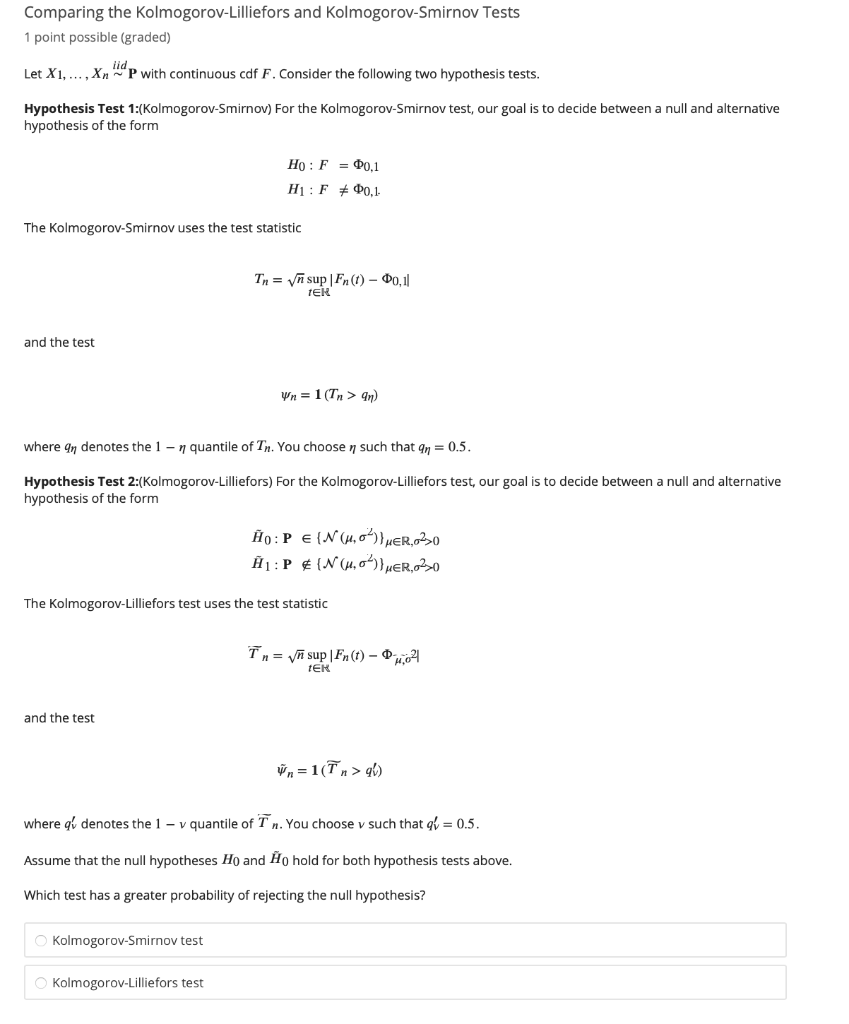
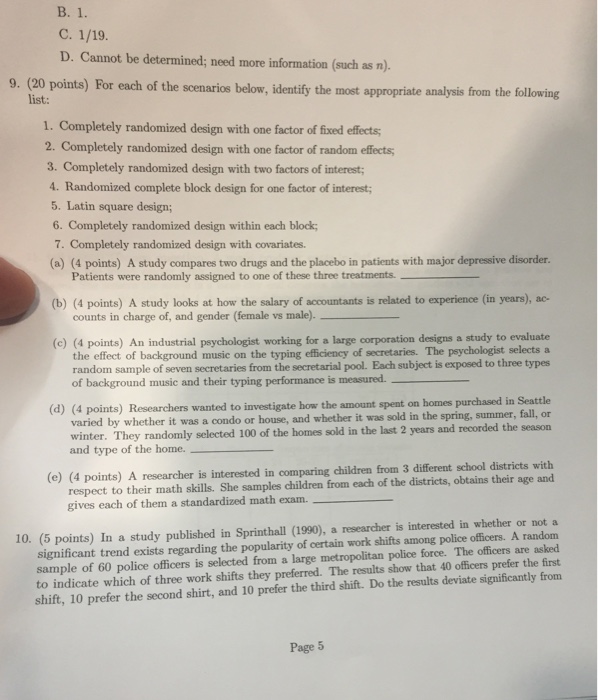

\fComparing the Kolmogorov-Lilliefors and Kolmogorov-Smirnov Tests 1 point possible (graded) Let X1, ..., Xn ~ P with continuous cdf F. Consider the following two hypothesis tests. Hypothesis Test 1:(Kolmogorov-Smirnov) For the Kolmogorov-Smirnov test, our goal is to decide between a null and alternative hypothesis of the form Ho : F = 10,1 H1 : F # 40,1 The Kolmogorov-Smirnov uses the test statistic In = Vn sup | Fn (1) - Do, 1 and the test Wn = 1(Tn > qn) where qn denotes the 1 - 7 quantile of In. You choose , such that qn = 0.5. Hypothesis Test 2:(Kolmogorov-Lilliefors) For the Kolmogorov-Lilliefors test, our goal is to decide between a null and alternative hypothesis of the form HO: P E ( N ( 1, 0 ) ) MER, 0320 A1 : P = (N ( H, O') ) HER, 0320 The Kolmogorov-Lilliefors test uses the test statistic In = Vn sup | Fn (1) - DM,64 and the test Wn = 1(T n > qu) where qv denotes the 1 - v quantile of T n. You choose v such that of = 0.5. Assume that the null hypotheses Ho and Ho hold for both hypothesis tests above. Which test has a greater probability of rejecting the null hypothesis? O Kolmogorov-Smirnov test O Kolmogorov-Lilliefors testB. 1. C. 1/19. D. Cannot be determined; need more information (such as n). list: 9. (20 points) For each of the scenarios below, identify the most appropriate analysis from the following 1. Completely randomized design with one factor of fixed effects; 2. Completely randomized design with one factor of random effects; 3. Completely randomized design with two factors of interest; 4. Randomized complete block design for one factor of interest; 5. Latin square design; 6. Completely randomized design within each block; 7. Completely randomized design with covariates. (a) (4 points) A study compares two drugs and the placebo in patients with major depressive disorder. Patients were randomly assigned to one of these three treatments. (b) (4 points) A study looks at how the salary of accountants is related to experience (in years), ac- counts in charge of, and gender (female vs male). (c) (4 points) An industrial psychologist working for a large corporation designs a study to evaluate the effect of background music on the typing efficiency of secretaries. The psychologist selects a random sample of seven secretaries from the secretarial pool. Each subject is exposed to three types of background music and their typing performance is measured. (d) (4 points) Researchers wanted to investigate how the amount spent on homes purchased in Seattle varied by whether it was a condo or house, and whether it was sold in the spring, summer, fall, or winter. They randomly selected 100 of the homes sold in the last 2 years and recorded the season and type of the home. (e) (4 points) A researcher is interested in comparing children from 3 different school districts with respect to their math skills. She samples children from each of the districts, obtains their age and gives each of them a standardized math exam. 10. (5 points) In a study published in Sprinthall (1990), a researcher is interested in whether or not a significant trend exists regarding the popularity of certain work shifts among police officers. A random sample of 60 police officers is selected from a large metropolitan police force. The officers are asked to indicate which of three work shifts they preferred. The results show that 40 officers prefer the first shift, 10 prefer the second shirt, and 10 prefer the third shift. Do the results deviate significantly from Page 5Consider the following incomplete ANOVA table: SS DF MS F 50 1 50 ? 80 2 40 ? 30 2 15 ? ? 12 '? 172 17 In addition to the ANOVA table, you know that the experiment has been replicated three times, and that the totals of the three replicates are 10, 12, and 14, respectively. The original experiment was run as a completely randomized design. Answer the following questions: (a) Estimate the standard deviation of the sample observations, and complete the ANOVA table. (b) Suppose that the experiment has been run in blocks, with each replicate a block, so that it is a randomized complete block design. What is the number of degrees of freedom for blocks? Compute the block sum of squares. (c) Reconstruct the ANOVA table for the randomized complete block design
Step by Step Solution
There are 3 Steps involved in it

Get step-by-step solutions from verified subject matter experts