Question: Question: What actions taken at the functional level enabled Virgin America to implement its strategy? (please help) Virgin America Prior to its 2016 acquisition by
 Question:
-
What actions taken at the functional level enabled Virgin America to implement its strategy? (please help)
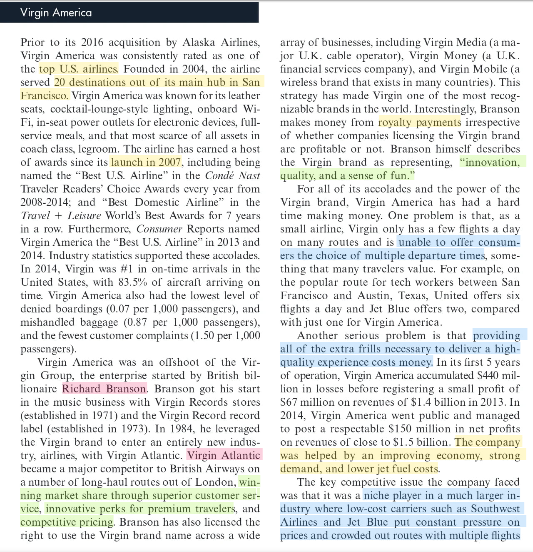
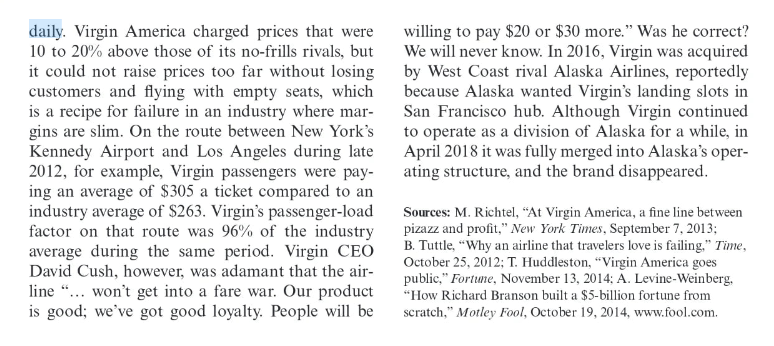
Virgin America Prior to its 2016 acquisition by Alaska Airlines, Virgin America was consistently rated as one of the top U.S. airlines Founded in 2004, the airline served 20 destinations out of its main hub in San Francisco. Virgin America was known for its leather scats, cocktail-lounge-style lighting, onboard Wi. Ti, in-seal power outlets for electronic devices, full- service meals, and that most scarce of all assets in coach class, Icgroom. The airline has carned a host of awards since its launch in 2007, including being named the "Best U.S. Airline" in the Cond Nast Traveler Readers' Choice Awards every year from 2008-2014, and "Best Domestic Airline" in the Travel + Leisure World's Best Awards for 7 years in a row. Furthermore, Consumer Reports named Virgin America the "Best U.S. Airline" in 2013 and 2014. Industry statistics supported these accolades. In 2014, Virgin was #1 in on-time arrivals in the United States, with 83.5% of aircraft arriving on time. Virgin America also had the lowest level of denied boardings (0.07 per 1,000 passengers), and mishandled baggage (0.87 per 1.000 passengers), and the fewest customer complaints (1.50 per 1,000 passengers), Virgin America was an offshoot of the Vir- gin Group, the enterprise started by British bil- lionaire Richard Branson, Branson got his start in the music business with Virgin Records stores (established in 1971) and the Virgin Record record label (established in 1973). In 1984, he leveraged the Virgin brand to enter an entirely new indus- try, airlines, with Virgin Atlantic. Virgin Atlantic became a major competitor to British Airways on a number of long-haul routes out of London, win- ning market share through superior customer ser- vice, innovative perks for premium travelers, and competitive pricing, Branson has also licensed the right to use the Virgin brand name across a wide array of businesses, including Virgin Media (a ma- jor U.K. cable operator), Virgin Money (a U.K. financial services company), and Virgin Mobile (a wireless brand that exists in many countries). This strategy has made Virgin one of the most recog- nizable brands in the world, Interestingly, Branson makes money from royally payments irrespective of whether companies licensing the Virgin brand are profitable or not. Branson himself describes the Virgin brand as representing, "innovation, quality, and a sense of fun." For all of its accolades and the power of the Virgin brand. Virgin America has had a hard time making money. One problem is that, as a small airlinc, Virgin only has a few flights a day on many routes and is unable to offer consum- ers the choice of multiple departure times, some- thing that many travelers value. For example, on the popular route for tech workers between San Francisco and Austin, Texas, United offers six flights a day and Jet Blue offers two, compared with just one for Virgin America. Another serious problem is that providing all of the extra frills necessary to deliver a high- quality experience costs money. In its first 5 years of operation, Virgin America accumulated S440 mil- lion in losses before registering a small profit of 567 million on revenues or $1.4 billion in 2013. In 2014, Virgin America went public and managed to post a respectable $150 million in net profits on revenues of close to $1.5 billion. The company was helped by an improving economy, strong demand, and lower jet fuel costs. The key competitive issue the company faced was that it was a niche player in a much larger in- dustry where low-cost carriers such as Southwest Airlines and Jet Blue put constant pressure on prices and crowded out routes with multiple flights daily. Virgin America charged prices that were 10 to 20% above those of its no-frills rivals, but it could not raise prices too far without losing customers and flying with empty seats, which is a recipe for failure in an industry where mar- gins are slim. On the route between New York's Kennedy Airport and Los Angeles during late 2012, for example, Virgin passengers were pay- ing an average of $305 a ticket compared to an industry average of $263. Virgin's passenger-load factor on that route was 96% of the industry average during the same period. Virgin CEO David Cush, however, was adamant that the air- line "... won't get into a fare war. Our product is good; we've got good loyalty. People will be willing to pay $20 or $30 more. Was he correct? We will never know. In 2016, Virgin was acquired by West Coast rival Alaska Airlines, reportedly because Alaska wanted Virgin's landing slots in San Francisco hub. Although Virgin continued to operate as a division of Alaska for a while, in April 2018 it was fully merged into Alaska's oper- ating structure, and the brand disappeared. Sources: M. Richtel, "At Virgin America, a fine line between pizazz and profit," New York Times, September 7, 2013; B. Tuttle, Why an airline that travelers love is failing," Time, October 25, 2012; T. Huddleston, "Virgin America goes public," Fortune, November 13, 2014: A. Levine-Weinberg, "How Richard Branson built a $5-billion fortune from scratch," Motley Fool, October 19, 2014, www.fool.com









 Study Help